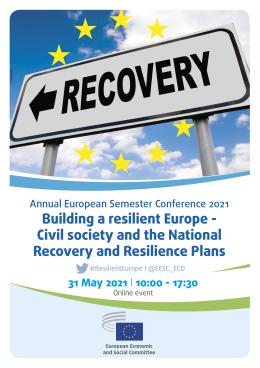
Building a resilient Europe - Civil society and the National Recovery and Resilience Plans
Event type
Conference
Location
Brussels
Belgium
The Recovery and Resilience Facility is moving into its next phase, and the European Semester Group of the EESC is following the process. In this high-level conference we will discuss whether the national recovery and resilience plans will deliver as regards the aim of achieving fair, inclusive, competitive and sustainable growth and cohesion through the new growth strategy – the European Green Deal. Focus will be on the implementation of the national recovery and resilience plans, with particular attention on the implementation of the European Pillar of Social Rights and the just transition towards a green, digital and sustainable European economy. The conclusions of this event will be forwarded to EU institutions and the "EU Recovery Summit" conference in Lisbon on 28 June 2021.
Activities of organised crime organisations like money laundering and the tapping of public funds have consequences for the economy, business and society. A crisis like the Covid-19 pandemic may be an opportunity for organised crime to spread their activity, gain power and even innovate to find new ways to pursue their objectives.
Following the outbreak of the COVID-19 pandemic, the European Economic and Social Committee (EESC) played a central role in bringing the consensual views of organised civil society in the EU to the attention of policy-makers and contributing to the rapidly evolving economic policy response at European level.
In this regard, we believe that now is the time for the EU institutions to make decisive steps in approving swiftly the new Facility and putting in place the necessary implementation mechanisms at European and national level, so that the hardest hit Member States, citizens and businesses can benefit from the relevant EU funding when they need it most.
Against this background, and on the occasion of the first meeting of the EESC's Section for Economic and Monetary Union and Economic and Social Cohesion (ECO) in our new term-of-office (2020-2025), we are organising a thematic debate on this issue between European policy-makers and civil society representatives.
The debate will take place on Thursday, 19 November 2020 from 14.30 to 16.40 as an online event, webstreamed live on the EESC website.
In their consultative work, the European Economic and Social Committee and the European Committee of the Regions have long been committed to sustainable development and fighting climate change. However, are we actually putting our recommendations into practice inside our own offices?
To ensure that the Committees act as environmentally as possible, since 2008 we have been engaged in setting up an EMAS-compliant environmental management system.
This brochure presents the EESC's opinions in the area of taxation and gives an overview of key recommendations. We believe that great efforts are needed to prevent aggressive tax planning behaviour by businesses and non-transparency by Member States to ensure equal treatment of firms and to promote European competitiveness for the benefit of all Europeans.