With recent surveys showing that 66% of Europeans would like the EU to have more say over health-related matters, and more than a half in favour of public health becoming the EU's top priority in terms of expenditure, the EU should start playing a more active role in protecting the health of its citizens. The EESC thinks that the Commission's recent package on an EU Health Union is a step in the right direction.
Hailed as ambitious and holistic, Europe's new plan for beating cancer has met with applause from cancer organisations and civil society. Now, as the pandemic is taking a heavy toll on cancer detection and care, the plan needs to be urgently and properly implemented. So much is at stake – without decisive action, Europe may face a cancer tsunami, with the disease projected to become the leading cause of mortality in just under 15 years.
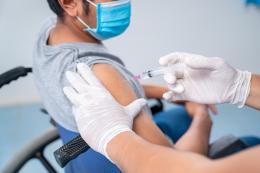
Faced with many barriers and less able to maintain social and physical distance, persons with disabilities are at greater risk of contracting COVID-19 and falling severely ill as a result of the disease. However, in the EU they have not been explicitly included in priority groups for vaccination
COVID-19 has blatantly exposed all the cracks and fissures in the European health systems and shown the EU to be unprepared for dealing with major health emergencies. But the first building blocks of the future European Health Union, recently proposed by the Commission, look promising and may give the EU the right weapons to fight pandemics in the future
This Own-initiative Opinion analyses the structural causes that have led to the elderly care systems in general and to the nursing homes in particular, to become some of the most contagious and lethal factors of this pandemic. To this end, the different systems that exist in EU Member States are compared to learn useful lessons.
In addition, the opinion calls for the need to address the demographic transition as one of the major challenges of the twenty-first century, alongside environmental and digital transitions.
Download format:
Download — Stellungnahme des Ausschusses: Towards a New Care Model for the Elderly: learning from the Covid-19 pandemic (own-initiative opinion - Gr III)
The EESC believes that evidence based processes like Health Technology Assessment (HTA) that is a key driver for socio-economic growth and innovation in the Union can be achieved through cooperation between Member States at Union level aiming at a high protection of health for patients and ensuring the smooth functioning of an inclusive Single Market. It is concerned about the set timelines of implementation and especially the delayed application of three years and believes that for the benefit of the patients and cost-effectiveness this could be shortened. In order to achieve the promise of digital health and care, of which HTA is part, the involvement of civil society is crucial.
Council of the EU compromise on COM(2018) 51 final – 2018/0018 (COD)
Interactio and Room JDE 62, EESC building, Rue Belliard 99, 1040 Brussels
Brussels
Belgium
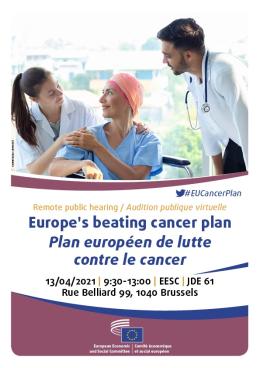
In order to prepare its opinion on the Commission's proposal "Europe's Beating Cancer Plan", the EESC is organising a public hearing on 13 April 2021 am.
The aim of the event is to gather input from other EU Institutions, civil society and health professionals. We will debate the following questions:
What are the strengths and weaknesses of the current proposal?
What kind of activities do different actors carry out with respect to beating cancer, and are there any best practices to be shared?
Extraordinary meeting of the Diversity Europe Group
Location
Brussels
Belgium
The hybrid conference will see the launch of the EESC study "The response of civil society organisations to the COVID-19 pandemic and the consequent restrictive measures adopted in Europe", as well as topical debates with high-level speakers and civil society representatives. External participants are kindly invited to follow the meeting from remote.
The EESC welcomes the new EU Disability Rights Strategy, acknowledging that it is a clear step forward compared with the previous one. It is however concerned about the lack of binding measures and hard legislation implementing the Strategy.
Among other recommendations, the Committee regrets the lack of specific actions addressing the needs of women and girls with disabilities and calls for a specific flagship initiative in the second half of the period of the Strategy. It also calls for the full involvement and participation of organisations of persons with disabilities in the proposed Disability Platform. As regarding the Recovery and Resilience Facility (RRF), the EESC feels it should be strongly linked to the Disability Strategy and used to help persons with disabilities recovering from the pandemic.
Download format:
Download — Stellungnahme des Ausschusses: Strategy on the rights of persons with disabilities