
European Economic
and Social Committee
Building trust in a fractured world: Health diplomacy and civil society must take centre stage
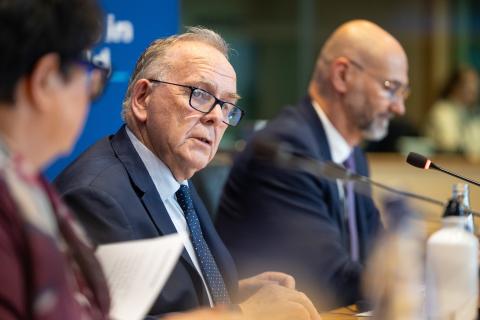
In a world marked by growing conflict, disinformation and fragmentation, Europe needs more dialogue, not less. That was the key message from speakers at the 2026 European Public Diplomacy Days (EPDD), held in Brussels from 30 September to 2 October 2026.
Bringing together representatives from EU institutions, civil society, academia and international organisations, the event explored how public diplomacy can help rebuild trust and strengthen cooperation at a time when societies face mounting political, economic, geopolitical and digital challenges.
EESC president Séamus Boland said that public diplomacy has become a strategic necessity in an increasingly divided world.
‘The answer to fragmentation cannot be isolation. It must be stronger cooperation, greater dialogue and renewed trust. By building trust, fostering dialogue and strengthening people-to-people connections, public diplomacy helps bridge divides and creates the foundations for effective international cooperation.’
President Boland noted that today’s global challenges, ranging from poverty and migration to climate change, public health and digital transformation, are increasingly interconnected and cannot be solved by countries acting alone. He emphasised the important role of organised civil society in building understanding between people, communities and institutions, and ensuring that cooperation remains possible even in times of tension.
Drawing on his recent visit to China for the 21st EU-China Civil Society Roundtable, President Boland highlighted the importance of maintaining channels of dialogue, even where differences exist.
He also stressed that civil society organisations are often the first to identify emerging challenges and the last to abandon communities in times of crisis, making them indispensable partners in addressing shared global concerns.
Health, peace and global solidarity
The EESC-led session, Civil society, health and peace: together for global solidarity, explored how health can serve as a powerful tool of public diplomacy, bringing together communities, professionals and institutions across borders.
Participants examined how cooperation in areas such as healthcare, disease prevention, health literacy and crisis preparedness can strengthen trust between societies and support broader international cooperation. Discussions highlighted the fact that health is not merely a policy area but also an important platform for dialogue, solidarity and peacebuilding.
EESC secretary-general Isabelle Le Galo Flores emphasised the wider significance of health diplomacy: ‘Health is more than a social policy. It is a foundation of trust. There can be no lasting peace without healthy societies, no health without dignity and inclusion, and no sustainable progress without active citizens and a vibrant civil society.’
Professor Ilona Kickbusch from the Global Health Centre, Graduate Institute in Geneva underlined the importance of trust in global health governance. She said that trust is the foundation of effective health cooperation. Without transparency, credible evidence and ethical leadership, it is much harder to respond collectively to crises that transcend borders.
Participants heard that recent global health emergencies demonstrated the importance of reliable information, strong public institutions and international collaboration. At the same time, growing levels of misinformation and disinformation continue to undermine confidence in institutions and weaken societies’ ability to respond effectively to common challenges.
Discussions also highlighted the essential contribution of civil society organisations, patient groups, employers, trade unions and healthcare professionals in strengthening health systems, combating disinformation and ensuring that policies reflect people’s real needs. Their close links with communities allow them to reach vulnerable groups, promote informed decision-making and support citizens when public services come under pressure.
Head of strategy and policy, Dr Rispah Walumbe from Amref Health Africa, called for communities to be involved from the very beginning of policymaking. She said that community voices must help shape the agenda from the outset, particularly the voices of those most at risk of being left behind.
Speakers repeatedly stressed that policies are most effective when they are developed with people rather than for people. Meaningful participation by civil society can help ensure that decisions are more inclusive, responsive and better aligned with realities on the ground.
Across the EPDD discussions, a clear consensus emerged: rebuilding trust in an increasingly fragmented world requires strong partnerships between institutions, citizens and organised civil society.
Three priorities stood out: strengthening civil society’s role in decision-making, investing in health literacy and information integrity, and placing equity, inclusion and human dignity at the centre of public policy.
Participants agreed that public diplomacy is ultimately about people. Trust is built through dialogue, cooperation and shared action, one community and one partnership at a time. In an era of growing uncertainty, promoting health, solidarity and citizen engagement can help keep channels of communication open and lay the foundations for more resilient, peaceful and inclusive societies.
Work organisation
Recommended for you
EWSA: Die EU muss die soziale Nachhaltigkeit stärker ins Blickfeld rücken
News
Der Europäische Wirtschafts- und Sozialausschuss (EWSA) fordert die Europäische Kommission auf, einen längst überfälligen Bericht zu veröffentlichen und die Ausweitung des Anwendungsbereichs der EU…
Ko-Kreation von Dienstleistungen von allgemeinem Interesse im Bereich Gesundheit als Beitrag zur Stärkung der partizipativen Demokratie in der EU
News
Bei dieser vom Europäischen Wirtschafts- und Sozialausschuss (EWSA) und der Universität Debrecen organisierten Veranstaltung wurde hervorgehoben, wie wichtig die Ko-Kreation von Dienstleistungen von…
Zur Bekämpfung des Klimawandels werden mehr öffentliche Investitionen in die Energieinfrastruktur in der EU gebraucht
News
In einer auf der Plenartagung im September verabschiedeten Stellungnahme erläutert der Europäische Wirtschafts- und Sozialausschuss (EWSA), dass zur Verwirklichung der Energiewende und der Klimaziele…
Energie – EWSA warnt vor neuen Abhängigkeiten
News
Der Europäische Wirtschafts- und Sozialausschuss (EWSA) bezieht in einer auf seiner September-Plenartagung verabschiedeten Stellungnahme klar Stellung zum Thema Energie: Der Vorschlag der Kommission…
Der EU-US-Handels- und Technologierat muss die Dynamik nutzen, um ein Wegweiser für Handel, Technologie und Innovation zu werden
News
Auf seiner Juli-Plenartagung zeigte sich der Europäische Wirtschafts- und Sozialausschuss (EWSA) optimistisch, dass der neue Handels- und Technologierat (TTC) ein innovatives Instrument für die EU…