
European Economic
and Social Committee
European energy grids: between economic security and strategic autonomy
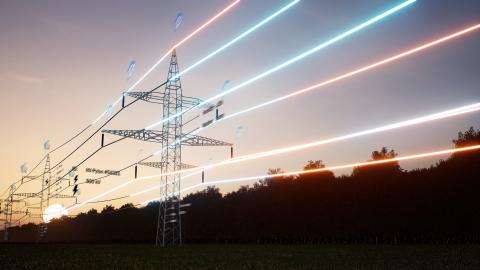
In recent years, the discussion on Europe’s energy transition has focused almost exclusively on renewable energy generation: more wind farms, more solar panels, more green energy. This transformation is undoubtedly necessary. Yet there is a critical element without which this transition cannot succeed: the energy grid.
The energy transition is not only about producing clean energy, but also about ensuring it can be transported to where it is needed. In Europe, this challenge is immense.
Renewable energy resources are not evenly distributed across the continent. Northern Europe benefits from strong wind potential, while southern regions enjoy abundant solar resources. To use these resources efficiently, electricity must be able to flow freely between Member States through an interconnected and modernised European grid.
For this reason, energy infrastructure has become much more than a technical issue. Today, it is a pillar of Europe’s economic competitiveness and strategic security.
The European Grids Package
This reality has been recognised by the European Commission, which has launched the European Grids Package, a legislative initiative to modernise and expand Europe’s electricity networks. The message is clear: without massive investment in electricity transmission and distribution infrastructure, Europe will not be able to meet its climate objectives, fully integrate renewable energy, or maintain competitive energy prices.
According to European Commission estimates, more than €1.2 trillion will be needed by 2040 to develop Europe’s electricity networks. In this context, the European Economic and Social Committee (EESC) has emphasised that energy grids should be regarded as strategic infrastructure, essential not only for the energy transition, but also for the economic and geopolitical security of the European Union.
Energy infrastructure
One of the EESC’s central messages is that the development of energy networks must be planned in close coordination with the evolution of Europe’s energy system. The integration of renewable energy, the electrification of transport and industry, and the changing structure of electricity generation are profoundly transforming the way energy systems operate.
Under these conditions, energy infrastructure planning can no longer be carried out in isolation. Stronger coordination at the European level is needed to enable the coherent development of interconnections and to avoid bottlenecks or inefficient investments.
At the same time, responsibility for planning electricity networks should largely remain at the national level, as long as the costs of expanding and operating these networks are primarily borne by consumers within each Member State.
The development of decentralised energy production, the emergence of energy communities, and the expansion of storage capacity can also help reduce pressure on grids while increasing public acceptance of the energy transition.
Administrative procedures and simplification
A major obstacle to the development of energy infrastructure remains the complexity of administrative procedures and lengthy permitting processes. In many cases, grid projects can take years to complete, largely due to bureaucratic procedures or disputes over environmental impacts and effects on local communities.
The European Grids Package proposes to accelerate these procedures. However, simplification must not come at the expense of transparency or public participation. Experience in recent years shows that early engagement with local communities, civil society organisations, and businesses can increase public trust and reduce opposition to energy projects.
At the same time, the energy transition is fundamentally transforming the way electricity grids operate. In the past, electricity was generated in large power plants and transported to consumers. Today, the system is becoming far more decentralised. Increasingly, renewable generation is connected at the distribution level, while consumers are also becoming energy producers.
In this context, distribution system operators are gaining a central role in managing an increasingly complex energy system. To cope with these changes, a clear regulatory framework, adequate resources, and investments in grid digitalisation will be essential.
Smart substations, real-time monitoring, and interoperable data platforms will become key elements of modern energy infrastructure. At the same time, flexibility solutions — such as demand-side management and energy storage — will play an increasingly important role in making efficient use of existing networks.
Investments
Modernising Europe’s energy infrastructure will require massive investment. Without the development of energy grids, increasing renewable energy generation will not automatically lead to lower energy prices.
From the Employers' Group perspective, investments in grid infrastructure should be seen as structural investments necessary to adapt Europe’s energy system to a new model of energy production and consumption. In a sense, Europe is entering a period of “one-off” investments aimed at building the infrastructure required for the efficient functioning of the energy system over the coming decades.
If energy infrastructure is recognised as strategic infrastructure for Europe’s competitiveness and security, then its financing must reflect this importance. Public funding should therefore play a greater role.
European instruments
European instruments such as the Connecting Europe Facility can support cross-border infrastructure projects, while institutions such as the European Investment Bank can provide long-term financing at lower costs than those available on private markets. At the same time, innovative financial instruments — such as state-guaranteed hybrid capital — could be explored to allow network operators to access financing at lower costs.
However, the success of these investments depends not only on the availability of funding, but also on the coherence of the regulatory framework. Investments in grids must be aligned with the evolution of the energy system and with the strategic objectives of the energy transition. The regulatory framework for grid investments should be systematically aligned with the objectives set out in the National Energy and Climate Plans (NECPs).
Conclusion
Beyond their economic role, energy grids are also a key component of Europe’s strategic security. In the current geopolitical context, energy security is closely linked to economic security and to the European Union’s strategic autonomy.
A modern and well-interconnected energy infrastructure can reduce vulnerabilities and strengthen the resilience of Europe’s energy system.
For the energy transition to succeed, Europe must build a truly integrated energy system at the continental level. This means removing infrastructure barriers, strengthening interconnections, enhancing European coordination, and developing effective financing mechanisms.
In a world shaped by global competition and geopolitical uncertainty, Europe can no longer afford to compete energetically between Member States. To remain competitive, Europe must compete as a whole.
By Daniela Dărăban, EESC Employers' Group member and Study Group member of Opinion TEN/863 - European grids package.
Recommended for you
EWSA: Die EU muss die soziale Nachhaltigkeit stärker ins Blickfeld rücken
News
Der Europäische Wirtschafts- und Sozialausschuss (EWSA) fordert die Europäische Kommission auf, einen längst überfälligen Bericht zu veröffentlichen und die Ausweitung des Anwendungsbereichs der EU…
Ko-Kreation von Dienstleistungen von allgemeinem Interesse im Bereich Gesundheit als Beitrag zur Stärkung der partizipativen Demokratie in der EU
News
Bei dieser vom Europäischen Wirtschafts- und Sozialausschuss (EWSA) und der Universität Debrecen organisierten Veranstaltung wurde hervorgehoben, wie wichtig die Ko-Kreation von Dienstleistungen von…
Zur Bekämpfung des Klimawandels werden mehr öffentliche Investitionen in die Energieinfrastruktur in der EU gebraucht
News
In einer auf der Plenartagung im September verabschiedeten Stellungnahme erläutert der Europäische Wirtschafts- und Sozialausschuss (EWSA), dass zur Verwirklichung der Energiewende und der Klimaziele…
Energie – EWSA warnt vor neuen Abhängigkeiten
News
Der Europäische Wirtschafts- und Sozialausschuss (EWSA) bezieht in einer auf seiner September-Plenartagung verabschiedeten Stellungnahme klar Stellung zum Thema Energie: Der Vorschlag der Kommission…
Der EU-US-Handels- und Technologierat muss die Dynamik nutzen, um ein Wegweiser für Handel, Technologie und Innovation zu werden
News
Auf seiner Juli-Plenartagung zeigte sich der Europäische Wirtschafts- und Sozialausschuss (EWSA) optimistisch, dass der neue Handels- und Technologierat (TTC) ein innovatives Instrument für die EU…