
European Economic
and Social Committee
EESC President Oliver Röpke's Visit to Gdańsk: A Call for Responsible AI Governance at Ministerial Conference
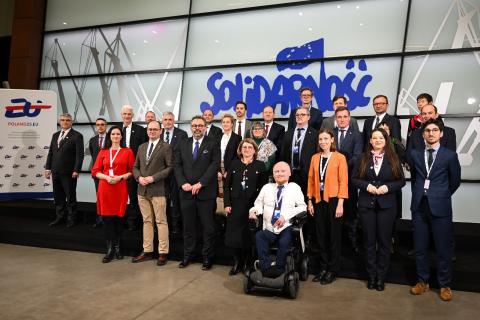
Artificial Intelligence is transforming the workplace, creating both new opportunities and serious challenges for workers, businesses, and policymakers. As part of ongoing efforts to shape AI’s role in the labour market, EESC President Oliver Röpke took center stage at a high-level ministerial conference in Gdańsk on February 20, 2025. Organized under the Polish Presidency of the Council of the European Union, the event brought together EU ministers, EU institutions social partners and civil society representatives to discuss AI’s impact on employment and workers' rights. President Röpke advocated for responsible AI governance, emphasizing the need for transparency, fairness, and worker involvement in AI deployment.
A Commitment to Human-Centric AI
President Röpke's visit underscored a firm commitment to ethical AI governance, highlighting the importance of placing human interests at the forefront of technological advancement. The EESC, representing workers, employers, and civil society, sought to ensure that AI serves as a tool for empowerment rather than control. President Röpke delivered a speech at the ministerial round table, stressing the need for robust protections for workers in an increasingly automated world. He was vocal about the necessity of creating legal frameworks that enhance social dialogue on AI deployment, advocating for worker involvement in the design and regulation of AI systems.
Key Issues on the Agenda
The discussions in Gdańsk focused on ensuring AI enhances, rather than threatens, job security and working conditions. The EESC warned that algorithmic management and AI-driven decision-making must not replace human oversight or erode labor rights. Transparency and worker participation in AI governance were key demands, alongside stronger safeguards against workplace surveillance and unfair automation. Addressing the risk of AI deepening economic inequalities, the conference highlighted the importance of fair wages, equal opportunities, and inclusive labor policies.
President Röpke also emphasized the need to champion “AI made in Europe”, stressing that Europe is setting global standards with the EU AI Act, which serves as a model for responsible AI governance. However, he warned that AI governance cannot be fragmented and called for a global approach that upholds transparency, accountability, and fairness across borders. He urged policymakers to provide and attract public and private funding to scale up European AI innovation while investing in critical digital infrastructure to ensure fair competition and counter market concentration.
Bilateral Meetings and Broader Implications
During his visit, President Röpke also held bilateral meetings with key figures, including Yiannis Panayiotou, Minister of Labour and Social Insurance of Cyprus and Inga Ruginienė, the newly appointed Minister of Social Security and Labour of Lithuania. These discussions focused on fostering cooperation between EU member states in addressing the challenges posed by AI and ensuring that labour rights remained a priority in national policies.
As Europe continued to establish responsible AI governance through the EU AI Act, President Röpke advocated for a cohesive approach that aligned with European values of democracy, fairness, and social justice. He stressed that effective AI governance must be rooted in a commitment to transparency and accountability, and that social dialogue should be integral to the policymaking process.
Looking Ahead
The Gdańsk conference marked a pivotal moment for the EU in shaping the future of work in the age of AI. President Röpke's participation reinforced the EESC's dedication to ensuring that technological advancements translate into social justice and economic prosperity for all. As Europe navigates the complexities of AI, the EESC remained committed to championing a human-centric approach, fostering collaboration among policymakers, industry leaders, and civil society to build an inclusive future where AI works for everyone.
Recommended for you
EWSA: Die EU muss die soziale Nachhaltigkeit stärker ins Blickfeld rücken
News
Der Europäische Wirtschafts- und Sozialausschuss (EWSA) fordert die Europäische Kommission auf, einen längst überfälligen Bericht zu veröffentlichen und die Ausweitung des Anwendungsbereichs der EU…
Ko-Kreation von Dienstleistungen von allgemeinem Interesse im Bereich Gesundheit als Beitrag zur Stärkung der partizipativen Demokratie in der EU
News
Bei dieser vom Europäischen Wirtschafts- und Sozialausschuss (EWSA) und der Universität Debrecen organisierten Veranstaltung wurde hervorgehoben, wie wichtig die Ko-Kreation von Dienstleistungen von…
Zur Bekämpfung des Klimawandels werden mehr öffentliche Investitionen in die Energieinfrastruktur in der EU gebraucht
News
In einer auf der Plenartagung im September verabschiedeten Stellungnahme erläutert der Europäische Wirtschafts- und Sozialausschuss (EWSA), dass zur Verwirklichung der Energiewende und der Klimaziele…
Energie – EWSA warnt vor neuen Abhängigkeiten
News
Der Europäische Wirtschafts- und Sozialausschuss (EWSA) bezieht in einer auf seiner September-Plenartagung verabschiedeten Stellungnahme klar Stellung zum Thema Energie: Der Vorschlag der Kommission…
Der EU-US-Handels- und Technologierat muss die Dynamik nutzen, um ein Wegweiser für Handel, Technologie und Innovation zu werden
News
Auf seiner Juli-Plenartagung zeigte sich der Europäische Wirtschafts- und Sozialausschuss (EWSA) optimistisch, dass der neue Handels- und Technologierat (TTC) ein innovatives Instrument für die EU…