
European Economic
and Social Committee
Speech by President Séamus Boland, EESC plenary debate with Dubravka Šuica, Vice-President of the European Commission
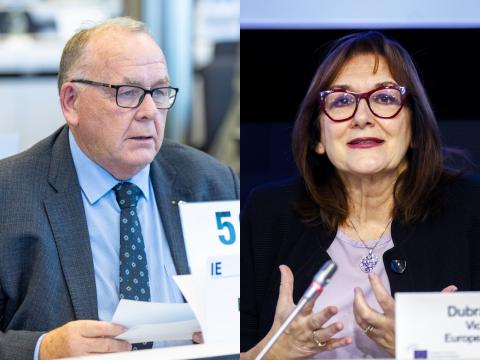
EESC plenary debate Strengthening civil dialogue and participatory democracy in the EU with Dubravka Šuica, Vice-President of the European Commission
Dear Vice-President,
I would like to thank you for joining us today - you are verey welcome at our plenary;
As shown by the latest Eurobarometer survey on democracy, one in three citizens identify ‘growing distrust and scepticism towards democratic institutions’ as a key threat to democracy. Furthermore, as we all know, our societies are undergoing deep and rapid changes.
While we need to protect our democracies on many levels, these challenges make it clear that it is time to invest more in their resilience from within!
The Conference on the Future of Europe (COFOE) was an opportunity to explore more participatory approaches. As you will remember, the COFOE emphasized the value of civil society as a vital component of democratic life. Furthermore, its final report recommended "reforming the way the European Union works, by better involving social partners and organised civil society" and, "(to) increase citizens’ participation and youth involvement", e.g. by "strengthening cooperation between EU legislators and civil society organisations to utilise the link between decision-makers and citizens which civil society organisations constitute".
It is now the time to build on these recommendations and, together, to lay the foundations for a more mature involvement of civil society organisations in the policy-making process.
In this Opinion, our Committee examines the way forward for civil dialogue and I want to take this opportunity to express my thanks and support to my colleague and Vice-President Pietro Barbieri for his work.
In particular, we call on the EU institutions to take the lead and to develop a strategy for civil society, resulting in an action plan.
Such an action plan should be the result of a shared process, where all stakeholders are invited to co-create guidelines on which topics, with whom and how civil dialogue should take place. This could be facilitated by the EESC, with the participation of civil society networks at EU level.
In parallel, our Group has published an Open letter, together with Civil Society Europe, which reflects the efforts of our Group.
As you know, as part of the principles enshrined in the Treaties, Article 11 of the Treaty on the European Union calls for EU Institutions to maintain an open, transparent and regular dialogue with representative associations and civil society. However, in spite of these legal provisions, civil dialogue remains patchy and unstructured across EU Institutions. We believe it is time to take a more structured approach. A first step in this direction could be a European Commission Communication on strengthening civil dialogue at EU level.
Finally, let me look ahead to the European elections. I emphasized earlier that is time to invest more in the resilience of our democracies. Civil society organisations play a key role in this regard. At the same time, they are key actors in building trust, fighting disinformation, shaping public opinions and acting as positive agents of change.
As mentioned by the rapporteur, today's debate on civil dialogue does not represent a point of arrival. Rather, our task is now to move from words to action and work together in developing participatory approaches and creating the blueprints for a more enabling environment for civil society organisations in the policy-shaping process.
Dear Vice-President, thank you very much for your attention and we look forward to continue this conversation with you.
Work organisation
Downloads
-
Speech by Séamus Boland, EESC debate with Vice-President of the European Commission Dubravka Šuica
Recommended for you
EWSA: Die EU muss die soziale Nachhaltigkeit stärker ins Blickfeld rücken
News
Der Europäische Wirtschafts- und Sozialausschuss (EWSA) fordert die Europäische Kommission auf, einen längst überfälligen Bericht zu veröffentlichen und die Ausweitung des Anwendungsbereichs der EU…
Ko-Kreation von Dienstleistungen von allgemeinem Interesse im Bereich Gesundheit als Beitrag zur Stärkung der partizipativen Demokratie in der EU
News
Bei dieser vom Europäischen Wirtschafts- und Sozialausschuss (EWSA) und der Universität Debrecen organisierten Veranstaltung wurde hervorgehoben, wie wichtig die Ko-Kreation von Dienstleistungen von…
Zur Bekämpfung des Klimawandels werden mehr öffentliche Investitionen in die Energieinfrastruktur in der EU gebraucht
News
In einer auf der Plenartagung im September verabschiedeten Stellungnahme erläutert der Europäische Wirtschafts- und Sozialausschuss (EWSA), dass zur Verwirklichung der Energiewende und der Klimaziele…
Energie – EWSA warnt vor neuen Abhängigkeiten
News
Der Europäische Wirtschafts- und Sozialausschuss (EWSA) bezieht in einer auf seiner September-Plenartagung verabschiedeten Stellungnahme klar Stellung zum Thema Energie: Der Vorschlag der Kommission…
Der EU-US-Handels- und Technologierat muss die Dynamik nutzen, um ein Wegweiser für Handel, Technologie und Innovation zu werden
News
Auf seiner Juli-Plenartagung zeigte sich der Europäische Wirtschafts- und Sozialausschuss (EWSA) optimistisch, dass der neue Handels- und Technologierat (TTC) ein innovatives Instrument für die EU…