
European Economic
and Social Committee
Inaugural speech by President Séamus Boland on 'Protecting Europe's most vulnerable through affordable and sustainable housing'
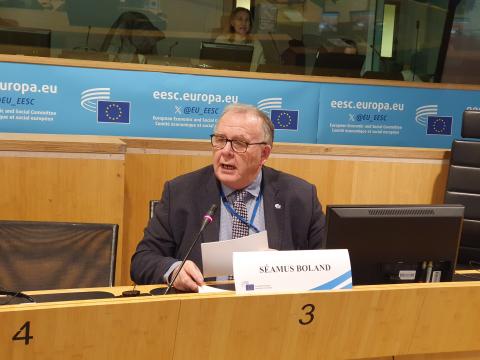
Conference on 'Protecting Europe's most vulnerable through affordable and sustainable housing', organised by the EESC Civil Society Organisations' Group, 21 November, Brussels (Belgium)
Séamus Boland, President of the Civil Society Organisations' Group
Ladies and gentlemen, dear colleagues,
It is with great pleasure that I would like to welcome you to this conference on 'Protecting Europe's most vulnerable through affordable and sustainable housing'. This topic is about social justice, healthier and happier communities, economic prosperity and a better protection of our planet. Allow me to begin by thanking all of our esteemed speakers at today's event, starting with the three speakers in the first panel, namely: Mr Ros Sempere, Member of the European Parliament, Mr Kattnig, EESC Member and Ms Maj, one of the authors of the study on 'Affordable and Sustainable Housing in the EU'. You are all very welcome.
Regrettably, 'housing' has been added to the increasingly long list of crises facing Europeans in their daily life. According to the October Eurostat figures, 10.6% of EU households in cities and 7% in rural areas spend 40% of their disposable income on housing costs. In less than ten years, since 2015, house prices rose by a staggering 48% and rents by 18%.
These figures should be understood within the wider context of the increasing poverty levels within the EU. In 2023, more than one in five adults were at risk of poverty and social exclusion, rising to almost one in four children. These figures are totally unacceptable! Although I very much welcome the proposal on the EC President-elect to set-up an EU anti-poverty strategy, I do believe that we should be aiming for the total eradication of poverty within the Union. Reducing levels is not enough! It is also imperative that civil society organisations are involved in the entire process of designing, implementing and monitoring this anti-poverty strategy.
Ladies and gentlemen, poverty is not only a daily shortage of the basics. It can also have a profound negative effect on identity and self-confidence, thus hindering opportunities to exit poverty. It often has a trans-generational dimension, with several members of the same household caught in the spiral of disadvantage. Solutions must examine the root causes, looking into every stage of people's lives. Crucially, they should address poverty through a cross-sectoral policy approach.
Without doubt, the provision of affordable and sustainable housing is central to poverty eradication. Strategies to increase qualitative and affordable housing must be implemented alongside policies to reduce energy poverty, enhance employment, promote equality, social cohesion, health-care etc. In this context, I congratulate the President-elect of the European Commission for including a Commissioner for Housing and Energy, who will be tasked with launching the first European Affordable Housing Plan.
What is perhaps less well known are the links between housing and sustainability. Residential housing is a major polluter, responsible for 17% of all global green-house gas emissions. Hence, sustainable housing should be examined from a broader perspective, including resource efficiency and circularity, resilience and adaptation, as well as economic accessibility. The links between climate crisis and vulnerable groups is something that the Civil Society Organisations' Group has already explored, with an own-initiative Opinion on this topic adopted by the EESC last year, for which the rapporteur was Yannis Vardakastanis.
This brings me to the first panel of our conference this morning, which will be the occasion to present the conclusions and recommendations of the study on 'Affordable and Sustainable Housing in the EU', that our Group asked the EESC to commission.
The central premise of this study is that access to adequate housing constitutes a social need and a right, that is essential to human dignity, identity and sense of belonging. This view is echoed in a resolution of the European Parliament adopted in 2021, which recognises adequate housing as a fundamental human right, to be enforceable through legislation.
Of particular interest in the study, is the view that several of the solutions to the challenges of affordable and sustainable housing are to be found within the sector itself. As you will hear, more use of digitalisation in the construction and housing industry, as well as the involvement of social economy actors in housing provision, can have tangible benefits. In the case of the social economy, with their not-for profit and cooperative models, they are able to increase the availability and long-term stability of affordable housing. At the same time, they help to foster social cohesion, whilst also addressing broader societal challenges such as ageing European populations and the integration of vulnerable groups. It is significant that the solutions that the authors propose rely heavily on a pan-European approach, to complement local and national efforts in the housing sector.
A second dimension to today's event that I would like to highlight, relates to the housing challenges faced by the most vulnerable groups in our societies. Be they people with disabilities, the Roma community or certain types of families, as we will hear. We could of course have included young and older persons, as well as migrants in this panel, but time was against us. What is certain is that these groups of people often live in poorly insulated and energy inefficient accommodation. Low-income houses are also much more at risk of mortgages and rent arrears, which can lead to evictions and homelessness. Regrettably, evictions do still happen in the EU of the 21st Century.
I will bring my comments to a close with a personal comment and a quotation. Our house, is where we feel safe and protected, where we bring down the barriers and share with the people we care about. I can only imagine that to be homeless, would be to feel adrift, 'lost' in a sea of people who have their place in society. Allow me quote a less known Irish poet, Patrick Kavanagh, who wrote: "The sun rose and set in a land of dreams, whether the clocks were right or wrong”. Myland of dreams is one where no child within the EU suffers poverty, nor has to choose between their future opportunities and economic survival.
Thank you for your attention.
Work organisation
Downloads
-
Inaugural Speech by President Séamus Boland