
European Economic
and Social Committee
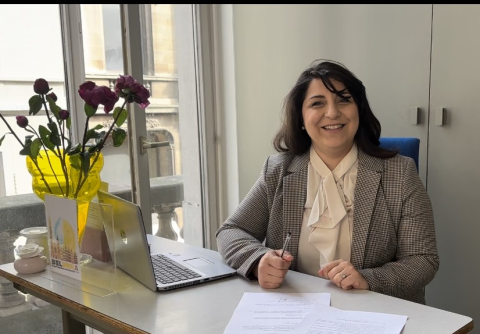
Four years into Russia’s full-scale invasion of Ukraine, civil society activist Rena Faradzeva has been at the forefront of coordinating and developing civil society initiatives in Belgium aimed at supporting Ukrainians both in the EU and back home. For EESC Info, she lists different organisations and programmes that assist Ukrainian refugees in Belgium and strengthen cooperation between EU and Ukrainian communities. Through its partnership initiatives, the EESC has played an important supporting role in organising partnership events and study visits for Ukrainian civil society organisations and young people.
From the very first days of the invasion, our priority was immediate action. Together with committed partners and volunteers, we mobilised all available resources and worked to build the necessary infrastructure to provide basic needs coverage for the enormous number of Ukrainians who fled to Belgium seeking temporary protection. The scale of displacement required rapid coordination, flexibility and strong cooperation between civil society actors while local governments searched for long-term solutions.
One of the key initiatives that emerged during this period was the Family Helps Family Fund (FHFF). What began as a focused support effort quickly expanded into a large and dynamic network connecting Europeans and Ukrainians. The Fund became not only a channel for humanitarian assistance but also a platform for solidarity, coordination and trust-building between communities. Its strength lies in the direct, human-centred approach: families supporting families, individuals supporting individuals.
The second major direction of my work has been the support and education of Ukrainian young people in Belgium. What initially started as assistance to help young Ukrainians integrate into Belgian society – through educational support, mentorship and community engagement – gradually evolved into a structured and ambitious initiative. This development led to the creation of BELUKRA, an exclusive joint Belgium-based non-governmental educational project for Ukrainian young people, which further strengthened cooperation between Belgian and Ukrainian stakeholders.
As a result of this process, we successfully established the European Collaborative Institute NGO. This organisation actively utilises both existing and newly available European grants and programmes to create educational opportunities and long-term development pathways for young Ukrainians. Our goal is not only integration, but empowerment – enabling young people to become active European citizens while preserving their identity and contributing to Ukraine’s future reconstruction.
The third pillar of my work has grown from accumulated experience, partnerships and cooperation with important diplomatic and civil society actors in Europe. Through this collaboration, we recognised the need for a more responsible, structured and results-oriented approach to international youth engagement. This vision led to the development of the International Youth Academy of European Diplomacy Europe NGO, which aims to prepare a new generation of young leaders equipped with knowledge of European institutions, democratic values and diplomatic processes.
In this context, cooperation with the European Economic and Social Committee (EESC) has been particularly important. The EESC provides an opportunity to work together at both public and institutional level, highlighting the actual and pressing challenges facing Ukraine and its society at different scales. Through its infrastructure, platforms and resources, the EESC helps ensure that these urgent issues – affecting Ukraine, its people and especially its children – become an important and visible part of European discussion. This cooperation contributes not only to raising awareness, but also to advancing concrete, solution-oriented approaches to the complex problems Ukraine is facing today.
None of these efforts would have been possible without the tireless work of the many organisations and activists of Ukrainian origin who have been helping day and night, both in Ukraine and across Europe. I would like to give particular recognition to the Ukrainian Scouts in Belgium NGO, Ukrainian Voices NGO and the Association of Ukrainian Women in Belgium NGO. Their dedication, cooperation and constant support have played a vital role in assisting displaced Ukrainians and sustaining humanitarian efforts.
Four years into the full-scale invasion, our work has evolved from emergency response to long-term structural cooperation. The challenge now is to sustain this commitment, deepen partnerships and ensure that solidarity translates into lasting impact – for Ukrainians in Belgium, for Ukraine and for Europe as a whole.
Rena Faradzheva is a Belgian-based NGO leader, founder, and CEO with more than 20 years of professional experience in education, social services, and international cooperation. She serves as project manager of several civil society initiatives in Belgium, focusing on access to education, human rights protection, youth engagement, and humanitarian support for vulnerable communities. Her work combines expertise in psychology, governance, cross-border project coordination, and diplomacy, with a strong commitment to social cohesion and European civic values.