Fundamental Rights and the Rule of Law

This page is also available in:

The EU is not only a common market; it is a union of common values that shape the European identity. These values are set out in the Treaty on the European Union and also include the rights, freedoms and principles laid out in the Charter of Fundamental Rights: the "indivisible, universal values of human dignity, freedom, equality and solidarity; [the Union] is based on the principles of democracy and the rule of law. It places the individual at the heart of its activities, by establishing the citizenship of the Union and by creating an area of freedom, security and justice."

The Charter brings together into a single text all the personal, civic, political, economic and social rights enjoyed by people within the EU and apply to the EU institutions and Member States when they implement EU law.

The EESC is very active in the promotion of fundamental rights, the rule of law and democracy, and especially in the fight against discrimination based on race, ethnic origin, disability or gender. In 2018, it established the Group on Fundamental Rights and the Rule of Law to further expand analysis of the situation across Europe and promote a constructive dialogue amongst all stakeholders.
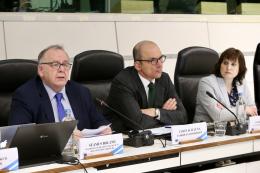
  • Civil society organisations (CSOs) must be recognised, involved and supported as partners that defend and strengthen European democracy and contribute to a functioning rule of law culture.

  • In its March plenary, the European Economic and Social Committee (EESC) adopted an opinion urging the European Institutions to address the fragmented implementation of foreign policy sanctions across Member States. The EESC is concerned about the inconsistency in standards and in the application of sanctions in national legislation, and is calling for immediate action to protect humanitarian aid and journalists in sanctioned regimes.

  • Conference on 'Civil society organisations defending and strengthening European democracy' organised by the EESC's Civil Society Organisations' Group

  • Réunion extraordinaire du Groupe des Organisations de la société civile

    Les inscriptions pour la conférence sont maintenant fermées. Nous vous invitons à suivre l'événement en direct sur : https://europa.eu/!bKTWBr 

  • Published in
    Thematic paper
    2 pages

    À en juger par les événements récents, la migration peut être imprévisible et sans précédent, la politique de l’UE étant anticipative et pourtant réactive. Le présent document met en lumière les politiques et évolutions récentes de l’UE, ainsi que la position du CESE en réponse à ces politiques.

  • Reference number
    15/2023

    Le 23 mars dernier, le Comité économique et social européen (CESE) a tenu un débat en plénière et il a adopté une résolution intitulée «Unie pour la démocratie» visant à renforcer les valeurs démocratiques dans l’ensemble de l’Union européenne. Les décideurs politiques, les experts et les représentants de la société civile organisée ont convenu que l’éducation civique, un meilleur financement des partenaires sociaux et l’accent mis sur la dimension locale étaient essentiels à la démocratie en Europe.

  • Adopté on 14/06/2023 - Bureau decision date: 21/03/2023
    Référence
    NAT/900-EESC-2023
    Session plénière
    579
    -
    Download format:
    Download — Avis du CESE: Étiquetage numérique des fertilisants UE
  • Les organisations de la société civile actives dans le domaine des droits fondamentaux, de l'état de droit et de la démocratie sont confrontées à des difficultés croissantes, allant des défis réglementaires aux contraintes financières et aux attaques concertées contre leur travail et leur crédibilité. Lors de l'audition, le CESE a l'intention de dialoguer avec les OSC et d'autres parties prenantes concernées pour identifier les principaux problèmes auxquels elles sont confrontées et proposer des moyens d'améliorer le soutien. L'audition alimentera l'avis, qui mettra particulièrement l'accent sur le financement de l'UE.

  • Published in
    12 pages

    Approche et domaines prioritaires du groupe des organisations de la société civile pour 2023

  • Published in
    8 pages

    Rapport sur la visite en Slovaquie – 7 et 8 juillet 2022
    Ce rapport relaie les points de vue de la société civile slovaque sur la liberté d’association, la liberté de réunion et l’État de droit.