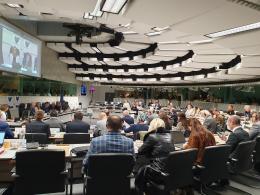
Fundamental Rights and the Rule of Law

This page is also available in:

The EU is not only a common market; it is a union of common values that shape the European identity. These values are set out in the Treaty on the European Union and also include the rights, freedoms and principles laid out in the Charter of Fundamental Rights: the "indivisible, universal values of human dignity, freedom, equality and solidarity; [the Union] is based on the principles of democracy and the rule of law. It places the individual at the heart of its activities, by establishing the citizenship of the Union and by creating an area of freedom, security and justice."

The Charter brings together into a single text all the personal, civic, political, economic and social rights enjoyed by people within the EU and apply to the EU institutions and Member States when they implement EU law.

The EESC is very active in the promotion of fundamental rights, the rule of law and democracy, and especially in the fight against discrimination based on race, ethnic origin, disability or gender. In 2018, it established the Group on Fundamental Rights and the Rule of Law to further expand analysis of the situation across Europe and promote a constructive dialogue amongst all stakeholders.

  • Published in
    16 pages

    Rapport sur la visite aux Pays-Bas – 7 et 8 février 2024 et observations des autorités sur le rapport
    Le rapport relaie les points de vue de la société civile néerlandaise sur la liberté d’association, la liberté de réunion et l’État de droit. Ce rapport a été communiqué aux autorités néerlandaises, qui ont ensuite transmis leur réponse.

  • Reference number
    34/2024

    Face à la multiplication à un rythme effrayant des discours et des crimes de haine, les Européens unissent leurs forces et renforcent leur action contre toutes les formes de haine pour faire valoir que dans l’Union européenne, il n’y a pas de place pour la haine

  • Published in
    11 pages

    Rapport sur la visite en Estonie – 12 et 13 octobre 2023 et observations des autorités sur le rapport
    Le rapport relaie les points de vue de la société civile estonienne sur la liberté d’association, la liberté de réunion et l’État de droit. Ce rapport a été communiqué aux autorités estoniennes, qui ont ensuite transmis leur réponse.

  • Published in
    8 pages

    Conclusions de la Semaine de la société civile 2024

  • Strengthen democracy, fight disinformation and fake news 

    In this issue:

    • Our members address the topic of disinformation and fake news
    • Guest articles by Paula Gori (European Digital Media Observatory), Renate Schroeder (European Federation of Journalists) and Eija Koivuranta (Finnish Federation for Social Affairs and Health SOSTE)
    • Interview with rapporteur Cristian Pîrvulescu on the EESC opinion 'No place for hate: a Europe untied against hatred'
    • Report on our recent conference on 'Strengthening civil society and participatory democracy in the EU: the way forward'
    • Civil Society Organisations' Bulletin - April 2024
  • Addressing immediate and long-term challenges, properly implementing existing EU policies and strengthening EU values are some of the priorities proposed by civil society organisations for the new mandate, along with structured civil dialogue and a strong social agenda.

  • Published in
    18 pages

    Rapport sur la visite au Luxembourg – 2 et 3 mars 2023 et observations des autorités sur le rapport
    Le rapport relaie les points de vue de la société civile luxembourgeoise sur la liberté d’association, la liberté de réunion et l’État de droit. Ce rapport a été communiqué aux autorités luxembourgeoises, qui ont ensuite transmis leur réponse.

  • A properly structured civil dialogue can be a means of making European democracies more resilient to current societal challenges. Civil society organisations (CSOs) trust in the European Parliament to be the driving force when it comes to an agreement on structured civil dialogue between the Council of the European Union, the European Commission and the European Parliament, as a Parliament resolution proposed such an agreement in 2022. CSOs consider such an inter-institutional agreement a basis for developing more inclusive and qualitative policy-making.

  • La conférence est ouverte au public. Vous avez la possibilité d’y participer en personne ou à distance. Une inscription préalable est requise dans un cas comme dans l’autre. Veuillez vous inscrire ici jusqu'au 11 avril 2024.

  • Published in
    12 pages

    Approche et domaines prioritaires du groupe des organisations de la société civile pour 2024