recommends that the Commission issue clear and transparent guidance on how to apply the proposed conditionality package and also reiterates the importance of ensuring that the EU's focus on stability and geopolitical interests does not come at the expense of the rule of law and democracy;
asks the Commission to support candidate and potential candidate countries in evaluating both the advantages and drawbacks of early market integration, identifying those that are adversely affected and implementing customised mitigation measures;
reiterates the importance of regional cooperation and good neighbourly relations throughout the EU accession process and welcomes the focus in the Commission's proposal on developing the Common Regional Market (CRM).
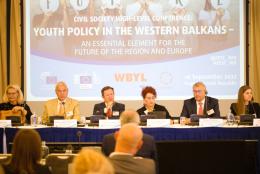
La conférence à haut niveau de la société civile sur la politique de la jeunesse dans les Balkans occidentaux, organisée par le Comité économique et social européen (CESE), a mis en évidence le rôle essentiel que jouent les jeunes dans l’avenir de cette région, et les a invités à participer activement à l’élaboration des politiques.
Afin d’assurer un avenir plus prospère à leurs citoyens, les Balkans occidentaux doivent aborder les problèmes auxquels sont confrontés les jeunes. Ce sont en effet eux qui détiennent les clés d’un tel avenir. L’octroi de dotations budgétaires suffisantes et transparentespour l’élaboration de la politique de la jeunesse et l’inclusion des jeunes dans le processus d’adhésion à l’Union européenne constituent une condition préalable à la facilitation de changements positifs et à l’amélioration de la situation des jeunes de la région.
Le forum de la société civile des Balkans occidentaux du CESE, qui s’est tenu à Skopje le 30 septembre et le 1er octobre, a mis en lumière la nécessité d’une perspective claire d’adhésion à l’Union européenne (UE) pour la région et le rôle que la société civile devrait jouer dans ce processus.
[fr bientôt disponible] At its March plenary session, the European Economic and Social Committee (EESC) hosted a debate with Olivér Várhelyi, Commissioner for Neighbourhood and Enlargement, to discuss the state of play of the accession of the Western Balkan partners. EESC members showed their convincement that integrating the Western Balkan partners in the EU is a geostrategic investment in peace and economic growth.
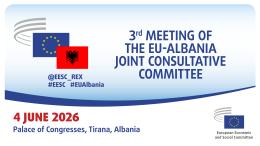
The 3rd meeting of the EU–Albania Joint Consultative Committee (JCC) brought together representatives of organised civil society and social partners from Albania and the European Union to exchange views on Albania’s accession process.
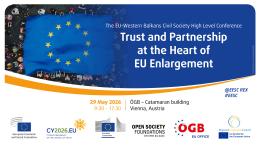
Trust and Partnership at the Heart of EU Enlargement
Event type
Conference
Location
ÖGB ,
Johann-Böhm-Platz 1 A
Vienna
Austria
On 29 May 2026, the European Economic and Social Committee (EESC) organised a High‑Level Civil Society Conference that brought together EU and Western Balkans stakeholders to discuss the role of civil society in advancing EU enlargement, strengthening democratic resilience and supporting socio‑economic convergence in the region.
The conference, took place on 12 March 2026 at Europe House Skopje, brought together representatives of civil society organisations, social partners, EU institutions, and national authorities to discuss key priorities related to North Macedonia’s EU accession process.
The opinion is being elaborated as an exploratory opinion at the request of the Cypriot Presidency of the Council of the EU.
The hearing will examine how organised civil society contributes to implementing reforms within the framework of EU’s Reform and Growth Facility for the Western Balkans and the Ukraine Facility.
First session will feature insights from Brussels based stakeholders, offering perspectives from EU-level actors engaged in the region. The following session will be a discussion with stakeholders from the countries concerned that will provide on the ground viewpoints from civil society representatives and practitioners directly involved in reform processes.