Circular Economy

This page is also available in:

The transition to a Circular Economy is high on the EESC agenda as a solution to fight the climate crisis and protect our planet. It is a great opportunity for civil society as it can help to:

  • increase the competitiveness of European industry;
  • promote sustainable economic growth;
  • generate new jobs.

The 'take-make-waste' model of production and consumption that still dominates our economy today is not only culminating in wasted resources, but also undermining the fight against climate change. Unlike the linear economy, a Circular Economy is a regenerative and restorative design that focuses on economic value creation and retention, tackling global environmental challenges such as climate change, biodiversity loss and pollution while yielding economic benefits.

The good news is that the circular transition is already happening on the ground. Stakeholders from civil society including businesses, trade unions, academia and knowledge communities, youth organisations as well as NGOs and other interest groups are creating and implementing many circular initiatives at local and regional level. Catalysing circular solutions and leadership from relevant stakeholders is Europe's best opportunity to accelerate the transition to a Circular Economy. 

As such, the European Circular Economy Stakeholder Platform, a joint initiative of the EESC and the European Commission, is a platform established in 2017 to bring together the Circular Economy community in Europe. The stakeholder-driven platform supports Europe's transition towards a Circular Economy by fostering dialogue, sharing knowledge and exchanging best practices.
  • Published in
    8 pages

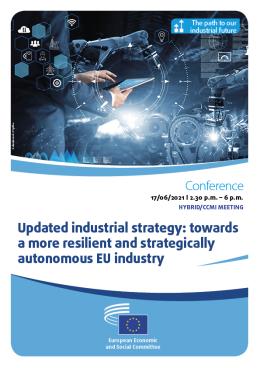
    Following the publication of the European Commission's Update to the New Industrial Strategy, the European Economic and Social Committee (EESC) has been carrying out a series of activities to fulfil its role of representing the views of organised civil society. A key event in this process has been a conference held on 17 June 2021, from 2.30 to 6 p.m., on Updated industrial strategy: towards a more resilient and strategically autonomous EU industry.

  • Published in
    8 pages

    Following the publication of the European Commission's Update to the New Industrial Strategy, the European Economic and Social Committee (EESC) has been carrying out a series of activities to fulfil its role of representing the views of organised civil society. A first event in this process has been a conference held on 17 June 2021, from 2.30 to 6 p.m., on Updated industrial strategy: towards a more resilient and strategically autonomous EU industry?

  • Published in
    Thematic paper
    2 pages
    Position paper – May 2021

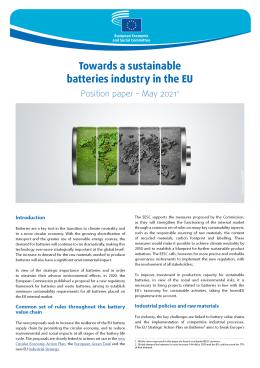
    The European Commission has published a proposal for a new regulatory framework for batteries and waste batteries, aiming to establish minimum sustainability requirements for all batteries placed on the EU internal market. The EESC supports the proposed measures, however, it calls for more precise and workable governance instruments to implement the new regulation, with the involvement of all stakeholders.

  • Published in
    Thematic paper
    4 pages

    The European Economic and Social Committee (EESC) and the Consultative Commission on Industrial Change (CCMI) believe that the present and future of critical raw materials resilience is of essential concern to EU's organised civil society. For this reason, and because the Commission's Action Plan represents a step forward by providing a clear roadmap with initiatives and actions to be taken at EU level, overall the EESC recommends that the European Parliament and the Council support this approach. 

  • Published in
    8 pages

    The European Circular Economy Stakeholder Platform is a joint initiative by the European Commission and the European Economic and Social Committee (EESC), launched in March 2017. The two institutions are working closely together to promote the Platform as a space for the exchange of ideas and a growing body of information, and to make the circular economy happen faster to the benefit of all. At the EESC, the Platform is spearheaded by three Members: Anders Ladefoged (Group I: Employers), Maria Nikolopoulou (Group II: Workers) and Cillian Lohan (Group III: Diversity Europe).

  • Published in
    Study
    61 pages

    The use of single-use plastics in packaging has grown significantly in the last decades, and with it, the pollution of our environment. There is an urgent need to improve the sustainability of our food systems, which includes also the development of more sustainable food packaging. The objective of this study is to identify and examine successful examples and approaches to food packaging in the EU and beyond, considering consumer safety, environmental, economic, social, legal and food waste reduction considerations.

  • Published in
    Study
    7 pages

    Circular economy strategies have been under development in European cities, regions, and countries in the last few years.  In the evolving context of the transition to a circular economy, strategies are valuable endeavours which draw attention to the topic, kickstart initiatives and bring stakeholders together. This publication is the executive summary of the study reviewing existing circular economy strategies across Europe, highlighting the different degrees of inclusiveness in terms of consultation.

  • Published in
    Study
    88 pages

    Circular economy strategies have been under development in European cities, regions, and countries in the last few years.  In the evolving context of the transition to a circular economy, strategies are valuable endeavours which draw attention to the topic, kickstart initiatives and bring stakeholders together.  This study reviews existing circular economy strategies across Europe, highlighting the different degrees of inclusiveness in terms of consultation.  The findings include a call for stronger involvement of civil society organisations in earlier phases of strategy deve

  • Published in
    Study
    124 pages

    The general objective of the Report is to study the recent evolution of the social economy in the European Union. It focuses on three areas: firstly, the social economy and the emergent concepts/movements related to it, secondly, the public policies adopted in both the EU and the member states in recent years to enhance the social economy sector and thirdly, measuring the weight of the social economy in each EU member country.

  • Published in
    28 pages

    The general objective of the Report is to study the recent evolution of the social economy in the European Union. It focuses on three areas: firstly, the social economy and the emergent concepts/movements related to it, secondly, the public policies adopted in both the EU and the member states in recent years to enhance the social economy sector and thirdly, measuring the weight of the social economy in each EU member country.