Europe

This page is also available in:

In Europe, the EESC maintains relations with social partners and civil society organisations (CSOs) in the Western Balkans, in the Eastern Neighbourhood, in the EEA EFTA states Iceland, Liechtenstein and Norway, and in the United Kingdom.

The Western Balkans Follow-up Committee – a permanent internal body of the EESC – is the main instrument for coordinating the EESC's activities in this region. The Western Balkans Civil Society Forum, held every two years, is part of the Follow-up Committee's work.

The EESC also works bilaterally with the countries in the Western Balkans that have started accession negotiations and with Türkiye, through specialised bodies created on the basis of association agreements between these countries and the EU: the goal of these Joint Consultative Committees is to involve social partners and CSOs in the monitoring of pre-accession and reform processes towards possible EU membership. Each body is made up of an equal number of members from the EESC and the partner country and usually meets once or twice a year.

The EESC has also set up an Eastern Neighbourhood Follow-up Committee, an internal body responsible for enhancing relations with civil society in the countries in the region, i.e. Armenia, Azerbaijan, Belarus, Georgia, Republic of Moldova and Ukraine.

The main cooperation mechanisms with Armenia, Georgia, Republic of Moldova and Ukraine are the Civil Society Platforms, which allow civil society organisations from both the EU and the partner country to monitor the implementation of the EU agreements with these countries and draft recommendations to the relevant authorities. Moreover, Ukraine and Republic of Moldova became candidate countries in 2022.

With regard to Belarus and Russia, relations are being developed with those civil society organisations that are still operating freely, most of them based on EU territory. The EESC considers it important to keep dialogue alive, while waiting for better conditions in the future.

The European Economic Area (EEA) brings together the EU Member States and the three EEA EFTA states (Iceland, Liechtenstein and Norway) in an internal market where goods, services, capital and persons can move freely. The EESC is part of the European Economic Area Consultative Committee, where questions of common interest are discussed with representatives of social partners from the EEA EFTA states.

Finally, the EESC has an EU-UK Follow-up Committee responsible for monitoring the relationship between the EU and the United Kingdom of Great Britain and Northern Ireland from a civil society angle. Its work particularly focuses on the implementation of the EU-UK Withdrawal Agreement and the Protocol on Ireland and Northern Ireland, on which it has an ongoing conversation with civil society organisations from the UK, as well as the implementation of the EU-UK Trade and Cooperation Agreement (TCA), on which the EU-UK Follow-up Committee cooperates with the EU Domestic Advisory Group under the EU-UK TCA.

  • -
    Event type
    JCC Meeting
  • Event type
    JCC Meeting

    For the 8th time, the European Economic and Social Committee (EESC) and Montenegro held the Civil Society Joint Consultative Committee (JCC) in Budva, Montenegro.

    This meeting tackled following issues: Assessment of the state of play in Montenegro accession negotiations to the EU, Chapter 28 of the accession negotiations – with focus on Consumer protection and Debate on the situation of young people on the labour market.

  • Event type
    Meeting

    Article 376 of the EU-Moldova Association Agreement foresees that each Party would establish a domestic advisory group (DAG) on sustainable development, which would advise on issues relating to the Chapter of trade and sustainable development. A joint meeting is held annually. The first meeting was held in July 2015.

  • Event type
    JCC Meeting
  • Inaugural meeting
    Event type
    Meeting
  • -
    Event type
    JCC Meeting

    The 24th meeting of of the European Economic Area Consultative Committee took place in Vaduz (Liechtenstein) on 19-20 May 2016.


    The members of the Committee discussed the latest developments in EEA and well as EU/EFTA issues. The Consultative Committee adopted two resolutions on the following topics:

    • Labour Mobility in the EEA
    • Better regulation to support businesses and protect workers in the EEA
  • Event type
    Meeting

    The first and inaugural meeting of the EU-Moldova Civil Society Platform (CSP) was held on 10 May 2016 at the EESC. The CSP complements the political bodies existing within the framework of the EU-Moldova Association Agreement, and it allows civil society organisations from both sides to monitor the implementation process and prepare recommendations to the relevant authorities both in the Republic of Moldova as well as in the European Union.

    The CSP is made up of nine members from both Parties, representing the EESC and large European civil society networks, on the one side, and civil society organisations from  Moldova, on the other side.

  • Published in
    Study
    36 pages

    This study examines how social partners and civil society organisations in six Member States — Italy, Austria, Hungary, Poland, Portugal and Sweden — view the effectiveness of current policies in raising employment levels and increasing adult participation in training. It also puts forward recommendations for improving policy outcomes.

  • Published in
    28 pages

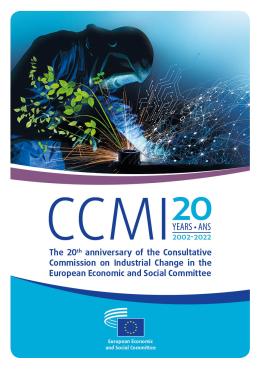
    On 8 June 2022 the Consultative Commission on Industrial Change (CCMI) celebrated its 20th anniversary with a conference focused on the challenges of today and the prospects for tomorrow. This publication is a record of the occasion and a commemoration of what CCMI has achieved since joining the EESC.

  • Published in
    Study
    63 pages

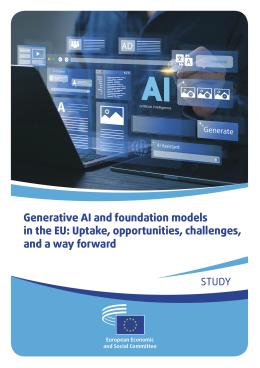
    Exploring the evolving landscape of generative artificial intelligence (GenAI) within the European Union, this study delves into technological advancements, market dynamics, and regulatory challenges. It highlights the EU’s position in the global GenAI ecosystem, revealing significant US dominance, while uncovering sector-specific opportunities and risks across industries such as automotive, renewable energy, and education.