European Economic
and Social Committee
European Economic
and Social Committee
The European Economic and Social Committee (EESC) is the voice of organised civil society in Europe.
Find out more about its role and structure at http://www.eesc.europa.eu/en/about
The EESC issues between 160 and 190 opinions, evaluation and information reports a year.
It also organises several annual initiatives and events with a focus on civil society and citizens’ participation such as the Civil Society Prize, the Civil Society Days, the Your Europe, Your Say youth plenary and the ECI Day.
Find the latest EESC opinions and publications at http://www.eesc.europa.eu/en/our-work/opinions-information-reports/opinions and http://www.eesc.europa.eu/en/our-work/publications-other-work/publications respectively.
The EESC is active in a wide range of areas, from social affairs to economy, energy and sustainability.
Learn more about our policy areas and policy highlights at http://www.eesc.europa.eu/en/policies
The EESC holds nine plenary sessions per year. It also organises many conferences, public hearings and high-level debates related to its work.
Find out more about our upcoming events at http://www.eesc.europa.eu/en/agenda/our-events/upcoming-events
Here you can find news and information about the EESC'swork, including its social media accounts, the EESC Info newsletter, photo galleries and videos.
Read the latest EESC news http://www.eesc.europa.eu/en/news-media/news and press releases http://www.eesc.europa.eu/en/news-media/press-releases
The EESC brings together representatives from all areas of organised civil society, who give their independent advice on EU policies and legislation. The EESC's326 Members are organised into three groups: Employers, Workers and Various Interests.
Find out more about our Members and groups at http://www.eesc.europa.eu/en/members-groups
The EESC has six sections, specialising in concrete topics of relevance to the citizens of the European Union, ranging from social to economic affairs, energy, environment, external relations or the internal market.
Find out more at http://www.eesc.europa.eu/en/sections-other-bodies
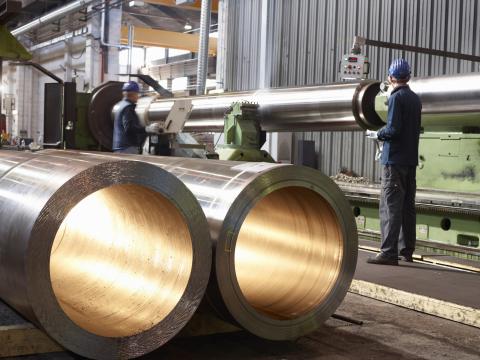
Am 9. November trat die Beratende Kommission für den industriellen Wandel (CCMI) zu einer Online-Debatte über die Stahlindustrie der EU zusammen. In der vom neuen CCMI-Vorsitzenden Pietro Francesco De Lotto geleiteten Debatte ging es um Überkapazitäten und Dekarbonisierung in der internationalen Stahlindustrie. Die Redner sprachen die Herausforderungen an, vor denen die europäische Stahlindustrie steht: den Aufbauplan der EU für die Zeit nach COVID-19, die Dekarbonisierung der Produktionsverfahren, Schutzmaßnahmen der EU und Handel.
Stahl ist in allen Industrie- und Entwicklungsländern ein grundlegendes Gut. Die COVID-19-Pandemie hat Fragen in Bezug auf die Abhängigkeit globaler Lieferketten aufgeworfen, zumal viele Länder von nur einem einzigen Lieferland abhängig sind.
Die Überkapazitäten der chinesischen Stahlindustrie sind bedenklich, denn China beherrscht mittlerweile mehr als die Hälfte des Weltmarkts. Seit 2018 erheben die USA Schutzzölle, um die Abhängigkeit der amerikanischen Wirtschaft von chinesischen Waren zu verringern. Diese Maßnahme traf auch den EU-Markt hart, denn die USA sind ein wichtiger Abnehmer von in der EU hergestelltem Stahl.
Gleichzeitig werden in vielen Ländern der Welt Anstrengungen zur Verringerung der Treibhausgasemissionen unternommen, und die Initiativen zur Verwirklichung einer Kreislaufwirtschaft nehmen zu.
„Wir müssen die Wettbewerbsfähigkeit derjenigen Bereiche der Stahlbranche sichern, die die für diese Umstellung nötigen Umweltnormen einhalten, die sich aber im Wettbewerb gegen andere Weltregionen behaupten müssen, in denen solche Normen überhaupt nicht vorhanden oder unzureichend sind“, betonte De Lotto zum Abschluss der Debatte. „Das Gleiche gilt für Arbeitsbedingungen und Arbeitnehmerrechte.“
Deshalb dringt der EWSA auf faire Wettbewerbsbedingungen zwischen europäischen Herstellern und Exporteuren in Drittländern. (tk/ks)