The hearing will build on the reflection launched by the FRRL Group at its first hearing on COVID-19 in December 2020. While the first hearing focused on COVID-19's impact on employers, workers and CSOs and the EU response, the second will look at the world after.
In the framework of the work on the opinion "Tackling non-performing loans in the aftermath of the COVID-19 pandemic', the ECO section decided to organise a hearing to discuss the action plan and to collect the views of various organisations on the topic.
The input session will bring together stakeholders and EESC Members to discuss fundamental rights, democracy and rule of law aspects of the COVID-19 crisis.
A first session will cover the ongoing impact of the crisis on the fundamental rights of employers, workers and civil society organisations. A second session will discuss how fundamental rights, democracy and the rule of law can play a key role in the design of a crisis exit strategy and in a post-COVID-19 recovery phase.
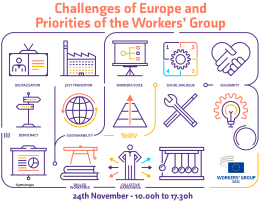
The Workers' Group is organising an extraordinary meeting on the current challenges for Europe and the priorities of the Workers' Group in this framework.
Following the outbreak of the COVID-19 pandemic, the European Economic and Social Committee (EESC) played a central role in bringing the consensual views of organised civil society in the EU to the attention of policy-makers and contributing to the rapidly evolving economic policy response at European level.
In this regard, we believe that now is the time for the EU institutions to make decisive steps in approving swiftly the new Facility and putting in place the necessary implementation mechanisms at European and national level, so that the hardest hit Member States, citizens and businesses can benefit from the relevant EU funding when they need it most.
Against this background, and on the occasion of the first meeting of the EESC's Section for Economic and Monetary Union and Economic and Social Cohesion (ECO) in our new term-of-office (2020-2025), we are organising a thematic debate on this issue between European policy-makers and civil society representatives.
The debate will take place on Thursday, 19 November 2020 from 14.30 to 16.40 as an online event, webstreamed live on the EESC website.
This report examines how the COVID-19 pandemic has affected the work of civil society organisations (CSOs) across Europe. It also focuses on how solutions implemented in individual EU Member States have impacted CSOs' ability to exercise their fundamental rights and freedoms.