Public debate in the ECO Section on the The Multiannual Financial Framework after 2027 - Assessing progress and outstanding challenges. The event will take stock of developments in the negotiations since the Commission presented their proposals for the next Multiannual Financial Framework and discuss outstanding challenges.
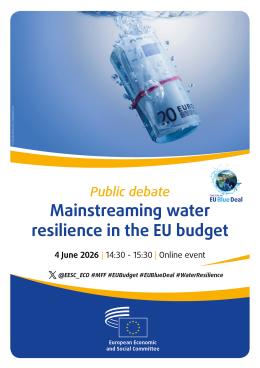
Mainstreaming Water Resilience in the EU Budget is a timely discussion on securing Europe’s water future. Discover how smarter EU investments can strengthen water resilience, sustainability, and preparedness, and how we should shape tomorrow’s funding priorities across programmes in the context of the EU´s next Multiannual Financial Framework.
"Cohesion policy 2028–2034: A new fund, a new framework, a new role for civil society?" brings together EU institutions, social partners and civil society representatives to reflect on the future of cohesion policy in the next Multiannual Financial Framework. The hearing explores proposals for reforming cohesion funding and governance, assesses the implications of the new framework through the National and Regional Partnership Plans and examines how civil society organisations can play a stronger role in the design, implementation and monitoring of cohesion policy. The discussion aims to identify how cohesion policy can continue to deliver territorial, social and economic cohesion while responding to new challenges and transitions facing the European Union.
Public debate in the ECO Section on the Latest twists and turns on the road to the next Multiannual Financial Framework in the framework of the opinion ECO/682 Multiannual financial framework 2028-2034.
The public hearing will examine how national, local and civil society actors will work together to foster collaboration through partnership principle and multi-level governance in order to deliver more inclusive, sustainable, and resilient outcomes across all regions.
The objective of the public hearing is to examine how cohesion policy can more effectively address housing affordability challenges to advance its core goals of economic, social and territorial cohesion. The participants will explore how strategic housing investments can stimulate regional economic development, enhance competitiveness, improve labour market efficiency, and reduce territorial disparities. The aim is to provide concrete recommendations for improving the effectiveness of existing instruments for the remainder of the 2021-2027 period and developing a more comprehensive approach to affordable housing within the post-2027 cohesion policy framework.
Lessons learned from the first years of the implementation of the programming period 2021-2027
Event type
Debate
Location
Online event
Belgium
Public debate on 9th Cohesion report: Lessons learned from the first years of the implementation of the programming period 2021-2027, in the framework of the ECO section meeting.
The EESC is convinced that islands, mountainous regions and sparsely populated areas face significant challenges and that there is a solid legal basis that obliges the EU to take action in order to tackle these challenges. In this context, the organised civil society has an important role to play and through this debate, the aim is to find the best practices and solutions so that these regions can perform better and recover from the multiple crises. Therefore the EESC- ECO section has decided to organise this public debate in the framework of the EESC own-intiative opinion on "Main challenges that EU islands, mountain and sparsely populated areas face.