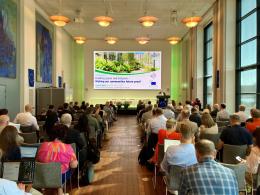
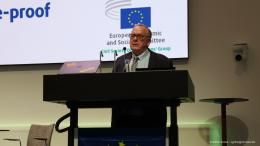
Reimagining the design of cities, communities and housing is essential to face the current challenges. Civil society organisations have a key role to play in steering this transformation. Sustainability and the right to housing must be at the heart of future strategies. The EU could contribute to this by increasing European funding for affordable housing and supporting the social economy.
Conference of the EESC Civil Society Organisations' Group in the framework of the Danish Presidency of the Council of the European Union, Copenhagen, Danish Society of Engineers (IDA), 2 July 2025
Les professionnels de la santé et les représentants de la société civile ont appelé les décideurs politiques à introduire une « Health check » pour toutes les politiques futures. Leur revendication juste avant les élections au Parlement européen : le « droit à la santé » doit rester en tête des agendas européens et nationaux, comme l’ont demandé les citoyens lors de la Conférence sur l’avenir de l’Europe.
Conference on 'The State of Health in the EU', organised by the EESC Civil Society Organisations' Group, in partnership with the Centre Hospitalier Universitaire de Liège and the Hôpital de la Citadelle, in the framework of the Belgian presidency of the Council of the EU, 4 June, Liège (Belgium)
L’initiative «Global Gateway» lancée par l’Union européenne constitue un pas en avant pour améliorer ses interconnexions avec ses partenaires extérieurs et les pays en développement partageant les mêmes valeurs qu’elle. Dans l’avis qu’il a élaboré sur le sujet, le CESE souligne que le comité qui sera mis en place pour coordonner les investissements réalisés dans le cadre de cette stratégie doit inclure des représentants de la société civile. Il fait également valoir que l’éligibilité des projets qui en relèvent doit être liée aux valeurs et aux principes de l’Union européenne.
rue Belliard 101, Jacques Delors building, room JDE 63, 9:30-11:00
Brussels
Belgium
EESC, room JDE 63, 9:30-11:00
The policy debate brings together stakeholders to assess how National and Regional and Partnership Plans will work in practice. In a workshop setting connected to the European Economic and Social Committee, participants from civil society, social partners and institutions will exchange perspectives on transparency, inclusiveness and impact. The discussion aims to highlight gaps, share best practices and strengthen the role of organised civil society in shaping and monitoring the implementation of NRPPs in the EU.
Débat public au sein de la section ECO sur «Le cadre financier pluriannuel après 2027: évaluation des progrès et des défis à relever». Cet événement permettra de faire le point sur l'évolution des négociations depuis la présentation par la Commission de ses propositions pour le prochain cadre financier pluriannuel et d'aborder les défis en suspens.
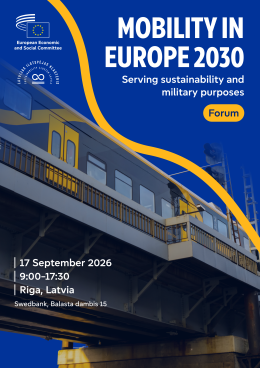
The TEN section, in cooperation with the Latvian Sustainability Cluster, is organising a forum on Mobility in Europe 2030 – serving sustainability and military purposes on 17 September 2026 in Riga, Latvia. The forum will deliver recommendations, identify investment and regulatory priorities, and clarify implementation pathways. The outcome of the forum will feed into the EESC’s policy work at EU level and provide practical guidance for Member States in advancing climate-neutral, resilient and competitive mobility systems, including strengthened military mobility, in response to evolving geopolitical challenges.
« Politique de cohésion 2028–2034 : un nouveau fonds, un nouveau cadre, un nouveau rôle pour la société civile ? » réunit les institutions de l'UE, les partenaires sociaux et les représentants de la société civile afin de réfléchir à l'avenir de la politique de cohésion dans le prochain Cadre financier pluriannuel. L'audition explore les propositions de réforme du financement et de la gouvernance de la cohésion, évalue les implications du nouveau cadre à travers les Plans de partenariat nationaux et régionaux et examine comment les organisations de la société civile peuvent jouer un rôle plus important dans la conception, la mise en œuvre et le suivi de la politique de cohésion. La discussion vise à identifier comment la politique de cohésion peut continuer à promouvoir la cohésion territoriale, sociale et économique tout en répondant aux nouveaux défis et transitions auxquels l'Union européenne est confrontée.