The European Economic and Social Committee hosted a hearing on how to foster innovation and digitalisation in the construction sector. Experts and industry representatives discussed the main barriers to innovation, from outdated regulations and lack of funding to skills shortages, and explored how digital tools, new materials and smarter rules could help modernise the sector.
Dans cet aperçu, le Comité économique et social européen (CESE) présente ses avissur les propositions de la Commission européenne pour le Cadre financier pluriannuel (CFP) 2028-2034, en rassemblant les points de vue de la société civile organisée sur l’orientation future du budget de l’UE.
rue Belliard 101, Jacques Delors building, room JDE 63, 9:30-11:00
Brussels
Belgium
EESC, room JDE 63, 9:30-11:00
The policy debate brings together stakeholders to assess how National and Regional and Partnership Plans will work in practice. In a workshop setting connected to the European Economic and Social Committee, participants from civil society, social partners and institutions will exchange perspectives on transparency, inclusiveness and impact. The discussion aims to highlight gaps, share best practices and strengthen the role of organised civil society in shaping and monitoring the implementation of NRPPs in the EU.
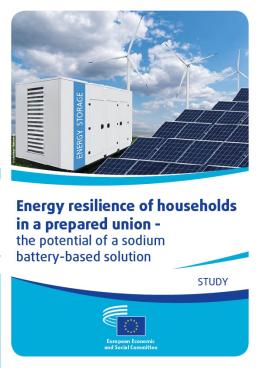
Cette étude examine le potentiel de la technologie des batteries au sodium pour renforcer la résilience énergétique des ménages et des entreprises européens, notamment pour atteindre l’objectif d’autosuffisance énergétique de 72 heures prévu par la Stratégie de l’UE pour une union de la préparation.
Débat public au sein de la section ECO sur «Le cadre financier pluriannuel après 2027: évaluation des progrès et des défis à relever». Cet événement permettra de faire le point sur l'évolution des négociations depuis la présentation par la Commission de ses propositions pour le prochain cadre financier pluriannuel et d'aborder les défis en suspens.
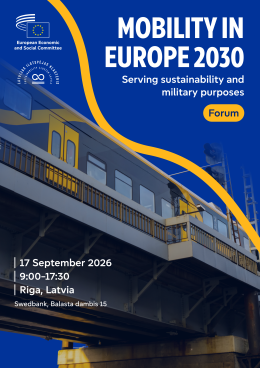
The TEN section, in cooperation with the Latvian Sustainability Cluster, is organising a forum on Mobility in Europe 2030 – serving sustainability and military purposes on 17 September 2026 in Riga, Latvia. The forum will deliver recommendations, identify investment and regulatory priorities, and clarify implementation pathways. The outcome of the forum will feed into the EESC’s policy work at EU level and provide practical guidance for Member States in advancing climate-neutral, resilient and competitive mobility systems, including strengthened military mobility, in response to evolving geopolitical challenges.