Healthcare professionals and civil society representatives called on policy-makers to introduce a ‘Health check’ for all future policies. Their demand just before the elections to the European Parliament: the ‘Right to Health’ must remain at the top of the EU and national agendas, as citizens demanded at the Conference on the Future of Europe.
Conference on 'The State of Health in the EU', organised by the EESC Civil Society Organisations' Group, in partnership with the Centre Hospitalier Universitaire de Liège and the Hôpital de la Citadelle, in the framework of the Belgian presidency of the Council of the EU, 4 June, Liège (Belgium)
The EU's Global Gateway initiative is the right step forward in improving connectivity with non-EU partners and like-minded developing countries. In its relevant opinion, the European Economic and Social Committee (EESC) underlines that civil society representatives must be included on the board that will be set up to coordinate Global Gateway investments. It also stresses that the eligibility of Global Gateway projects must be linked to the EU's values and principles.
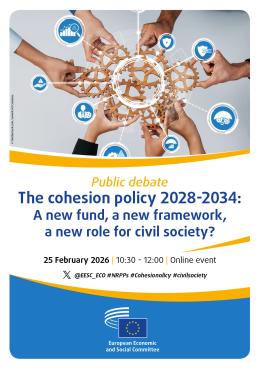
"Cohesion policy 2028–2034: A new fund, a new framework, a new role for civil society?" brings together EU institutions, social partners and civil society representatives to reflect on the future of cohesion policy in the next Multiannual Financial Framework. The hearing explores proposals for reforming cohesion funding and governance, assesses the implications of the new framework through the National and Regional Partnership Plans and examines how civil society organisations can play a stronger role in the design, implementation and monitoring of cohesion policy. The discussion aims to identify how cohesion policy can continue to deliver territorial, social and economic cohesion while responding to new challenges and transitions facing the European Union.
Public debate in the ECO Section on the Latest twists and turns on the road to the next Multiannual Financial Framework in the framework of the opinion ECO/682 Multiannual financial framework 2028-2034.
The public hearing will examine how national, local and civil society actors will work together to foster collaboration through partnership principle and multi-level governance in order to deliver more inclusive, sustainable, and resilient outcomes across all regions.
At the initiative of the EESC’s Civil Society Organisations’ Group, this exhibition showcases projects that have been coordinated by the Danish architecture firm BIG-Bjarke Ingels Group.
The objective of the public hearing is to examine how cohesion policy can more effectively address housing affordability challenges to advance its core goals of economic, social and territorial cohesion. The participants will explore how strategic housing investments can stimulate regional economic development, enhance competitiveness, improve labour market efficiency, and reduce territorial disparities. The aim is to provide concrete recommendations for improving the effectiveness of existing instruments for the remainder of the 2021-2027 period and developing a more comprehensive approach to affordable housing within the post-2027 cohesion policy framework.
Conference in the framework of the Danish Presidency of the Council of the EU
Event type
Conference
Location
The Danish Society of Engineers (IDA), Kalvebod Brygge 31-33
Copenhagen
Denmark
This event is an in-person conference that will be live streamed on our website. Registration for in-person participation is closed. We invite you to follow our webstreaming.