
European Economic
and Social Committee
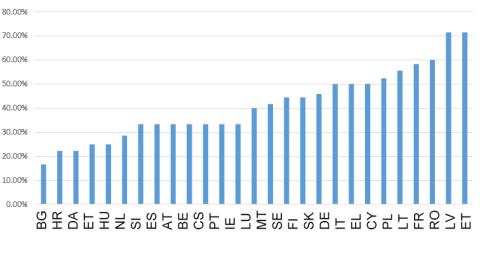
The EESC's 2020-2025 term of office has the highest number of new and female members since statistics on membership began in 2010. Ireland has 33 % new members and 22.22 % female members.
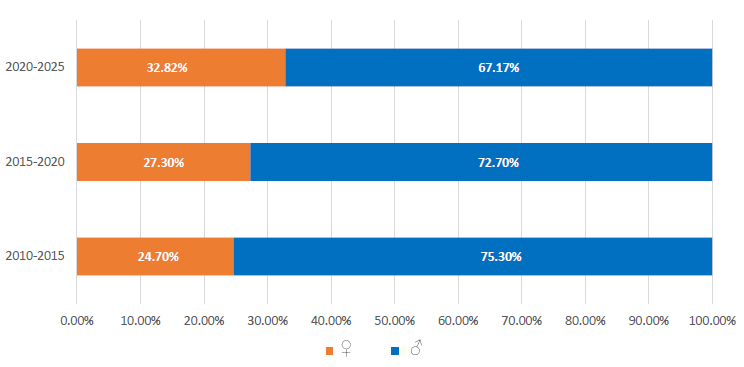
There is a higher percentage of women at the Committee than ever before: 33% compared to 28% in 2015 and 24.70% in 2010 (see graph 3).
In addition, for the first time in 15 years, a woman, Austria's Christa Schweng from the Employers Group, will lead the new Committee.
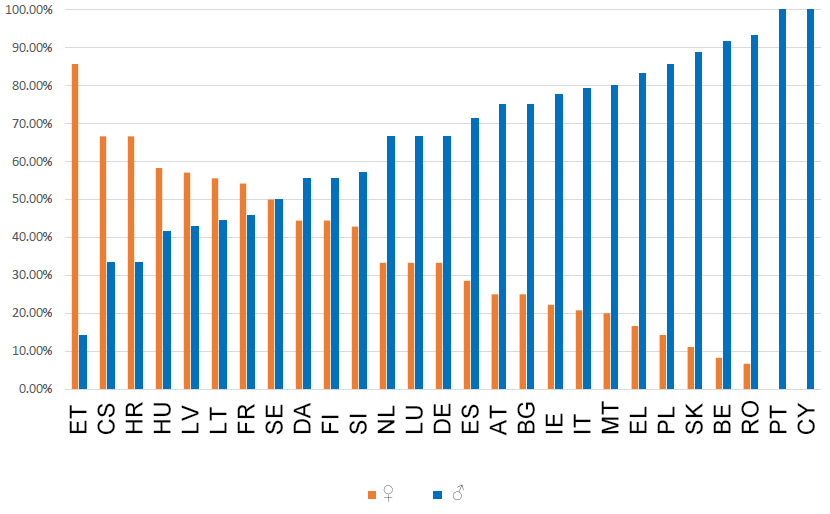
The countries with the most female members are Estonia, at 85.71%, and the Czech Republic and Croatia with 66.67%. At the other end of the scale, Portugal and Cyprus have appointed no women at all. Sweden has a perfect gender balance (see graph 2).
Overall, seven countries (those already mentioned plus Hungary, Latvia, Lithuania and France) have more women than men.
Of the three groups that make up the EESC, the Workers have the most female members (37.96%) and the Employers the fewest (28.30%), with Diversity Europe coming in between (32.17%).
The Council of the EU's guidelines to Member States ahead of the renewal flagged up the need to ensure a gender balance. While the Council is formally responsible for appointing EESC members, Member State governments put forward names after hearing the social partners and other civil society organisations.
With 137 new members out of a total of 329, the incoming EESC has the highest percentage of newcomers (41.64%) of the last three terms, up from 30% in 2010 and 40.29% in 2015 (see graph 4).
Latvia and Estonia have the highest renewal rate, with five new members out of a total of seven, and Bulgaria the lowest: just two out of 12 (see graph 1).

The Workers have the fewest members serving a first term (39 out of 108) and Diversity Europe the most (52 out of 115), while the Employers are in between (46 out of 106).
In terms of age, the youngest member is 27 and the oldest 76, the average age is 55.
Compared to the European Parliament and the Committee of the Regions, the other EU assemblies which are renewed on a regular albeit different basis, the EESC currently has a smaller percentage of new members and women than the former (58.50% and 40.40% respectively) but a higher one than the latter (31% and 29.10%). (dm)