Newsletter Info

EESC info

European Economic and Social Committee A bridge between Europe and organised civil society

MARCH 2022 | EN

GENERATE NEWSLETTER PDF

Available Languages:

  • BG
  • CS
  • DA
  • DE
  • EL
  • EN
  • ES
  • ET
  • FI
  • FR
  • GA
  • HR
  • HU
  • IT
  • LT
  • LV
  • MT
  • NL
  • PL
  • PT
  • RO
  • SK
  • SL
  • SV
Peace is the only battle worth waging

Peace is the only battle worth waging

The war in Ukraine has provided us with a brutal reminder of the initial purpose of the creation of the EU – maintaining long-standing peace on the continent. Unfortunately, we have managed to forget this. At a certain point, the European narrative of peace was no longer attractive, especially for the younger generation. Now, we are learning again that, in the words of Albert Camus, "peace is the only battle worth waging" and that we must keep going with our efforts to bring change where it is needed.

Read more in all languages

The war in Ukraine has provided us with a brutal reminder of the initial purpose of the creation of the EU – maintaining long-standing peace on the continent. Unfortunately, we have managed to forget this. At a certain point, the European narrative of peace was no longer attractive, especially for the younger generation. Now, we are learning again that, in the words of Albert Camus, "peace is the only battle worth waging" and that we must keep going with our efforts to bring change where it is needed.

The Russian invasion of Ukraine brought back the worst nightmare of twentieth century – war on the European continent. The territorial integrity of a country is again being questioned. This comes along with the risk of famine and genocide. Russian aggression goes against everything that is "European" and everything that is "democratic", and Europe cannot and will not tolerate it. Peace is the foundation of the European Union. This union was founded on the power of law not on the law of power.

Ten years ago, the European Union was awarded the Nobel Peace Prize in recognition of over 60 years of peace, reconciliation and democracy. The EU must continue to be, and become an even stronger guardian of peace and democracy on European soil and beyond.

The biggest challenge for Europe now is war and its consequences – migration, further inflation, rising energy prices and the need for militarisation. However, previously existing challenges such as COVID-19, fighting climate change or building Europe's strategic autonomy remain. We need to address all of this and keep helping our neighbours – the Ukrainian people. In this context, I welcome the conclusions of the EU informal summit in Versailles, which reflect the EESC's recommendations to immediately stop military action on Ukrainian soil, to protect people in Ukraine and the country's refugees and to strengthen Europe's autonomy, notably in the energy sector.

These are not easy times, especially since we are still feeling fatigue after COVID-19 and recent lockdowns. However, we need to keep up the current spirit of unity. One point for me is sure: a resilient democracy builds its strength and vitality from what the Greek called "demos" – the people, be it employers, workers or citizens at large! Only united can we build our European future.

We have just found the emotional link and sense of ownership of the European project that we have been recently missing – PEACE.

Christa Schweng
EESC President

Diary Dates

31 March 2022 – 1 April 2022, Brussels (virtual event)

Your Europe, Your Say! 2022

31 March 2022, Brussels (virtual event)

Health challenges in the EU in the pandemic context

8 April 2022, Brussels

Employment of young people with disabilities

7 May 2022, Brussels (virtual event)

Europe Day 2022

Sławek Kaminski / GW

From Ukraine on the road to...

We can see the tragic history of Ukraine unfolding before our very eyes, thanks to the tireless and heroic work of journalists, photographers and camera operators who go where we cannot. One of them, Polish photographer Sławek Kaminski, sent us his photos from the Belarus-Polish border, Rzeszów and Medyka-Shehyni.

Today we are publishing the first of them from the Polish-Ukrainian border. Thank you for the moments captured in frame. (ehp)

Read more in all languages

We can see the tragic history of Ukraine unfolding before our very eyes, thanks to the tireless and heroic work of journalists, photographers and camera operators who go where we cannot. One of them, Polish photographer Sławek Kaminski, sent us his photos from the Belarus-Polish border, Rzeszów and Medyka-Shehyni.

Today we are publishing the first of them from the Polish-Ukrainian border. Thank you for the moments captured in frame. (ehp)

The Surprise Guest

Every month in our column "The Surprise Guest" we introduce a public figure whose work and commitment are seen by others as a source of inspiration. In particular their courage, strength of character and determination to take action are exemplary.

Read more in all languages

Every month in our column "The Surprise Guest" we introduce a public figure whose work and commitment are seen by others as a source of inspiration. In particular their courage, strength of character and determination to take action are exemplary.

In this month's EESC Info, we give the floor to Sławek Kamiński, photographer for Gazeta Wyborcza, who shares with us the photos he took at Ukraine's border with Poland.

There are similar scenes are in other places, because Ukrainian people is crossing borders in several European countries, Poland, Hungary, Slovakia, Romania, Moldavia.

Although an experienced photographer who witnessed human tragedy on many occasions , Slawek Kamiński says his throat tightened at the sight of Ukrainian mothers and children entering Poland in Rzeszow, Przemyśl, and in Medyka-Szeginie, saying goodbye to husbands and fathers who return to their country to fight.

With the tragic history of Ukraine unfolding before our very eyes, it is thanks to the tireless and heroic work of journalists, photographers and cameramen like to Sławek Kaminski, who go where we cannot go, that we learn about the events on the ground and the tragic plight of people in a war. It is thanks to them that we remain in the know and that we are mobilized to help.

Sławek Kamiński is the winner of several awards and distinctions in prestigious press photography competitions. He won the Grand Prize - Photo of the Year in the Grand Press Photo 2019 competition. With his camera, he has been documenting political changes in Poland for more than 30 years. His work has been published in most Polish and many foreign press outlets and books. He has also taken part in major advertising projects. His news photos can be seen on Wyborcza.pl and Reuters.(ll/ehp)

Sławek Kaminski: Border

I left for the border very spontaneously with a colleague at 5 a.m. on Saturday the 26th of February 2022. The Russian invasion of Ukraine had been going on for two days.

Read more in all languages

I left for the border very spontaneously with a colleague at 5 a.m. on Saturday the 26th of February 2022. The Russian invasion of Ukraine had been going on for two days.

Trips like this are the daily bread of any experienced photographer, but the thrill is there as always. We are driving a bit in the dark, towards Przemyśl. On the way we run out of fuel, a lot of confused people, slight panic.

We make it. First the border crossing in Medyka. Huge traffic jam, lots of parked cars. Crowds of people waiting for relatives and friends.

There is the first group. I have seen a lot in my life but this sight makes something tighten in my throat. Young mothers are walking. Each is pushing a pram, dragging a suitcase or holding a child's hand. They are helped by Polish border guards. They are touched.

Everything looks a little different than it did at the other border, not so long ago. Here, newcomers are greeted with joy, with tears in their eyes. Friends or family take these young women in their own cars. They are now safe. Not far away, in fact right next door, there is a crowd of Ukrainian citizens who want to return to their country. They are mainly men. They will fight the enemy.

Then I head to the border crossing in Korczowa. In the evening, the railway station in Przemyśl and the reception point at the hypermarket.

And so on for three days.

Each time it is different. More and more refugees and more and more people who want to help. And they are helping. The situation seems to be under control. Shops are working, there is electricity and, for the time being, you can call everywhere. Piles of clothes and food are growing. Everything will come in handy. Only the news from the front is getting more and more terrible.

On the way back a long column of military vehicles passes us. The matter is serious. After all, there is a real war just across the border.

There are more and more refugees from Ukraine. Their number has long since exceeded one million.

Most of them are going to big cities. There they live in railway stations, stadiums and care centres.

One question to..

One question to….

In our "One question to ..." column, EESC member Javier Doz answers a question from the EESC info on the most important tasks in 2022 of the European Semester Group, of which he is the president.

EESC: You are the President of the European Semester Group. What are the most important tasks for the Group this year?

Read more in all languages

In our "One question to ..." column, EESC member Javier Doz answers a question from the EESC info on the most important tasks in 2022 of the European Semester Group, of which he is the president.

EESC: You are the President of the European Semester Group. What are the most important tasks for the Group this year?

Javier Doz: the work of the European Semester Group

The European Semester Group (ESG) has 42 members, a three-person presidency — with Luca Jahier (Group III) and Gonçalo Lobo (Group I) as vice-presidents — and a three-person secretariat, headed by Jakob Andersen and supported by a trainee. Its structure is completed by 27 tripartite national delegations adding a further 39 members.

Read more in all languages

The European Semester Group (ESG) has 42 members, a three-person presidency — with Luca Jahier (Group III) and Gonçalo Lobo (Group I) as vice-presidents — and a three-person secretariat headed by Jakob Andersen and supported by a trainee. Its structure is completed by 27 tripartite national delegations making up a further 39 members.

The name of the Group clearly defines its remit: to analyse and issue opinions on EU economic governance and its procedures and content, including the stages that take place at national level. Of the various documents that make up the autumn and spring Semester packages, the ESG most closely monitors the Annual Sustainable Development Strategy and the two opinions (the initial one and the additional one) that the Committee adopts on the Strategy each year. The Group holds five meetings per year, one of which is an open conference that usually takes place in May or June.

The ESG's current mandate began in the middle of the COVID-19 pandemic and with an EU response that represents a profound shift in the economic policy model from the one adopted in the 2008-2012 crisis: a combination of expansionary monetary and fiscal policies and an EUR 750 billion Recovery Plan, financed by European debt. The ESG's work has since focused on analysing the NextGenerationEU and the associated National Recovery and Resilience Plans (NRRPs). This has boosted the role of the Group’s national delegations, which are playing a key part in drafting the two resolutions to be adopted by the EESC on the recovery plans. The first, adopted by the EESC plenary in February 2021, focused on evaluating the involvement of civil society organisations (CSOs) in the drafting of the NRRPs. The evaluation was based on feedback from national delegations, in the form of a five-question survey, and on various national debates. The Resolution criticised the fact that, despite the provisions of the Recovery and Resilience Mechanism (RRM) Regulation, CSO participation has generally been low and of poor quality.

The ESG and its national delegations are currently drafting a new resolution, to be discussed at the May Plenary, which will assess the content of the plans, their impact on the economy and society, and the involvement of CSOs in their implementation. This time, the survey contains 21 questions. Consideration will also be given to the conclusions of the discussions that have taken place, such as the two national conferences co-organised with the national ESCs in two of the countries that will receive the largest amounts of RRM funds: Spain and Italy. The main evaluations of NRRPs being carried out by European think tanks, as well as data provided by Recover-EC, will be used as a frame of reference.

Once the work on drafting the second resolution has been completed, the Group’s activity will focus on the reform of the European Semester and on the assessment of the investment needed to achieve the aims of the European Green Deal and in particular those required for the just transition towards a climate-neutral green economy in 2050. The reform of the European Semester procedures, linked to the reform of the Stability and Growth Pact, will be the topic of discussion at the upcoming ESG conference on 3 June. To analyse the investment needs of the Green Deal, the ESG will propose that the ECO section, together with the NAT section, organise a conference in the last quarter of the year.

I shall conclude by pointing out that, in the coming months, the ESG will certainly have to address the economic fallout of Russia's invasion of Ukraine and of the sanctions adopted by the EU in response to this. We will also have to press for restoration of the sovereignty of our neighbouring country - one of our family.

Javier Doz, President of the European Semester Group

To the point

To the point

In our column "To the point", we invite EESC members to highlight the aspects of the opinion that they consider important. This time we asked Ozlem Yildirim to explain the challenges arising from the links between environmental protection and fundamental rights.

Read more in all languages

In our column "To the point", we invite EESC members to highlight the aspects of the opinion that they consider important. This time we asked Ozlem Yildirim to explain the challenges arising from the links between environmental protection and fundamental rights.

Ozlem Yildirim: Recognising the right to a healthy enviroment as a fundamental right

 Recognising that environmental degradation and climate deregulation have a direct and indirect impact on a range of fundamental rights (such as the right to life, the right to health and the right to education), the EESC, for the first time, looked into this clear link which risks undoing the progress made in recent decades in the areas of development, global health and poverty reduction.

Read more in all languages

 Recognising that environmental degradation and climate deregulation have a direct and indirect impact on a range of fundamental rights (such as the right to life, the right to health and the right to education), the EESC, for the first time, looked into this clear link which risks undoing the progress made in recent decades in the areas of development, global health and poverty reduction.

The information report on "Environmental protection as a prerequisite for respect for fundamental rights" provided an opportunity to address key issues, notably the right to a healthy environment as a fundamental right. As the author of this report, I would like to stress that the European Environment Agency (EEA) considers air pollution to be the biggest environmental health risk in Europe. Not only does this form of pollution pose a serious risk to human health, it entails considerable economic costs resulting from increased medical expenses, a drop in productivity, chiefly due to working days lost, and lower agricultural yields. In light of this situation, we are delighted to see a new human right emerging: the right to a healthy, safe and sustainable environment.

According to the International Labour Organization (ILO), 1.2 billion jobs (40% of world jobs) depend on a healthy environment. Heat stress will reduce working hours in the world by 2% in 2030, representing 72 million jobs. Pollution and environmental degradation will have an impact on workers' productivity, health, income, and food security.

Hence the information report states that "the EU must establish itself as a reliable partner on the international stage by strengthening and implementing legislation incorporating a comprehensive, human-rights-based approach to climate and environmental action, so as to guide climate change mitigation policies and measures while protecting the rights of all. Especially, the EU has to be consistent and pay more attention to trade agreements."

Among the various proposals for the EU's climate action to be centred around fundamental rights, this report advocates, in particular, the adoption of a clear and coordinated interdisciplinary strategy and the need to finalise the EU's accession to the European Convention on Human Rights (ECHR). Lastly, the EESC calls for the adoption of a European law to tackle "strategic lawsuits against public participation", in order to achieve a high and uniform level of protection across Europe by fighting against the misuse of legal procedures which aim to silence whistle blowers, journalists, rights defenders or other public watchdogs.

Ozlem Yildirim, EESC Member and Vice-President of the Group on Fundamental Rights and the Rule of Law

EESC News

Europe is not safe without a safe and secure Ukraine

In a spontaneous debate initiated by the EESC president Christa Schweng during the February plenary session, the members of the European Economic and Social Committee condemned the unjustified and unprovoked invasion of Ukraine by the Russian Federation. EESC members expressed their solidarity with the Ukrainian people and called for firm actions at both EU and national level in a spirit of unity in this dramatic time.

Read more in all languages

In a spontaneous debate initiated by the EESC president Christa Schweng during the February plenary session, the members of the European Economic and Social Committee condemned the unjustified and unprovoked invasion of Ukraine by the Russian Federation. EESC members expressed their solidarity with the Ukrainian people and called for firm actions at both EU and national level in a spirit of unity in this dramatic time.

Opening the debate, president Christa Schweng underlined the critical nature of this situation for Europe and stated: "Today we witnessed an aggression at the doorstep of the EU. Such a move constitutes a blatant violation of international law and international agreements, including the Minsk Agreements. In these hours, our thoughts are with Ukraine and its civil society, the innocent women, men and children as they face this unprovoked attack and fear for their lives. Europe needs to stand with Ukraine and its civil society!" president Schweng said.

Stefano Mallia, president of the Employers' Group, highlighted: "The EU is certainly united in a desire for firm action. I was there at Maidan Square and one thing I remember clearly is the great desire of civil society to be part of Europe, to be part of the EU. Ukraine cannot be abandoned. We need to be ready to also pay a price for the efforts and actions that need to be taken".

Oliver Röpke, president of the Workers' Group, also added: "This is the time for us to voice our opposition and say clearly that Europe will never allow this. We need to be united and find the response to this aggression and stand side by side in full solidarity with the people of Ukraine".

In the same spirit, Séamus Boland, president of the Diversity Europe Group, expressed his support: "We are standing at a precipice and we must reach out to civil society organisations in Ukraine. Above all, the EU must remain unified and in solidarity with our neighbours".

The president of the EESC External Relations Section, Dimitris Dimitriadis, said that the EESC would strive to continue supporting Ukrainian civil society through our well-established channels, such as the EU-Ukraine Civil Society Platform and through our bilateral contacts. (at)

Industrial policy: sustainability must go hand in hand with competitiveness and strategic autonomy

The EU needs to reassess the priorities of its industrial policy in light of the pandemic and the conflict on Europe's eastern border. This is the message that emerged from the conference on 'A sustainable future for European industry' hosted by the European Economic and Social Committee on 4 March 2022, in cooperation with the European Commission and the French presidency of the Council of the European Union.

Read more in all languages

The EU needs to reassess the priorities of its industrial policy in light of the pandemic and the conflict on Europe's eastern border. This is the message that emerged from the conference on 'A sustainable future for European industry' hosted by the European Economic and Social Committee on 4 March 2022, in cooperation with the European Commission and the French presidency of the Council of the European Union.

Opening the Conference, EESC President Christa Schweng stressed the need for a cooperative approach to shaping EU industrial policy: "We must work in partnership with industry, public authorities, and the social partners when building a sustainable future for EU industry. In this process, we must leave nobody behind".

While the EU is still dealing with the aftermath of the COVID-19 crisis, the dramatic events in Ukraine have shocked the continent. The Executive Vice-President of the European Commission, Margrethe Vestager, said that "Europe's industries must reduce one-sided reliance on others. We must also protect the Single Market from external influence, whether in the form of distortive foreign subsidies or attempts at coercion by foreign governments."

Most speakers saw the conflict as yet another strong argument to keep pushing for green objectives, although some felt that circumstances call for a rethink of our green goals, and even envisaged a return to coal in Europe. "New emerging factors, such as inflation, debt, defence, and energy, are completely changing the industrial strategy we need to pursue. Strategic autonomy and defence must be our new imperative," urged MEP Carlo Calenda.

Thomas Courbe, Director-General for Enterprise at the French Ministry of the Economy, Finance and the Recovery, further believes that the transition to sustainable energy represents an opportunity to modernise Europe's industrial foundations. The twin transition must foster fair and socially just job creation conditions, in line with the principle of leaving no-one behind. "The goal should be to reduce greenhouse gas emissions as much as possible at the lowest possible socioeconomic cost," added Sandra Parthie, EESC rapporteur on Updating the new industrial strategy.

Lastly, Thierry Breton, European Commissioner for the Internal Market, reiterated that in times of growing geopolitical tensions, it is essential to encourage the development of a cohesive vision of the European Union and its industries. (gb/dm)

The unfolding aggression directed at Ukraine calls for further strengthening of the EU project

The European Economic and Social Committee (EESC) held a conference entitled Shaping Europe Together. The purpose of this conference, organised with a view to the conclusion of the Conference of the Future of Europe, was to wrap up the work done so far by the Committee and to discuss the current state of affairs, the challenges ahead and ambitions for the future.

Read more in all languages

The European Economic and Social Committee (EESC) held a conference entitled Shaping Europe Together. The purpose of this conference, organised with a view to the conclusion of the Conference of the Future of Europe, was to wrap up the work done so far by the Committee and to discuss the current state of affairs, the challenges ahead and ambitions for the future.

ESSC president Christa Schweng kicked off the debate, referring to the recent historic developments in Ukraine and answering the opening question as to whether now was the right time to discuss the future of Europe.

"Witnessing the aggression against Ukraine and its people shows the urgent need to further strengthen the European project and Europe's fundamental values, such as peace, freedom and democracy", said Ms Schweng.

She highlighted the importance of this event as a moment to take the pulse of where we were now and to evaluate what had happened in the past few months.

The EESC has conducted outreach initiatives and events in all Member States in order to guarantee fair representation, to involve employers, workers and the whole of organised civil society, and to convey their points of view to the Conference on the Future of Europe. The Committee also adopted a resolution on the new narrative for Europe and published several ideas on the Conference's online platform. 

In a closing statement, Clément Beaune, Secretary of State for European Affairs to France's Minister for Europe and Foreign Affairs, said: "Implementing the citizen's proposals will require debates and institutional decisions, and the EESC will act as guardian to ensure that this meets your expectations".

The EESC has played an exceedingly active role in the Conference on the Future of Europe through its ad-hoc group, as an observer on the Conference's executive board, and as a member of the plenary. (ks)

We need to walk together on this long road towards gender equality

The conference on Women in the Labour Market organised by the EESC to mark International Women's Day was held on 8 March under the shadow of the war. The participants paid tribute to the remarkable Ukrainian women for their strength, bravery and resilience.

Read more in all languages

The conference on Women in the Labour Market organised by the EESC to mark International Women's Day was held on 8 March under the shadow of the war. The participants paid tribute to the remarkable Ukrainian women for their strength, bravery and resilience.

In her opening address, EESC president Christa Schweng referred to the Ukrainian women and girls who are being forced to leave their country, putting them at heightened risk of violence.

In the same vein, the president of the ad hoc Group on Equality and EESC member, Maria Nikolopoulou, highlighted: "Women, mothers, spouses are stuck in a war zone, many of them are becoming soldiers themselves, others are trying to escape from the atrocities of the attacks. We join our voices with the civil societies that demand an end to the war, in all countries".

The COVID-19 pandemic has further widened the gender employment gap and it has also contributed to a surge in violence and harassment at work.

Commissioner for Equality, Helena Dalli, announced that the European Commission would present a proposal for a directive on combatting violence against women and domestic violence that would be binding for all Member States.

Regarding the artificial intelligence sector, women make up only 16% of the workforce, which leaves the 84% of men to take all the decisions and the lead. "If women are absent from these sectors, this means our whole new world will be fashioned by men, with their possible bias", said Ms Schweng.  (at)

EU organic awards

First EU Organic Awards

This year 2022, the European Economic and Social Committee (EESC) will jointly organise the first EU organic awards with the European Commission, the European Committee of the Regions (CoR), COPA-COGECA and IFOAM Organics Europe, with the aim of recognising excellence and rewarding the best and most innovative actors in the EU organic value chain.

Read more in all languages

This year 2022, the European Economic and Social Committee (EESC) will jointly organise the first EU organic awards with the European Commission, the European Committee of the Regions (CoR), COPA-COGECA and IFOAM Organics Europe,  with the aim of recognising excellence and rewarding the best and most innovative actors in the EU organic value chain.

The #EUOrganic awards comprises 7 categories and 8 awards for best organic:

  1. farmer (female and male)
  2. region
  3. city
  4. bio-district
  5. small-medium enterprise
  6. food retailer
  7. restaurant.

The EESC advocating for years for a more sustainable and comprehensive food policy in the EU, will be responsible for three awards: best organic SME, best organic food retailer, and best organic restaurant. Online applications will be open from 25 March to 8 June 2022, and will be available here.

A ceremony will be organised on EU Organic Day on 23 September 2022, where winners will present their innovative projects and be awarded a non-financial recognition.

The Commission has defined a target of 25% of EU agricultural land under organic farming by 2030. In support of that target, the Commission adopted the action plan for the development of organic production in March 2021. This action plan takes the approach that in order to stimulate organic production and consumption, increased public awareness of its characteristics and benefits is critical. The action plan therefore includes annual awards as one of the strategies to reach this goal. (mr)

EESC plenary: the biggest threat to climate transition comes from waiting until it is too late

At its plenary session on 24 February, the European Economic and Social Committee (EESC) presented its opinion "Fit for 55": delivering the EU's 2030 Climate Target on the way to climate neutrality. The EESC has put forward concrete proposals to help accelerate the energy transition so as to enable the EU to reduce net greenhouse gas emissions by at least 55% by 2030.

Read more in all languages

At its plenary session on 24 February, the European Economic and Social Committee (EESC) presented its opinion "Fit for 55": delivering the EU's 2030 Climate Target on the way to climate neutrality. The EESC has put forward concrete proposals to help accelerate the energy transition so as to enable the EU to reduce net greenhouse gas emissions by at least 55% by 2030.

Reaching the revised 2030 targets, as proposed in the Fit for 55 package, will unevenly affect regions, communities and individuals across Europe.

To address those concerns, the EESC recommends that the European Commission undertake granular mapping of the impact the transition will have on employment and skills in the different countries, regions and sectors, including on subcontractors and downstream value chains.

We need to embark on a model that results in a prosperous, sustainable and competitive economy. That is why the EESC is recommending that all the legislative proposals submitted within the framework of Fit for 55 undergo a competitiveness check so that the full implications for enterprise are properly understood.

Social partners and key civil society organisations have a critical role to play and must be involved in both the planning and implementation phases of the Fit for 55 package.

Therefore, "the EESC supports the establishment of tripartite 'Just Transition Commissions' to allow regional authorities, social partners and civil society organisations to participate in the implementation of the national and regional just transition plans", stressed Mr Lohan.

Addressing climate change will have huge financial, social and environmental implications. "This is why we need to make sure that the Fit for 55 package is an important stepping-stone, rather than a stumbling-block, towards a net-zero European economy by 2050," pointed out Mr Mallia. (mr)


Measures to fight the pandemic are exceptional and must not come at the expense of shared EU values

Emergency measures taken by public authorities in extraordinary circumstances should always be strictly proportionate, clearly limited in time and closely monitored. Addressing the EESC plenary on 23 February 2022, Christa Schweng, EESC President and Věra Jourová, European Commission Vice-President for Values and Transparency, took a firm stand.

Read more in all languages

Emergency measures taken by public authorities in extraordinary circumstances should always be strictly proportionate, clearly limited in time and closely monitored. Addressing the EESC plenary on 23 February 2022, Christa Schweng, EESC President and Věra Jourová, European Commission Vice-President for Values and Transparency, took a firm stand.

Referring to the COVID-19 crisis and the state of emergency declared by many EU Member States to protect public health, resulting in restrictions on several fundamental rights and freedoms, Ms Schweng said: "The pandemic is a stress test for our societies and for our democracies. From the perspective of fundamental rights, the rule of law and democracy, the EESC felt it was essential to closely monitor the situation. We have particularly listened to civil society actors regarding the consequences, challenges, and exit strategies related to the crisis. The EU needs to come out of the COVID-19 crisis reinforcing its common values."

Ms Jourová underlined that the COVID-19 pandemic had forcefully illustrated how vital our fundamental rights and democratic values were for our daily lives and how they could not be taken for granted: "An important lesson from the health crisis has been that measures necessary to combat the pandemic should not be taken at the expense of protecting democratic values and fundamental rights. We need to be vigilant and uphold our fundamental rights and common values, which should be central to our response to COVID-19."

The EESC's position on the impact of COVID-19 on fundamental rights and the rule of law across the EU and the future of democracy, was outlined in the opinion presented by the EESC Fundamental Rights and Rule of Law Group, drafted by José Antonio Moreno Díaz and Cristian Pîrvulescu. In the document, adopted by the plenary, the Committee points out that the special measures to address the COVID-19 crisis should remain exceptional and time-limited, and should not go against the rule of law or endanger democracy, the separation of powers and the fundamental rights of European inhabitants. (mp)

The greening transition in water transport must take into account people's health

The greening of maritime and inland waterway transport must take into account the health and quality of life of those living and working near to navigation channels and ports. This is the main message of the EESC opinion drawn up by Pierre Jean Coulon and adopted at the Committee's February plenary session.

Read more in all languages

The greening of maritime and inland waterway transport must take into account the health and quality of life of those living and working near to navigation channels and ports. This is the main message of the EESC opinion drawn up by Pierre Jean Coulon and adopted at the Committee's February plenary session.

In the document, the EESC addresses the societal dimension of local and regional maritime transport issues, making recommendations that are key to the future enhancement of the blue economy, and complementing the conclusions of two other recently adopted opinions: FuelEU Maritime (TEN/751) and NAIADES III (TEN/752).

Speaking on the sidelines of the plenary, Mr Coulon said "we need an innovative and sustainable approach that combines green and health objectives. In maritime transport, close cooperation with all stakeholders in the cluster and supply chain is needed to reach the ultimate goal. Close cooperation is also needed to ensure the obvious benefits of creating intermodal terminals, allowing for the development of inland waterway transport in cities and contributing to a better quality of life".

Maritime transport makes up approximately 75% of EU freight transport. It is therefore extremely important to strike a balance between the economic, social and environmental aspects through an integrated approach. Port authorities and transport stakeholders should work together with local and regional authorities to rethink the links between cities, ports, and modes of transport.

Other concerns that need to be addressed are staff training, employment prospects, unequal treatment between men and women, and the profound changes brought about by job digitalisation and automation. (mp)


EESC says EU needs to turn to a prosperity-oriented economic framework

The EESC and DG ECFIN held an online conference on the EU economic governance framework as part of the related public debate. The event aimed to engage civil society with a view to building consensus on the future of the economic governance framework.

Read more in all languages

The EESC and DG ECFIN held an online conference on the EU economic governance framework as part of the related public debate. The event aimed to engage civil society with a view to building consensus on the future of the economic governance framework.

EESC president Christa Schweng opened by stating that "instead of a return to normal, we advocate for a turn to a revised and rebalanced prosperity-oriented economic governance framework." She also highlighted the need to involve all key stakeholders, including civil society organisations. The Commissioner for Economy, Paolo Gentiloni, then followed, stating that "building a consensus in time for 2023 will not be an easy task, but we must seize this unique opportunity to align our fiscal rules with our ambition for strong, sustainable and inclusive growth in Europe". Margarida Marques MEP then presented the EP's report on the review of the macroeconomic legislative framework, and was followed by a panel discussion. The last part was dedicated to how a renewed economic governance framework could resolve the investment gap challenge in order to achieve the twin transition. EESC rapporteur Dominika Biegon presented her own-initiative opinion "Reshaping the EU fiscal framework for a sustainable recovery and a just transition". (tk)

New EESC Director for Communication and Interinstitutional Relations

Alexander Kleinig is the new EESC Director for Communication and Interinstitutional Relations. Mr Kleinig began his career in the European Parliament in 1996 as an administrator for the Employment and Social affairs Committee. In 2005, he joined the European Parliament's DG COMM as project manager for the visitors' centre, launching and managing the Parlamentarium between 2011 and 2018.


Read more in all languages

Alexander Kleinig is the new EESC Director for Communication and Interinstitutional Relations. Mr Kleinig began his career in the European Parliament in 1996 as an administrator for the Employment and Social affairs Committee. In 2005, he joined the European Parliament's DG COMM as project manager for the visitors' centre, launching and managing the Parlamentarium between 2011 and 2018.

''I am impressed by the level of quality of the debates and the professionalism of the Committee's staff. Everywhere I go, I meet colleagues who are committed, proud of their work and enthusiastic. I am also sincerely touched by the friendly welcome that I have received from Directorate D staff. I would like to take this opportunity to thank my predecessor, Ms Eleonora Di Nicolantonio, who has managed the directorate so well in the past.''

News from the Groups

The awakening of a new Europe

By Stefano Mallia, EESC Employers’ group president

“We are asleep until we fall in love!” Leo Tolstoy writes brilliantly in his eternal masterpiece War and Peace.

Vladimir Putin should have read through the lines of his compatriot’s work to understand that Europe might have been asleep when Russia annexed Crimea, but that a united continent which has suffered two world wars on its soil, could not stay asleep forever.

Read more in all languages

By Stefano Mallia, EESC Employers’ group president

“We are asleep until we fall in love!” Leo Tolstoy writes brilliantly in his eternal masterpiece War and Peace.

Vladimir Putin should have read through the lines of his compatriot’s work to understand that Europe might have been asleep when Russia annexed Crimea, but that a united continent which has suffered two world wars on its soil, could not stay asleep forever.

And so, it happened: Europe fell in love with Ukraine and woke up. What we have seen on display in recent days is a continent falling in love with a country, which fights against aggression, for its self-determination, for its freedom, for its democratic values.

Immediately after the beginning of the Russian invasion of Ukraine, the EU pushed measures that were unimaginable just a few months ago. The war in Ukraine is bringing out the humanity of the EU and its citizens, who are putting freedom and peace before interest and trade.

At the speed of light, the EU has adopted the largest sanctions package in the Union’s history, hitting Russia’s financial system, its high-tech industries and its corrupt elite. These sanctions will take a heavy toll on the Russian economy and on the Kremlin. They will also come at a cost for the European economy.

The awakening of Europe is visible across the policy spectrum. If Europe wants to continue to live in peace, it must finally build a strong foreign policy and common defence policy. The taboo has vanished after seeing war again on our continent.

The EU needed to rediscover its desire for peace to keep building its vision. Putin, rather than dividing Europe, has united us all towards that mission.

Read the full article: https://timesofmalta.com/articles/view/the-awakening-of-a-new-europe-stefano-mallia.938838 (dv/kr)


International Women's Day 2022

By Maria Nikolopoulou, member of the EESC Workers' Group

This year's commemoration of International Women's Day is marked by the COVID-19 pandemic and the war in Ukraine. Both events make it clear that women's rights come crashing down during times of political, social and economic instability.

Read more in all languages

By Maria Nikolopoulou, member of the EESC Workers' Group

This year's commemoration of International Women's Day is marked by the COVID-19 pandemic and the war in Ukraine. Both events make it clear that women's rights come crashing down during times of political, social and economic instability.

We have seen that female workers were hit harder by the loss of employment during the pandemic, were unevenly affected in terms of work-life balance while teleworking and domestic violence has risen during lockdowns. Structural inequalities that existed before the pandemic were exacerbated.

The war reshuffles priorities and the fight to survive has to come first. Women in their different roles, mothers, carers, workers, fighters, refugees, will suffer physically and psychologically and their only option is to keep resisting and move on.

The Trade Union movement and the EESC Workers' Group's will and duty is to stand in solidarity with all the women whose survival and rights are currently under attack. Women of the world unite to restore peace and build a fair and prosperous future for all!  

Civil society organisations from the EU27 call for immediate climate action under their own leadership

By the EESC Diversity Europe Group

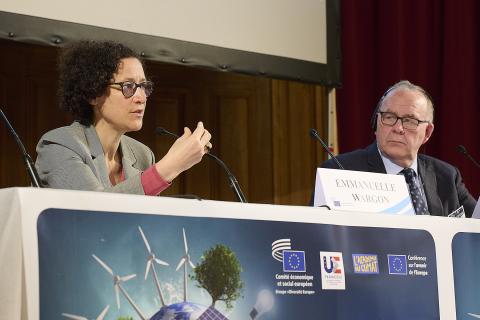
At a conference in Paris, civil society organisations from across Europe have called for just, fair and inclusive climate and energy transitions that involve citizens, civil society organisations and in particular young people.

Read more in all languages

By the EESC Diversity Europe Group

At a conference in Paris, civil society organisations from across Europe have called for just, fair and inclusive climate and energy transitions that involve citizens, civil society organisations and in particular young people.

They consider dialogue, cooperation and coordination at all levels a prerequisite for success, alongside major investment in preparing emergency plans and in adapting to the changing climate and the energy transition. Sustainable financial resources, backed up by strong commitments from public authorities, business, civil society and citizens, should be increased, as should renewable, affordable and home-grown energy and efficient consumption.

The EESC's Diversity Europe Group hosted the hybrid conference on 'Climate Change and Energy Transition' on 2 March at the Académie du Climat. The event addressed the multi-faceted and inter-related aspects of the topic, including the social and geo-political dimensions, the role of advertising and citizens' attitudes, as well as local, national and European actions.  

Séamus Boland, president of the Diversity Europe Group, opened the conference by emphasising the urgency of efficient and immediate action on climate change and the energy transition, not least in the light of the United Nation's IPCC report on climate change, which was presented on the conference sidelines. "Climate change and energy transition is a topic which is urgent and that concerns us all. Like peace, it is about our common future. It is about values and our humanity. And for that reason, we need to address it, even in these turbulent times," he said.

Mr Boland stressed the pivotal role of civil society in driving and maintaining the momentum on climate mitigation and adaptation among communities and citizens. He highlighted that …

Further reading: the full press release on the Diversity Europe Group's conference is available at: Civil society organisations from the EU27 call for immediate climate action led under their auspices | European Economic and Social Committee (europa.eu)

For the presentations of all guest speakers and photos, see: Climate Change and Energy Transition | European Economic and Social Committee (europa.eu) (jk)

Soon in the EESC/Cultural events

The EESC's cultural events

The Circular Economy Stakeholder Conference (ECESP) 2022 and International Women's day were celebrated through different cultural expressions.

Read more in all languages

The Circular Economy Stakeholder Conference (ECESP) 2022 and International Women's day were celebrated through different cultural expressions.

An extraordinary music performance was held on 2 March by the international percussion trio TrashBeatz, a band that makes music with trash. Their slogan "reduce-reuse-recycle your trash" perfectly matched the topic of this year's Circular Economy Stakeholder Conference. If you missed the show, you can still watch it online.

The EESC hosted an artistic performance entitled "…because I'm a woman?" by the talented young Polish artist Patrycja Alenkuć. The video featured a dance performance complemented by storytelling. The concept was focused on highlighting how resilient women are despite not being given enough support regardless of their age, class, the country they live in, their profession or other factors. "…because I'm a woman?" was one of the highlights of the EESC's Conference on Women in the Labour Market, with the video bringing the day's events to an artistic conclusion. (ck)

Your Europe, Your Say 2022!

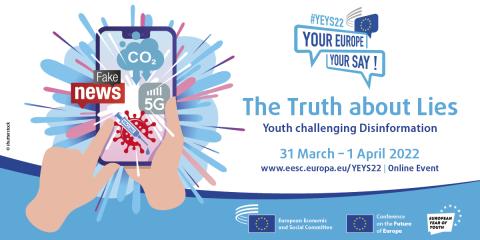
The Your Europe, Your Say 2022! youth event will take place fully online on 31 March and 1 April 2022. "The Truth about Lies. Youth Challenging Disinformation" is the subject that the school pupils will debate on.

Read more in all languages

The Your Europe, Your Say 2022! youth event will take place fully remotely on 31 March and 1 April 2022. "The Truth about Lies. Youth Challenging Disinformation" is the subject that the school pupils will debate on.

Visits by EESC members to the selected national schools will still be taking place until 25 March. Meanwhile, pupils are feeling the excitement of getting on board on 31 March and 1 April. Executive Vice-President Commissioner Jourova will address the 99 pupils during the closing youth plenary to welcome the youth assembly's recommendations and respond to policy demands. Don't forget to follow the YEYS social media accounts to get more feedback by clicking on this link: https://www.facebook.com/youreuropeyoursay.

The programme is available online. (ck)

Editors

Ewa Haczyk-Plumley (editor-in-chief)
Daniela Marangoni (dm)
 

Contributors to this issue

Amalia Tsoumani (at)
Chrysanthi Kokkini (ck)
Daniela Marangoni (dm)
Daniela Vincenti (dv)
Ewa Haczyk-Plumley (ehp)
Giorgia Battiato (gb)
Jasmin Kloetzing (jk)
Katerina Serifi (ks)
Laura Lui (ll)
Marco Pezzani (mp)
Thomas Kersten (tk)


Coordination

Agata Berdys (ab)
Katerina Serifi (ks)

Technical support
Bernhard Knoblach (bk)
 

Address

European Economic and Social Committee
Jacques Delors Building,
99 Rue Belliard,
B-1040 Brussels, Belgium
Tel. (+32 2) 546.94.76
Email: eescinfo@eesc.europa.eu

EESC info is published nine times a year during EESC plenary sessions. EESC info is available in 24 languages
EESC info is not an official record of the EESC’s proceedings; for this, please refer to the Official Journal of the European Union or to the Committee’s other publications.
Reproduction permitted if EESC info is mentioned as the source and a link  is sent to the editor.
 

March 2022
04/2022

Follow us

  • Facebook
  • Twitter
  • LinkedIn
  • Instagram