
European Economic
and Social Committee
Gender inequality continues to cast a shadow over the media
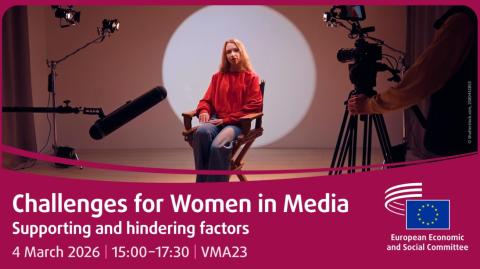
Gender stereotypes continue to be perpetuated and amplified by contemporary media, particularly in the digital sphere. At a conference organised by the European Economic and Social Committee (EESC), speakers called for stronger use of EU legal instruments to address the repression of female journalists, both online and offline.
The conference “Challenges for Women in Media – supporting and hindering factors”, held on 4 March by the EESC Equality Group to mark International Women’s Day, focused on the structural obstacles faced by women in media, the threats targeting women journalists and conflict reporters, and the persistence of female stereotypes and online violence.
Women in media continue to face structural barriers, targeted harassment, and persistent stereotypes, challenges that affect not only individuals, but the quality and integrity of our public discourse. Gender equality in media is not only a matter of fairness: it is a matter of democracy, safety, and societal integrity
, stressed Christa Schweng, President of the EESC Equality Group, in her opening speech.
Threats facing women journalists
One of the speakers, Hanna Liubakova, a Belarusian independent journalist and media analyst living in exile since 2020, highlighted the specific threats faced by detained or imprisoned women, including journalists. These include difficulties in maintaining contact with their families and children, as well as restricted access to hygiene products.
When the authorities put me on the terrorist watch list, some people from Belarus started to ask me what I had done. It's painful to see how the regime influences people's minds,
Ms Liubakova said. She underscored the transnational nature of this repression, which makes it difficult for journalists to travel safely without risking arrest in countries cooperating with the Belarusian regime.
Conference participants also emphasised the ongoing lack of visibility for female journalists. Although women account for more than 40% of the global journalism workforce, they hold only about a quarter of senior editorial positions. This reduces their influence over key editorial decisions, such as shaping narratives, selecting topics, and steering recruitment processes.
Speakers therefore called for celebrating women and men who work to increase women’s visibility, paving the way for future generations to achieve full equality and overcome stereotypes that hold back women journalists.
We cannot accept a system where some are pushed out so that others remain comfortable. Not in the name of tradition. Not in the name of politics. Not in the name of fear. When we witness harassment, online or offline, we must choose: silence or solidarity. Silence usually protects the wrong side. So let us stand close to women on the front line. Let us make women visible,
urged Isabelle Le Galo Flores, Secretary-General of the EESC.
Online challenges
Digital media present particularly severe challenges for women, including female journalists. Contrary to initial expectations that online platforms might level the playing field, the digital environment has instead become a significant source of inequality and gender‑based harassment.
While social media platforms create the opportunity for women users to take control over how they are represented, they have also become avenues of online harassment, threats and exploitation, so called technology-facilitated gender-based violence. Artificial intelligence further aggravates this situation. It is clearer than ever that regulation is needed, so that women's safety and agency in offline and online media can be ensured,
said Marija Hanževački, EESC Vice-President for Communication.
Participants stressed the need for the EU to make more effective use of existing legal instruments, including the European Media Freedom Act, the Digital Services Act, and the Directive on combating violence against women and domestic violence. The latter must be transposed into national law across the 27 Member States by the end of next year, and civil society organisations, including the EESC, must ensure that its provisions are not weakened.
Furthermore, EU countries should facilitate the resolution of legal issues—including visas—for journalists working in exile within the EU, regardless of gender, thereby enabling them to continue carrying out their professional duties.
Vice-President Hanževački appealed to civil society organisations and institutions to remember, show solidarity and support those women who, in pursuing their profession as journalists or fighting for the truth, often pay with their lives.
I strongly believe that journalism is the foundation of democracy and in this context, I would like us to remember the female journalists who are fighting for the right to speak the truth, and those who lost their lives doing so.
- Let us remember Daphne Caruana Galizia, Anna Politkovskaya, the Ukrainian journalists who were killed because of their brave work.
- Let us remember the heroic Iranian women fighting against the radical regime, especially now during the critical political situation in Iran.
- Let us not forget Mahsa Amini, a 22-year-old Iranian woman who died in police custody in 2022 after being arrested for allegedly violating rules requiring women to wear the headscarf.
- Some of these women have been honoured with awards such as Mzia Amaglobeli, a Georgian independent journalist, currently imprisoned, who was awarded with the Sakharov Prize in 2025 for her commitment to truth, democracy, and human rights.
- Finally, let us remember the women who are still fighting against authoritarian systems who have been forced to emigrate and leave their countries. Many of them continue their struggle from abroad because they face the threat of imprisonment in their home country, such as our guest, Hanna Liubakova, an independent Belarusian journalist in exile.
- It is our duty in European institutions and civil society organisations to remember these women and to not allow their names to be forgotten.