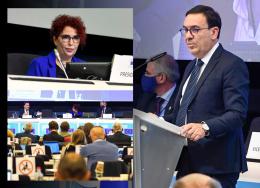
The 1st European Civil Society Forum on Trade and Sustainable Development organised by the European Economic and Social Committee (EESC) took place as a hybrid meeting on 29 March 2022.
This report and its recommendations reflect the discussions and different speakers’ view.
This handbook aims to present the EU Domestic Advisory Groups (DAGs) in their mission, their composition, the organisation of their work and their relations with stakeholders. It provides the necessary information for any new DAG member and for third countries' partners who request information on DAGs. It also compiles a list of horizontal issues to facilitate coordination across DAGs.
In a plenary debate on the future of EU trade policy in a changing global reality, the EESC stressed that open, fair, inclusive and sustainable trade is the only trade that will deliver a resilient recovery and bring prosperity to business and people. It also acknowledged the key role of the World Trade Organisation towards this effort.
The new trade strategy launched by the Commission in February brings engaging principles to the table that will support the EU in achieving its domestic and external policy objectives. The European Economic and Social Committee (EESC) welcomes this trade strategy as a way of improving market access and levelling the playing field. Alongside this, the modernisation of the World Trade Organization (WTO) will be the key to delivering for future generations.
This report provides a study of the retail sector, which is one of the biggest in Europe in terms of the number of enterprises active and individuals employed. The study aims to provide practical insights on revitalising small retailers in urban and rural areas. The underlying objective is achieved through identifying the main trends, challenges and opportunities faced by small retailers, and outlining what types of good practices have been put into place to support these enterprises in city-centres, including highlights on the situation of small retailers located in rural areas.
As the name of the study implies, the focus is on export activities at the Member State level. The study describes the way export promotion is organised in Denmark, Germany and Spain at the strategic and operational levels. It also contains information regarding effectiveness of export promotion in the respective Member States and looks upon European cooperation.
On 8 February 2005, the European Economic and Social Committee, after a request received on February 2005 from the next UK's Presidency of the EU approved to draw an exploratory opinion on Ethical Trade and Consumer Assurance Schemes.
Download — Ethical Trade and Consumer Assurance Schemes