
European Economic
and Social Committee
Rethinking EU Competitiveness: Employers' Group debate with SGI Europe and Copa-Cogeca
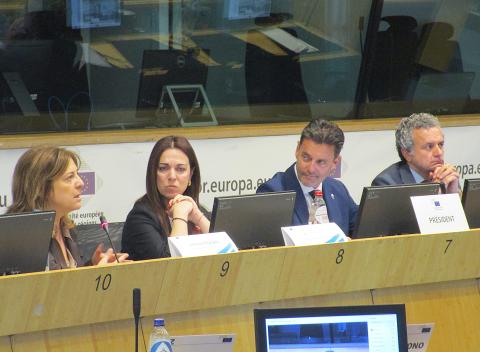
On 29 April 2025, Employers' Group members discussed EU priorities and addressed the future of EU competitiveness with two partner organisations: SGI Europe and Copa-Cogeca, putting a special focus on the agri-food sector and the broader economic ecosystem.
Valeria Ronzitti, Secretary General of SGI Europe, and Copa-Cogeca’s Secretary General, Elli Tsiforou, highlighted both the challenges and opportunities the European Union is facing as it seeks to balance strategic autonomy, sustainability, and economic resilience.
Strategic Autonomy: From Rhetoric to Action
A recurring theme was the EU’s struggle to translate the concept of strategic autonomy into tangible competitiveness. Too often, strategic autonomy is invoked only in times of crisis, rather than being integrated as a core ingredient of EU competitiveness.
Participants urged the EU to develop a distinct model of competitiveness that leverages its unique strengths, such as robust welfare systems and a commitment to dialogue and consultation. Indeed, the EU’s welfare model, often seen as a cost, should instead be recognised as a competitive advantage that attracts investment and supports long-term growth.
Valeria Ronzitti underlined the need to see things in an ecosystem and create an EU model for competitiveness.
Infrastructure and Ecosystem Thinking
The business community emphasised the need for resilient water systems, efficient logistics, and advanced digital infrastructure. Recent crises in Spain and Portugal, where infrastructure failures forced hospitals to operate at minimum capacity, underscored the critical importance of these systems. The call to action is clear: invest in and simplify the regulatory environment for infrastructure, while also fostering capacity-building to maintain Europe’s competitive edge.
The Circular Single Market: Bridging Supply and Demand
While the EU has made strides in creating supply for circular products, demand remains weak due to high costs. Stakeholders argued for ecosystem-based approaches that combine regulatory simplification with targeted investment, aiming to make circular products more accessible and affordable.
"We must reprofile the economic pillar of sustainability," said Copa-Cogeca's Elli Tsiforou, adding that competitiveness goes beyond economic aspects: food security is part of defence. Instability and geopolitical uncertainty and climate pressure have to be embedded in our Competitiveness strategy.
Agriculture at a Crossroads: Sustainability, Innovation, and Fairness
Copa-Cogeca’s Secretary General reflected on the agricultural sector’s recent challenges. The previous policy mandate prioritised environmental concerns, sometimes at the expense of economic and social sustainability. Tsiforou stressed that farmers were not resisting the green transition, but rather the way it was implemented—often without adequate consultation.
A key point was the need to re-balance the three pillars of sustainability: environmental, economic, and social. Food security, innovation, and generational renewal emerged as priorities. The Common Agricultural Policy (CAP) remains a cornerstone, but there is concern over proposals to dissolve it into a broader Single Fund, which could undermine support for farmers and threaten the integrity of the single market.
Trade remains vital for EU agriculture, but participants warned of rising pressures from new trade agreements and global competitors. There was consensus on the need to uphold EU standards and ensure that trade agreements are reciprocal and fair. The imbalance in the food chain—where retailers wield disproportionate power over farmers—was also flagged as a critical issue requiring regulatory intervention.
Innovation, particularly digitalisation, is seen as essential for the sector’s future. However, scaling up access so that every farmer benefits from it remains a challenge.
SGI Europe and Copa-Cogeca underscored the urgency of forging a unified, innovative, and fair approach to EU competitiveness. By investing in infrastructure, rebalancing sustainability, and defending the EU’s unique economic model, Europe can position itself as a global leader—resilient in the face of crisis and committed to the prosperity of its citizens.
Recommended for you
La creazione condivisa di servizi pubblici nel settore sanitario contribuirà a una democrazia più partecipativa nell'UE
News
L'evento organizzato dal Comitato economico e sociale europeo (CESE) in collaborazione con l'Università di Debrecen ha posto in evidenza l'importanza cruciale della creazione condivisa di servizi di…
Per combattere i cambiamenti climatici, l'UE ha bisogno di maggiori investimenti pubblici nelle infrastrutture energetiche
News
In un parere adottato nella sessione plenaria di settembre, il Comitato economico e sociale europeo (CESE) avverte che, per realizzare gli obiettivi climatici e di transizione energetica, sono…
Energia - Il CESE mette in guardia di fronte al rischio di nuove dipendenze
News
Il Comitato economico e sociale europeo (CESE) assume una posizione ferma in materia di energia in un parere adottato nella sessione plenaria di settembre. La proposta della Commissione, infatti, è…
La transizione digitale deve essere equa: i diritti umani e il controllo umano devono rimanere pilastri fondamentali
News
Il Comitato economico e sociale europeo (CESE) sottolinea le opportunità offerte dalla rivoluzione digitale, ma mette anche in guardia dai rischi: se attuate troppo rapidamente, le soluzioni digitali…
L'UE ha bisogno di un piano d'azione per fornire alloggi dignitosi e a prezzi accessibili
News
Il convegno ad alto livello organizzato a Riga dal Comitato economico e sociale europeo (CESE) ha lanciato l'allarme per la crisi degli alloggi a prezzi accessibili, sottolineando che è il momento…