European Economic
and Social Committee
European Economic
and Social Committee
The European Economic and Social Committee (EESC) is the voice of organised civil society in Europe.
Find out more about its role and structure at http://www.eesc.europa.eu/en/about
The EESC issues between 160 and 190 opinions, evaluation and information reports a year.
It also organises several annual initiatives and events with a focus on civil society and citizens’ participation such as the Civil Society Prize, the Civil Society Days, the Your Europe, Your Say youth plenary and the ECI Day.
Find the latest EESC opinions and publications at http://www.eesc.europa.eu/en/our-work/opinions-information-reports/opinions and http://www.eesc.europa.eu/en/our-work/publications-other-work/publications respectively.
The EESC is active in a wide range of areas, from social affairs to economy, energy and sustainability.
Learn more about our policy areas and policy highlights at http://www.eesc.europa.eu/en/policies
The EESC holds nine plenary sessions per year. It also organises many conferences, public hearings and high-level debates related to its work.
Find out more about our upcoming events at http://www.eesc.europa.eu/en/agenda/our-events/upcoming-events
Here you can find news and information about the EESC'swork, including its social media accounts, the EESC Info newsletter, photo galleries and videos.
Read the latest EESC news http://www.eesc.europa.eu/en/news-media/news and press releases http://www.eesc.europa.eu/en/news-media/press-releases
The EESC brings together representatives from all areas of organised civil society, who give their independent advice on EU policies and legislation. The EESC's326 Members are organised into three groups: Employers, Workers and Various Interests.
Find out more about our Members and groups at http://www.eesc.europa.eu/en/members-groups
The EESC has six sections, specialising in concrete topics of relevance to the citizens of the European Union, ranging from social to economic affairs, energy, environment, external relations or the internal market.
Find out more at http://www.eesc.europa.eu/en/sections-other-bodies
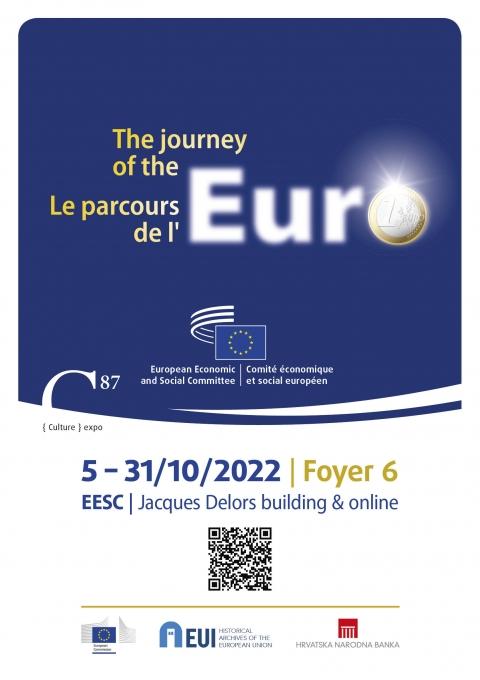
"Il viaggio dell'euro" consiste di una serie di immagini che tracciano la storia dell'euro, combinando materiale proveniente dagli archivi storici dell'Unione europea, informazioni fornite dalla Commissione europea e oggetti messi a disposizione dalla Banca nazionale croata.
Mentre è in corso il dibattito sull'eventuale introduzione dell'euro digitale, le celebrazioni per il ventesimo anniversario della moneta unica coincideranno con un aumento del numero di Stati membri che l'hanno adottata: la Croazia entrerà infatti a far parte della zona euro il 1° gennaio 2023.
Il percorso espositivo invita i visitatori a seguire il viaggio dell'euro dalla sua concezione iniziale all'effettiva introduzione di monete e banconote denominate in tale valuta, e li stimola a considerare e a comprendere meglio il significato particolare di una valuta comune, che costituisce al tempo stesso una figurazione della pace e l'esempio più tangibile dell'integrazione europea.
La mostra rimarrà allestita presso il CESE dal 5 al 31 ottobre 2022. (ck)