The EU-Türkiye Civil Society Joint Consultative Committee established in 1995 is composed of members from the EESC and members representing organised civil society in Türkiye. Its objective is to contribute to the dialogue among civil society organisations in Türkiye and the EU and to issue reports and recommendations to the Turkish authorities and the EU institutions.
9 October 2024, 11:30 - 13:00 - Rue Belliard, 99 - Meeting room: JDE 63
Brussels
Belgium
Convergence and competitiveness are key for the next EC mandate. Convergence via cohesion policy is developing constantly. Europe must become highly competitive compared to its counterparts and cohesion policy can help towards this direction. Civil society can be a catalyst in these twin challenges. Chambers, SMEs, businesses, universities, unions and NGOs need to make the transition and become more competitive, effective and productive. They will help the European economy and help eliminate economic and social disparities.
Competitiveness is a key priority of both the Hungarian Presidency and the new von der Leyen Commission for the next political cycle. The issue will be addressed with our members and members' organisations at the extraordinary Group meeting on 8 October in Budapest. The debate will focus on the agri-food and industrial sectors.
On Friday 4 October 2024, the EESC´s Ad hoc Group on the European Citizens’ Initiative (AHG ECI) organised a debate on "The European Citizens’ Initiative – State of play in Croatia" in Zagreb. The objective of the debate was for the ad hoc group members to listen to and talk with local stakeholders about their experience, views and ideas, especially on the visibility and awareness of the European Citizens´ Initiative (ECI) in Croatia, and on lessons learned and good practices identified so far.
This year, the European Economic and Social Committee and the European Committee of the Regions will be jointly hosting the kick-off event of the European Cybersecurity Month.
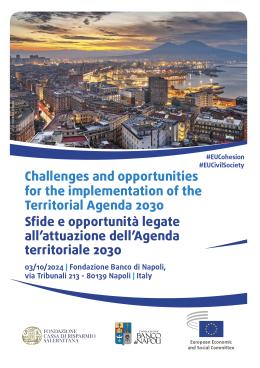
The Territorial Agenda (TA) 2030 is an inter-governmental declaration with no direct legal, financial or institutional implementation instrument. The application of the Territorial Agenda 2030 relies on informal multilevel cooperation between Member States, sub-national authorities, the European Commission, the European Parliament, the European Committee of the Regions, the European Economic and Social Committee, the European Investment Bank and other relevant players.
The TA 2030 envisages a stocktaking in 2024 including a review of the governance system and implementation progress. This review has slowly started during the Spanish EU Presidency in 2023 and continues with the Belgian Presidency. As the focus is expected to be on governance and implementation, civil society organisations and the EESC have to play a more active role in the governance of the TA 2030 and contribute to the priorities that have been set.
Section debate on A step forward in meaningful youth participation organised by the EESC during the NAT Section meeting on 2 October 2024 (14:30 - 16:00 CEST).
Three organisations are awarded the 15th EESC Civil Society Prize
Location
Brussels
Belgium
The EESC is pleased to announce the three winners of the 15th edition of the Civil Society Prize, which rewards effective, innovative and creative initiatives carried out on the territory of the EU to combat harmful polarisation of European society.