May I send my best wishes to the French government, which will assume the Presidency of the Council of the EU today, on January 1st 2022. The challenges facing citizens in the Union are well documented and require ...
Conférence dans le cadre de la présidence chypriote du Conseil de l'UE
Event type
Conference
Location
Centre d’aide et d’activités sociales de la municipalité de Larnaca, Faneromenis 62
Larnaca
Cyprus
Les inscriptions pour participer en présentiel seront closes le jeudi 16 avril 2026 à midi. La diffusion en direct sera disponible sur cette page le jour de l'événement. Aucune inscription préalable n'est requise pour accéder à la diffusion en direct.
Audition publique dans le cadre de l'avis ECO/689 – La dimension insulaire dans les politiques européennes en faveur de la cohésion, de la compétitivité et du développement durable.
Lessons learned and a new Inflation Governance Framework
Event type
Conference
Location
room VMA 22, Van Maerlant 2
Brussels
Belgium
On Wednesday, 3 September 2025, from 14:00 – 17:30 (CET), the European Economic and Social Committee (EESC) will host an event organised by the Foundation for European Progressive Studies, in cooperation with Fondazione Pietro Nenni and tasc, discussing lessons learned from the recent inflation episode and the new inflation governance framework that needs to be developed to prevent or mitigate the supply side inflation shocks in the future.
Dans un contexte comme celui que traverse l'Europe, marqué par de multiples crises, il est opportun de promouvoir une réflexion sur les biens publics européens et sur les priorités politiques fondamentales capables d'assurer la croissance durable de l'UE et le bien-être de ses citoyens. Cette réflexion prend d'autant plus d'importance dans la perspective des négociations à venir sur le prochain cadre financier pluriannuel européen pour la période post-2027.
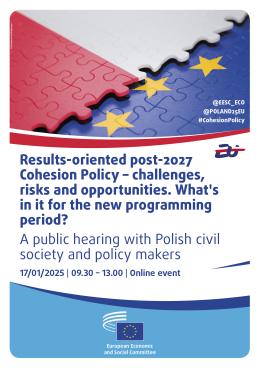
Public hearing with Polish civil society and policy makers
Event type
Public hearing
Location
Online event
ul. Wspólna 2/4
00-926 Warszawa
Warsaw
Poland
In the context of the ongoing exploratory opinion, requested by the Polish Presidency, to examine how civil society actors can make use of a results-orientation approach in cohesion policy in the next programming period, the EESC is organizing a hearing in Warsaw on 17 January 2025. The hearing will be important as the EESC will explore how civil society and local actors understand the concept of a results-orientation approach to cohesion policy, to which degree they are prepared and if they have the administrative capacity to implement it.
The hearing is co-organized with the Polish Presidency of the Council of the EU and it has the patronage of the Polish Presidency. The venue is the premises of the Ministry of Development Funds and Regional Policy of Poland.
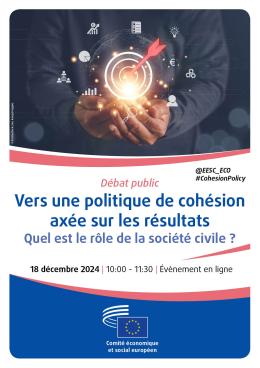
Le CESE organise ce débat public afin de discuter de la manière dont les partenaires de la société civile peuvent utiliser une approche axée sur les résultats dans la politique de cohésion pour la prochaine période de programmation. Les principes de la gouvernance à plusieurs niveaux et de la gestion partagée sont-ils contradictoires ou complémentaires à la politique de cohésion axée sur les résultats ?