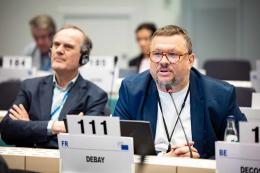
The EU’s next long-term budget cannot be reduced to a battle over numbers. At a high-level EESC debate with MEP Siegfried Mureșan, the European Commission, Germany’s Federal Foreign Office and leading researchers, one message was clear: if the EU wants to do more on security, competitiveness and climate resilience, it needs to equip itself with a stronger budget, and to do so without weakening cohesion and agriculture. Just as importantly, spending must work better, with the regions, the social partners and civil society involved from design to delivery.
On 15 September, the European Economic and Social Committee (EESC) will bring together civil society organisations, EU institutions and other stakeholders to help shape an ambitious, resilient and inclusive European contribution to the UN Water Conference, taking place on 8 – 10 December 2026.
In an opinion adopted at its July plenary, the European Economic and Social Committee (EESC) emphasises that drone technologies are evolving quickly and that future EU action should prioritise its ability to detect, prevent and respond to malicious activities in the European airspace. At the same time, Europe must develop its competitiveness and strategic resilience in this field while investing in people and skills.
Gender equality is not only a fundamental EU value, but also a driver of economic growth, competitiveness and democratic resilience, the European Economic and Social Committee (EESC) says in its opinion on the Gender Equality Strategy 2026-2030, adopted during its July plenary session.
Alors que le système énergétique européen est confronté à une profonde transformation géopolitique, économique et sociale, le Comité économique et social européen (CESE) fait valoir, dans un avis récemment adopté, que l’UE a désormais besoin d’un plan clair et commun pour le stockage de l’énergie. Ce sera un élément indispensable pour garantir l’indépendance énergétique et la sécurité de l’approvisionnement.
Europe's migration policy must be built on rights, integration and legal pathways, not just border controls and returns, the European Economic and Social Committee (EESC) says in its opinion on the European Migration and Asylum Strategy, adopted during its July plenary session.
As wildfires become more frequent and destructive across Europe, the European Economic and Social Committee (EESC) is calling for prevention to become the cornerstone of EU wildfire policy.
Committee welcomes Commission's strategy but calls for stronger funding, mandatory labelling and strengthening competitiveness for Europe's livestock farmers.
The European Economic and Social Committee (EESC) has broadly welcomed the European Commission's new Vision for Agriculture and Food and its forthcoming livestock strategy, but says Brussels must go significantly further if it wants Europe's livestock sector to remain competitive, sustainable and resilient. While supporting the Commission's overall direction, the Committee argues that the current proposals leave important gaps on financing, trade, labelling and support for farmers.
Le CESE continue de préconiser que soit mis un terme à la crise du logement en Europe. Dans un nouvel avis, il fait valoir que, pour proposer des logements plus abordables, l’UE a besoin d’un certain nombre de mesures urgentes, parmi lesquelles: une meilleure stratégie pour l’utilisation des sols et les zones rurales, des investissements et des financements publics plus massifs liés à des critères sociaux clairs, des procédures de planification et d’autorisation plus rapides grâce à la numérisation, une main-d’œuvre et des compétences adéquates ou encore des méthodes de construction modernes.
The fight against racism in Europe must move beyond good intentions and become a genuine political priority, the European Economic and Social Committee says in its recently adopted opinion on the EU Anti-Racism Strategy 2026-2030.