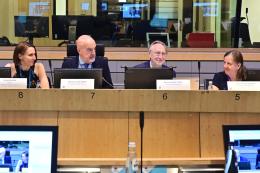
As global trade governance becomes more fragmented and politicised, members from all 15 EU Domestic Advisory Groups met in Brussels to discuss how organised civil society can strengthen its contribution to the implementation of EU trade agreements and ensure that sustainability commitments are effectively monitored and followed up.
Europe will need significantly more investment if it wants to secure the critical raw materials required for its green, digital and defence transitions, the European Economic and Social Committee (EESC) warned in an opinion adopted at its June plenary session.
On 30 June, the European Economic and Social Committee initiative 'Empowering youth voices through the EESC Youth Test' joined three other finalists in the 'Excellence in diversity and inclusion' category at the ceremony for the Ombudsman Award for Good Administration. Amidst the shortlisted projects, the winning recognition was awarded to the DiscoverEU Inclusion Action, a European Commission initiative dedicated to opening Europe to young people with fewer opportunities.
Le Comité économique et social européen (CESE) soutient la proposition de règlement sur les réseaux numériques de la Commission européenne et juge nécessaire de supprimer les obstacles au marché unique et de garantir un ensemble de règles uniformes. Une gouvernance efficace s’avère fondamentale à cet effet, et doit reposer sur une répartition claire des compétences entre l’Union européenne et les autorités nationales, qui évite les chevauchements et les doubles emplois institutionnels.
During its June plenary session, the European Economic and Social Committee (EESC) adopted an opinion evaluating the implementation of the EU Whistleblower Protection Directive, warning that significant gaps remain between legal protections and their practical application. The Committee calls for stronger safeguards against retaliation, better support for whistleblowers, greater involvement of civil society and a cultural shift that sees whistleblowing as a contribution to democracy, transparency and the public interest.
The European Economic and Social Committee (EESC) has adopted an information report and a resolution calling for a stronger role for social partners and civil society organisations in shaping national reforms and investments. The EESC calls for the creation of a European code for structured consultations and mandatory assessments of partnership practices to improve transparency, effectiveness and democratic legitimacy.
Le Comité économique et social européen (CESE) a adopté un avis où il fait valoir que l’application du nouveau Bauhaus européen peut contribuer à lutter contre la crise du logement. Cela suppose de passer de projets pilotes inspirants à une mise en œuvre qui soit à la fois systémique, modulable et territorialisée.
On World Refugee Day (20 June), the European Economic and Social Committee (EESC) reaffirms its long-standing commitment to a fair, humane and comprehensive European approach to migration, asylum and refugees: one that upholds fundamental rights while recognising the social and economic contributions of people on the move.
Lors d’une conférence organisée à Bruxelles par le Comité économique et social européen et le gouvernement basque, il a été mis en évidence l’importance politique et sociale que revêtent les services d’intérêt général pour faire de la solidarité intergénérationnelle une réalité en Europe et pour construire une société plus inclusive.