The European Economic and Social Committee (EESC) announces that applications for the fourth edition of the EU Organic Awards open today, 11 February 2025. The application period runs until 27 April 2025, and interested parties can access the clear and friendly user application form on the EESC's official website starting today.
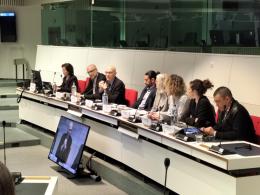
On Tuesday 28 January, the European Economic and Social Committee (EESC) and the UN Human Rights Regional Office for Europe, in partnership with the Human Rights and Democracy Network (HRDN), hosted an interactive dialogue between civil society representatives and the UN High Commissioner for Human Rights, Volker TÜRK. The discussions highlighted concerns over shrinking civic space, disinformation, threats to democracy, the need for stronger protections for human rights defenders, migration policies, international justice and corporate accountability.
A new report on Europe’s progress toward the Sustainable Development Goals (SDGs) highlights a significant slowdown, raising concerns about the EU’s ability to meet the 2030 targets. The Europe Sustainable Development Report 2025 (ESDR), published by the UN Sustainable Development Solutions Network (SDSN), finds that the pace of SDG progress between 2020 and 2023 was more than twice as slow as in the previous period.
Les intérêts légitimes de l’Union dans l’Arctique européen seront mieux défendus ensemble au moyen d’une stratégie arctique de l’UE qui renforce la participation de la société civile à toutes les décisions pertinentes. Une coopération étroite avec le Groenland est également cruciale pour investir de manière durable dans l’Arctique afin de garantir la prospérité et la résilience de la région.
The EU needs a sharper focus on competition policy to strengthen its global competitiveness, boost productivity and ensure the single market remains a pillar of economic strength, according to the EESC.
Le Comité économique et social européen (CESE) préconise de modifier les règles de l’Union européenne en matière d’aides d’État afin de reconnaître les besoins des entités de l’économie sociale, qui contribuent de manière fondamentale à relever les défis de société, et de pouvoir y répondre plus efficacement.
The euro area is facing pressing challenges: low labour productivity, weakening competitiveness, and slowing economic momentum compared to global peers like the United States. To reverse this trend, the European Economic and Social Committee (EESC) is calling for an urgent and coordinated strategy. In a new opinion, the Committee outlines a plan to drive growth by deepening the internal market, cutting regulatory red tape, and ensuring fiscal sustainability. At the same time, policies must address transformative trends like artificial intelligence (AI) and the pressures of an ageing population.
In January's plenary session of the European Economic and Social Committee (EESC), leading voices from policymaking, academia, and civil society convened to discuss the urgent need for a fair and inclusive approach to climate and biodiversity action. As the EU accelerates its push toward climate neutrality, the EESC has issued a clarion call for a coordinated and inclusive transition.
Le Comité économique et social européen (CESE) traite de l’avenir du marché de l’électricité et plaide dans l’avis qu’il a adopté à cet égard au mois de janvier en faveur d’un modèle mixte qui allie des mesures des pouvoirs publics et des mécanismes de marché, faisant prévaloir une régulation gouvernementale lorsqu’elle est nécessaire et l’entrepreneuriat privé lorsqu’il est possible.