
European Economic
and Social Committee
In an opinion adopted in its May plenary, the EESC supports the European Commission's communication on sustainable carbon cycles and says it believes that the Common Agricultural Policy (CAP) must provide the strategic framework paving the way for a low-carbon transition in agriculture.
Responding to the urgency for climate action, the European Union has set into law its objective of economy-wide Climate Neutrality by 2050. To achieve this ambitious objective, sustainable and climate-resilient carbon cycles must be established through key actions such as recycling carbon from waste streams, from sustainable sources of biomass or directly from the atmosphere and upscaling carbon removal solutions that capture carbon dioxide (CO2) from the atmosphere and store it long term.
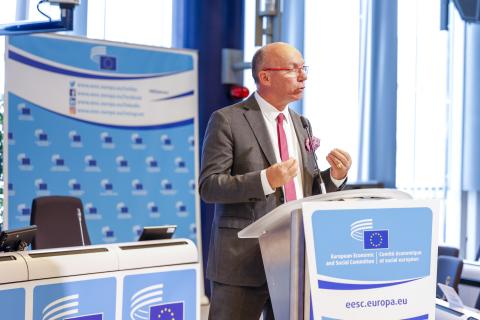
''Finding a solution to carbon neutrality requires a reduction in greenhouse gas emissions, finding green alternatives to fossil carbon and increasing carbon sinks,'' said opinion rapporteur, Arnold Puech d'Alissac. He added that the EESC supports the European Commission's communication on carbon cycles, which proposes two solutions for removing and sequestering carbon: nature-based solutions (known as "carbon sequestration") and industrial technological solutions.
The EESC therefore encourages the European Commission to take a holistic approach to the topic: increasing carbon sinks and replacing fossil carbon as much as possible will require more biomass to be produced, which will affect the land sector. The land sector can be actively involved in combating global warming while contributing to the broader transition towards a sustainable food system.
Carbon sequestration should be seen not only as a commercial opportunity, but also as a key component of European agriculture in the future and as a tool for climate action: carbon credits must remunerate a service rendered, namely that of atmospheric carbon sequestration, but must also support the agricultural sector's carbon transition.
The Committee also highlights the critical role that the CAP must play in providing the policy framework that paves the way for the low-carbon transition in agriculture, whereby the sector will emit less and sequester more. However, it also stresses that carbon storage should not be a condition of the CAP and that a specific market must be created and supported. The EESC considers that the development of carbon sequestration will require a clear legal framework that is shared by the Member States, taking into account the differences in the level of investment and support that the Member States can provide. (ks)