Newsletter Info

EESC info

European Economic and Social Committee A bridge between Europe and organised civil society

JANUARY 2021 | EN

GENERATE NEWSLETTER PDF

Available Languages:

  • BG
  • CS
  • DA
  • DE
  • EL
  • EN
  • ES
  • ET
  • FI
  • FR
  • GA
  • HR
  • HU
  • IT
  • LT
  • LV
  • MT
  • NL
  • PL
  • PT
  • RO
  • SK
  • SL
  • SV
Editorial

May this year bring more predictability, peace and joy

May this year bring more predictability, peace and joy

Dear readers,

We entered 2021 still gripped by COVID-19, lockdown and havoc in the jobs market but with hope for a better future thanks to the vaccine. This year will be about securing doses for everyone and convincing people to get a jab. As this progresses, the focus will be more and more on recovery and shaping a post-COVID-19 Europe.

Portugal, which took over the Presidency of the Council of the EU on 1 January, is clearly taking this broader, forward-looking approach. Lisbon's priorities concentrate on fighting the economic crisis and counteracting its impact on citizens through a fair, green and digital recovery.

Read more in all languages

May this year bring more predictability, peace and joy

Dear readers,

We entered 2021 still gripped by COVID-19, lockdown and havoc in the jobs market but with hope for a better future thanks to the vaccine. This year will be about securing doses for everyone and convincing people to get a jab. As this progresses, the focus will be more and more on recovery and shaping a post-COVID-19 Europe.

Portugal, which took over the Presidency of the Council of the EU on 1 January, is clearly taking this broader, forward-looking approach. Lisbon's priorities concentrate on fighting the economic crisis and counteracting its impact on citizens through a fair, green and digital recovery.

The EESC welcomes these priorities and will contribute to turning words into action through exploratory opinions requested by the Portuguese Presidency. We will address the topic of teleworking, including from the perspective of gender equality. Our members will also work on opinions on vocational training and on challenges ahead of the Single European Railway Area.

The role of the social economy in creating jobs and in implementing the European Pillar of Social Rights (EPSR) is the topic of another requested opinion. Staying in the field of social affairs, I have high expectations for the informal EU Social Summit scheduled to take place in Porto in May 2021. The EESC is willing to continue its involvement in implementing the EPSR.

Certainly, we will keep up working on the digital and green transitions – two major megatrends that are crucial for shaping the future of the EU. As I underlined in my presidency priorities, we need to ensure that the EU in general and its citizens in particular reap the benefits of these transitions.

2021 is the first year of the new long-term EU budget and the time when the outstanding exceptional resources available under the Next Generation EU Recovery Fund will be released. The EESC wishes to monitor its implementation at the national level. Our members' grassroots expertise could help to identify bottlenecks in releasing the funds and assess the impact of these unprecedented resources on the recovery. Quick access to the funding remains extremely important.

Sadly, there is still no decision on the Conference of the Future of Europe. I hope that the inter-institutional debate on this matter comes to an end so we can start working on organised civil society's input to this discussion.

Last but not least, we will continue to rebuild our institution's image. As promised at the beginning of my presidency, we are working on strengthening ethical standards and transparency through an enhanced Code of Conduct.

I hope you all enjoy reading this newsletter and wish you all the best for 2021! May this year bring us more predictability, peace and joy.

Christa Schweng

EESC President

Diary Dates


24 - 25 February 2021, Brussels
EESC plenary session


18 - 19 March 2021, Brussels
Your Europe, Your Say! 2021

One question to...

One question to…

In our section "One question to…" we ask EESC members to respond to a topical question that seems to us to be particularly relevant.
 

Read more in all languages

In our section "One question to…" we ask EESC members to respond to a topical question that seems to us to be particularly relevant.

We have asked Dimitris Dimitriadis, president of the External Relations Section, to share with EESC Info readers his views on the US elections.
 

For a strong EU-US partnership

By Dimitris Dimitriadis, President of the External Relations Section

The New Transatlantic Agenda is currently at the heart of the political agenda for all European institutions. Our Committee, particularly the External Relations Section, is very much in alignment with it, as demonstrated by the recent meeting of our Transatlantic Relations Follow-up Committee, featuring very prominent guests who stressed the importance of robust and solid civil society dialogue, and by the EESC president's declaration and my statement on the 2020 US election expressing hope for a strong partnership in facing global challenges.

Read more in all languages

By Dimitris Dimitriadis, President of the External Relations Section

The New Transatlantic Agenda is currently at the heart of the political agenda for all European institutions. Our Committee, particularly the External Relations Section, is very much in alignment with it, as demonstrated by the recent meeting of our Transatlantic Relations Follow-up Committee, featuring very prominent guests who stressed the importance of robust and solid civil society dialogue, and by the EESC president's declaration and my statement on the 2020 US election expressing hope for a strong partnership in facing global challenges.

The European Union is and will always be a strong partner and ally of the United States, and we will be happy to engage once more in productive and fruitful dialogue on all the issues that were blocked during the previous administration.

I, therefore, support the areas identified for potential greater cooperation (working together for a healthier world – COVID-19 and beyond; working together to protect our planet and prosperity; working together on technology, trade and standards; and, last but not least, working together towards a safer, more prosperous and more democratic world) and believe that strong civil society dialogue and interpersonal relations have a crucial role to play in achieving those objectives. The abovementioned objectives of course include the principles of multilateralism and the international structures we have jointly helped to build.

Our Committee, as representatives of European civil society organisations, and particularly the president of our Transatlantic Relations Follow-up Committee, Mr Christian Moos, and myself in my capacity as External Relations Section president, remains committed and determined to strengthen bridges across the Atlantic.

Guess who is our guest..

Surprise guest

Each month we introduce you to our surprise guest. This will be a well-known European figure who has been in the news and who will give us their take on the world: a breath of fresh air to broaden our horizons, inspire us and allow us to update our knowledge.

Read more in all languages

Each month we introduce you to our surprise guest. This will be a well-known European figure who has been in the news and who will give us their take on the world: a breath of fresh air to broaden our horizons, inspire us and allow us to update our knowledge.

Our surprise guest is Professor Danuta Hübner, Member of the European Parliament. Her very rich professional career is dominated by international and European themes.

In Poland, Danuta Hübner was called Ms Europe because she was one of the most important people in Poland's accession to the European Union. In 2001-2004, she was Minister for European Affairs. In 2004, she became the first Polish member of the European Commission, responsible first for the portfolio of international trade and then for regional policy in Romano Prodi's and then José Manuel Barroso's Commission (2004-2009).

After winning a seat in the 2009 European Parliament (EP) elections, she became a member of the Group of the European People's Party, chairing the Committee on Regional Development. Re-elected to the EP in 2014-2019, she chaired the Committee on Constitutional Affairs.

Re-elected for the third time in 2019, she sits on the Committee on International Trade, the Committee on Economic and Monetary Affairs, and the Constitutional Affairs Committee where she is the EPP's coordinator. She has been member of the EP Brexit Steering Group and is currently chairing the Monitoring Group on the implementation of Withdrawal Agreement.
 

The surprise guest, Professor Danuta Hübner shares her opinion on Brexit with our readers

A consultative referendum in which the citizens of the United Kingdom were asked whether their country should leave the European Union took place on 23 June 2016. By a very small majority, the British people supported the idea of leaving the EU. The outcome differed across the country: in Scotland, Northern Ireland and also in London, the people’s will was not to leave. Nevertheless. the referendum was followed by the UK government’s commitment to get Brexit done. First, on 1 February 2020, the Withdrawal Agreement entered into force, allowing for an 11-month transition period. This provided legal certainty to all those affected by Brexit. Then, as of 1 January 2021,  when the agreement on the future relationship took effect,  the UK officially became a third country. 

Read more in all languages

A consultative referendum in which the citizens of the United Kingdom were asked whether their country should leave the European Union took place on 23 June 2016. By a very small majority, the British people supported the idea of leaving the EU. The outcome differed across the country: in Scotland, Northern Ireland and also in London, the people’s will was not to leave. Nevertheless. the referendum was followed by the UK government’s commitment to get Brexit done. First, on 1 February 2020, the Withdrawal Agreement entered into force, allowing for an 11-month transition period. This provided legal certainty to all those affected by Brexit. Then, as of 1 January 2021,  when the agreement on the future relationship took effect,  the UK officially became a third country. 

The EU-UK agreement on trade and cooperation is unprecedented on many accounts. Its most important feature is that it has significantly narrowed relations between the UK and the EU, which they had built jointly for more than 45 years. 

A major economy has voluntarily left a preferential trade area, the single borderless market of 450 million people and the world's biggest and most influential standard-setting and regulatory power. 

It has done so at a time when the world will quite clearly be shaped by three major global powers - the US, the EU and China, at a time when a global pandemic requires solidarity and cooperation. The withdrawal from the EU was driven by the political will to take back control and by a rather traditional understanding of the term "sovereignty".

Negotiating this agreement was a painful and difficult process, fraught with uncertainty, keeping us in the no-deal territory nearly till the last minute of the transition period. Still, the European Commission managed to keep negotiations alive long enough to reach the moment when agreement became feasible. Fortunately, the British government did not use the sovereignty argument as a pretext for a no-deal calamity. 

No-deal has never been an option for the EU. We were also aware  that even a wafer-thin agreement is better than a no-deal. In any case, with a deal or without it, there will be distortions and costs to be paid by the general public and the business community on both sides of the Channel. 

With the UK becoming a third country, even the most effective preparedness measures would not protect us fully against the consequences of Brexit. The good news is that all of the measures envisaged in the Withdrawal Agreement regarding the Irish border and citizens' rights have been implemented and become operational on time. 

What is worth mentioning is that the European Parliament demonstrated enormous flexibility regarding its democratic right to scrutinise the future agreement and agreed to proceed with its consent under the exceptional circumstances to the provisional application of the agreement. 

The Parliament has decided to pay this price because we believe that achieving agreement on the future partnership will allow us to keep the conversation over the channel open in the long term. And this is a price worth paying. 

Nobody knows what the outcome of a referendum might be if it were held today, when the British public at large is much better informed than back then in 2016, with regard to the consequences of no longer being citizens of the European Union and when the world around the UK has changed so dramatically. Is the ethos of Brexit still valid in the UK? We will never know. But I wish our British friends all the best. 

Real life will test everyone's preparedness for the new situation. It will test the agreement reached. It will test the value of British sovereignty. 

Both sides believe we have a good deal. But there will be costs related to the inevitable disruptions. Consumers and businesses will pay the costs of the UK no longer being part of the single market or the customs union. Students from the EU wishing to study in the UK will no longer have the status of home students. The British government was not interested in the UK participating in the Erasmus exchange programme. 

The free movement of persons, goods, services and capital between the EU and the UK has come to an end. There will be barriers to mobility and trade. 

The City of London will remain an important global financial hub and I hope we will be able to develop a cooperative approach. 

The Good Friday Agreement has been saved. The EU has managed to defend the integrity of its internal market of 450 million participants. It has also maintained its unity from day one, while protecting its core values and principles. 

The President of the European Commission said at the end of the negotiations that she felt satisfaction and relief. It is true that Brexit consumed a lot of our time and energy. It is done. The UK will continue its go-it-alone journey. The European Union now has to focus on its future and its global mission. 

The agreement on our future relations is a complex one. There are many risks and challenges to its implementation and enforcement. Many difficult times lie ahead of us. Though it is an unprecedented agreement, there are elements of unfinished business. Talks will continue and regulatory dialogue will be fundamental. And for our British friends, full understanding of what it means to be a third country is still to come. The good thing is that having a deal will help us to continue the dialogue. 

Professor Danuta Hübner,

Member of the European Parliament

EESC News

Portugal's EU presidency to focus on delivering on the MFF, the Brexit deal and vaccination

On 1 January 2021, Portugal took over the presidency of the Council of the EU, with the motto "Time to deliver: a fair, green and digital recovery".

The Portuguese presidency will face the challenging task of transferring from paper to real life the deals clinched in the last stretch of the German presidency on the EU's multiannual budget (MFF) and Recovery Fund, implementing the post-Brexit agreement with the UK and overseeing Europe's vaccination against COVID-19.

Read more in all languages

On 1 January 2021, Portugal took over the presidency of the Council of the EU, with the motto "Time to deliver: a fair, green and digital recovery".

The Portuguese presidency will face the challenging task of transferring from paper to real life the deals clinched in the last stretch of the German presidency on the EU's multiannual budget (MFF) and Recovery Fund, implementing the post-Brexit agreement with the UK and overseeing Europe's vaccination against COVID-19.

This presidency has five clear objectives for the next six months:

  • to get the MFF up and running, adopting the necessary regulations and launching the programmes associated with it.
  • to get the Resilience and Recovery Fund to countries as quickly as possible, thus accelerating the green and digital transitions.
  • to successfully implement the vaccination plan for Europe and help make it a reality in the rest of the world, too.
  • to implement the European Pillar of Social Rights and give it a vital boost during the Social Summit scheduled for 7-8 May in Porto.
  • to strengthen the EU's relations with key strategic partners such as India and Africa and get relations with the US back on track. 

The EESC will contribute to the work of the Portuguese presidency to ensure that the voice of Europe's civil society is heard. In particular, the EESC will share the views of civil society on the following topics, through opinions it is preparing at the presidency's request:

  • The challenges of teleworking: organisation of working time, work-life balance and the right to disconnect
  • Vocational training: the effectiveness of systems in anticipating and matching skills and labour market needs and the role of the social partners and different stakeholders
  • The role of the social economy in job creation and in implementing the European Pillar of Social Rights
  • Teleworking and gender equality – establish conditions ensuring that teleworking does not exacerbate the unequal distribution of unpaid care and domestic work between women and men and that it becomes an engine for promoting gender equality
  • The Single European Railway Area
  • How to promote the skills needed for Europe to establish a more just, cohesive, sustainable, digital and resilient society through lifelong learning and training.

Portugal will hold the six-monthly rotating presidency of the Council of the EU from 1 January to 30 June. It will be followed by Slovenia, which in the second half of 2021 will close the trio initiated by Germany.

This will be the fourth Portuguese presidency since the country's accession to the EU in 1986. (mr)

EESC welcomes prominent Irish disability advocate Sinéad Burke

On 2 December, the European Economic and Social Committee hosted a debate with Irish disability advocate and writer Sinéad Burke at its plenary session dedicated to the empowerment of persons with disabilities and their inclusion in all spheres of economic, social and political life in the EU and beyond.

Read more in all languages

On 2 December, the European Economic and Social Committee hosted a debate with Irish disability advocate and writer Sinéad Burke at its plenary session dedicated to the empowerment of persons with disabilities and their inclusion in all spheres of economic, social and political life in the EU and beyond.

Held on the eve of the International Day of Persons with Disabilities, the debate was marked by an inspiring and very personal speech delivered by Ms Burke.

"I ask you to work with disabled people, not for them, to transform the landscape. I am so grateful that you are facilitating this conversation and instigating this debate. But this cannot just be a moment. It is a movement that I invite you to join," Ms Burke told the EESC plenary session where she addressed the EU institutions for the first time.

She has just received a literary award for her first book, Break the Mould, which encourages children to acknowledge differences and be proud of who they are, just as they are. She is also the first little person to feature on the cover of Vogue and to attend the Met Gala. Through her company, Tilting the Lens, she works towards accelerating systemic change in the perception and treatment of persons with disabilities in the fields of education and design.

Ms Burke was welcomed by the EESC president, Christa Schweng, who spoke about the importance of the United Nations Convention on the Rights of Persons with Disabilities (UN CRPD), a breakthrough international treaty which changed the way we perceive disability.

"Unfortunately, the situation is still difficult and further measures are needed," said Ms Schweng.

The speakers in the debate stressed the importance of inclusive education and employment, accessible workplaces and the use of language, which should make persons with disabilities feel safe and comfortable. Involving these people in all decisions that directly affect them is also paramount.

The debate shone a spotlight on the devastating effect of the pandemic on people with disabilities.

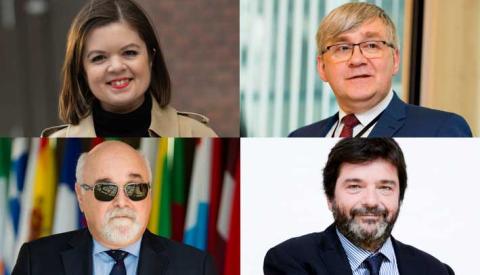
"The EU Disability Strategy for the next decade can only be efficient if it considers the consequences of the pandemic and influences Member States' policies and expenditure," warned the head of the EESC's Thematic Group on Disability Rights, Pietro Vittorio Barbieri.

Ioannis Vardakastanis, EESC member and president of the European Disability Forum, said that instead of being protected and prioritised, people with disabilities had been neglected by decision makers.

"The health situation and lives of persons with disabilities matter too," he stressed. (ll)


Unity rights of people with disabilities

We invite you to relive some of the key moments of a virtual press conference on the International Day of Persons with Disabilities 2020, organised by the Press Unit on 2 December 2020.

Read more in all languages

We invite you to relive some of the key moments of a virtual press conference on the International Day of Persons with Disabilities 2020, organised by the Press Unit on 2 December 2020.

What lessons can be learned for people with disabilities from the pandemic crisis, which has lasted almost a year? This is just one of many questions. We encourage you to read our guests' opinions.

Presentation in a nutshell

Sinéad Burke –  Irish disability advocate and director of Tilting the Lens: "I am a disabled woman, I am an educator, a writer and an advocate for disability"

Ioannis Vardakastanis – EESC member and disability activist, president of the European Disability Forum: "I have dedicated my life to campaigning, advocating, fighting for the rights of persons with disabilities, from my village to the whole world".

Krzysztof Pater – EESC member and author of the report on the right of persons with disabilities to vote in the EP elections: "For 20 years I have been trying to assist, to find solutions, to create a better legal environment for people with disabilities".

Pietro Vittorio Barbieri – President of the EESC's Thematic Group on Disability Rights: "This is not an ordinary day; we are now going through a period that is taking us from inclusion to exclusion. The main issue is people's isolation during the pandemic".

Worth knowing...

How optimistic are you concerning your efforts to encourage children to accept differences and celebrate their own self? How are they reacting?

Sinéad Burke: "I have tangible hope that the future will be better. We often say that children don't see difference, I don't think that's true. Children do see difference; they are aware of identity. How children differ from adults is that they respond with curiosity. I would ask adults to take note of how children respond. Acceptance and curiosity are so important. I think adults need to be inspired and take direction from children on how they respond to disability".

What can we do so that people with disabilities in Northern Ireland are not separated from the Republic of Ireland in terms of human rights and working conditions, especially for remote workers with disabilities?

Ioannis Vardakastanis: "Collaboration with organisations for people with disabilities will go on and issues concerning people with disabilities will be high on the agenda. The message is clear. Unity and the rights of people with disabilities have to be respected by all governments. They cannot be isolated through Brexit or other political decisions".

Pietro Vittorio Barbieri: "The Brexit agreement by the end of 2020 will define the political agenda"

Sinéad Burke: "As we move forward to Brexit, we should not continue to focus on profit and trade but should shift the focus to people. Creating people-centred policies, particularly in the pandemic, is important. I hope we will continue to be allies and support those who are marginalised, who are often people with disabilities".

Krzysztof Pater: "The European Disability Forum is a fantastic platform. At the time of the report and before the European Parliament elections, nobody expected the UK to leave the EU, but the UK has a number of legislative solutions that should be taken into consideration by many EU organisations"

What, in your opinion, has been the biggest impact of the pandemic on people with disabilities and which aspects of daily life have been affected most?

Krzysztof Pater: I would like to underline the lack of contact with others, which not only affects people's mental health but also their everyday life (in terms of assistance, shopping, rehabilitation). Action plans imposed by governments during the pandemic have forgotten about people who live in long-term care institutions".

Pietro Vittorio Barbieri: "The area most affected is people living in care homes and the feeling of isolation. Old people have been abandoned".

Sinéad Burke: "During the pandemic they were measuring your ability to survive the treatment. If you were older or disabled you were less likely to receive treatment. Some lives are more valid than others? I think now that we are designing places for social distancing we have the opportunity to create new foundations and think about how we would like the world to look, with disabled people at the heart of this development".

Ioannis Vardakastanis: "Paraphrasing the US slogan, lives of people with disabilities matter, too. During the pandemic, we have seen exclusion, health poverty, discrimination and inequalities in the health system. "Nothing about us without us" has to be a real driving force for changing policies and systems to make lives of people with disabilities matter." (at)

EESC demands a change to EU electoral law

The European Economic and Social Committee (EESC) has called on the European Parliament (EP), the Council of the EU and Member States to urgently amend the 1976 Electoral Act in a way that guarantees that all EU citizens with disabilities have a genuine right to vote in the EP elections in 2024.

Read more in all languages

The European Economic and Social Committee (EESC) has called on the European Parliament (EP), the Council of the EU and Member States to urgently amend the 1976 Electoral Act in a way that guarantees that all EU citizens with disabilities have a genuine right to vote in the EP elections in 2024.

In its opinion on The need to guarantee real rights for persons with disabilities to vote in European Parliament elections, adopted on 2 December, the EESC said it was asking for the principles of universality, secrecy and directness to be clarified in the text of the Act.

This would put a stop to discrimination against voters with disabilities linked to current rules or arrangements in different Member States, which differ considerably from one country to another. It could also remove legal or technical barriers currently in place across Europe, depriving millions of their voting rights.

The opinion is a follow-up to the EESC's information report which had found that, due to these barriers, not a single EU country was able to guarantee that elections were fully accessible to all.

The findings of the report, published two months prior to the 2019 EP elections, were later confirmed by the election reports from media and civil society organisations.

"The EESC considers such discrimination to be unacceptable and contrary to the fundamental values of the EU, to the Treaties and to major international legal and political acts," said Krzysztof Pater, author of both the report and the opinion.

"What we are asking has to do with the principle of equal rights for all. How is it possible that in the 21st century, millions of EU citizens with disabilities cannot enjoy their right to vote and decision-makers do almost nothing to change that? This is a key issue for EU democracy. Above all, this is a matter of human dignity," Mr Pater stressed.

In the EESC's view, existing practices that discriminate against EU citizens with disabilities can be quickly removed by amending the Electoral Act in a way that makes it mandatory for EU countries to implement standards that would guarantee that these people have a genuine right to vote.

These standards include adding a statement stipulating that no EU citizen may be deprived of their right to vote in EP elections because of a disability or health condition on the basis of national law.

The standards needed to clarify the principles of directness and secrecy will ensure that all persons with disabilities, regardless of the type of their disability, can vote unassisted and in secret. (ll)

Congratulations for securing a comprehensive EU UK partnership

Joint declaration by Christa Schweng, President of the European Economic and Social Committee (EESC) and Jack O'Connor, President of the EESC's Brexit Follow-Up Group

Congratulations to the European Union and United Kingdom negotiators for successfully concluding a most complex and difficult negotiation to deliver a Trade Agreement which is vitally important to the people of both the UK and all of Europe.

Read more in all languages

Joint declaration by Christa Schweng, President of the European Economic and Social Committee (EESC) and Jack O'Connor, President of the EESC's Brexit Follow-Up Group

Congratulations to the European Union and United Kingdom negotiators for successfully concluding a most complex and difficult negotiation to deliver a Trade Agreement which is vitally important to the people of both the UK and all of Europe.

Now the EESC is ready to build all possible linkages with Civil Society in UK.

It is first of all a great relief that in the end, after a long and complex negotiation, the EU and the UK government managed, in the very last stretch, to secure a deal on the partnership agreement.

After the United Kingdom's decision to leave the European Union on 31 January 2020, after 47 years of EU Membership, it was absolutely vital to know how the future relations would be governed between the two partners.

The partnership agreement will be the cornerstone on which future relations between the EU and UK will be built.

On behalf of the EESC, we warmly congratulate Michel Barnier, the EU Chief negotiator, and his team who have shown undisputed professionalism, resilience and experience, working relentlessly to keep a united European front.

We also want to extend, of course, our congratulations to the UK delegation who has worked successfully to seal the deal. We are fully aware that this was all but easy.

From 1 January 2021, companies, workers and citizens on both sides of the Channel will now be able to organise themselves. The partnership agreement brings certainty, the very element that is crucial for companies to plan their investments, for workers to decide where to work and for citizens to decide where they want to live.

As EESC, we have followed the Brexit negotiations closely including through an ad-hoc working group that we have established.

Our role will focus on looking to optimise the cooperation with the other European institutions and key stakeholders and build all possible linkages with Civil Society in the United Kingdom. We believe, more than ever, that this has to be the EESC's mission for years to come.

Christa Schweng

President of the EESC

Jack O'Connor

President of the EESC's Brexit Follow-Up Group


2021-2027 EU budget – EESC pleased to see views of civil society having an impact

The EESC welcomes the adoption by the EU's Heads of State and Government of the Multiannual Financial Framework (MFF) 2021-2027 on 10 December 2020. The compromise on the European budget and the recovery fund plus a rule of law mechanism takes into consideration the proactive and comprehensive contribution of the EESC in favour of a more ambitious MFF for the EU.

Read more in all languages

The EESC welcomes the adoption by the EU's Heads of State and Government of the Multiannual Financial Framework (MFF) 2021-2027 on 10 December 2020. The compromise on the European budget and the recovery fund plus a rule of law mechanism takes into consideration the proactive and comprehensive contribution of the EESC in favour of a more ambitious MFF for the EU.

By supporting the European recovery and helping build a stronger, greener and more digital European Union, the Committee is continuing to play a unique role in EU policy‑making. Its input as the voice of civil society organisations has once again proved to be important, as demonstrated by the many EESC opinions on the EU's long-term budget that were taken on board by the other EU institutions.

"It is our duty to communicate the benefits that the increase in the 2021-2027 budget has for civil society. I am happy to note that the EESC contribution made a difference. The agreement on the new Multiannual Financial Framework and on the new Recovery and Resilience Facility is timely. We hope that it will be the starting point for a speedy recovery of Europe and the building block of a stronger and greener Union and that the final result will be in line with the EU's ambitions and needs," said Cillian Lohan, EESC vice-president in charge of communication.

Read EESC President Christa Schweng Statement on the Multiannual Financial Framework 2021-27 and the Recovery Fund.

For information on the EESC opinions that are reflected in the MFF, please see this appendix. (mp)

#DigitalServicesAct, #DigitalMarketsAct: Time for our democracy to catch up with technology

The European Commission's latest initiatives to regulate digital services and markets will ensure that providers take responsibility for the services they offer and that digital giants do not impose their own rules on Europe's markets, said Commission executive vice-president Margrethe Vestager at the EESC's December plenary.

Read more in all languages

The European Commission's latest initiatives to regulate digital services and markets will ensure that providers take responsibility for the services they offer and that digital giants do not impose their own rules on Europe's markets, said Commission executive vice-president Margrethe Vestager at the EESC's December plenary.

The European Commission's Digital Services Act and the Digital Markets Act, released on 15 December, will help European democracy catch up with the last twenty years of digital development, defining how digital services should be provided and digital markets work, said Ms Vestager to the EESC's plenary during a debate on A Europe fit for the digital age.

EESC president Christa Schweng stressed that the digital transition has become more important than ever as one of the two building blocks of Europe's recovery from the COVID-19 crisis, together with the green transition.

The EESC president quoted a recent study which estimated that by 2030 the cumulative additional GDP contribution of new digital technologies could amount to EUR 2.2 trillion in the EU – the equivalent of Spain's and the Netherlands's combined GDP for 2019.

Ms Schweng said: "We need a European, human-centred approach to digitalisation. Without the trust of the citizens and businesses we will not be able to seize the opportunities offered by digitalisation. To that end, it's important to build a genuine European Dataspace where our data is protected and privacy and self-determination are ensured. We also need to build EU technological sovereignty while maintaining global digital trade."

Ms Vestager outlined the key elements of the Commission's digital strategy, its focus on leveraging private investment, its reliance on flagship initiatives (on digital skills, digital public services and cybersecurity) and the building and deploying of digital capacities.

Now "the Digital Services Act will make sure that digital service providers take responsibility and are accountable for the services they provide and that trust can be rebuilt," said Ms Vestager. "Illegal online content and products which do not live up to the rules that we have for physical products are the problem. Both should be fixed, and should be fixed on a European scale."

"The Digital Markets Act", she went on to remark, "will say to giant companies: you are more than welcome to do business in Europe, you are more than welcome to be successful, but there is a list of do's and don'ts when you reach that gatekeeper position in order for fair competition to be there and serve consumers in the best possible manner. The fundamental point here is that the market should serve us as consumers and that we want technology that we can truly trust." (dm)


National public services are essential for democracy and the rule of law in the EU

The EESC advocates a set of common principles for public services in order to help Member States comply fully with democracy and the rule of law.

Read more in all languages

The EESC advocates a set of common principles for public services in order to help Member States comply fully with democracy and the rule of law.

In an opinion adopted by the plenary assembly on 2 December, the EESC notes that public services, by ensuring equal and universal access to services to all, including vulnerable and disadvantaged groups, contribute to social progress and to a vibrant society. They can act as  crucial "automatic stabilisers" in times of crisis, which have increased in recent years in areas such as security, the economy, asylum, the environment, climate and health.

EESC rapporteur Christian Moos explained: "Public administration and services are the most important link between governments and civil society. They are key to the resilience of liberal democracy in Europe. The EU needs effective mechanisms to guarantee full respect of the rule of law and the impartiality of public administration in all Member States."

A set of common principles

The EESC identifies a set of common principles for public services and administrations:

  • The right to good administration reinforces societal trust. Transparency of public services ensures independent oversight and contributes to the fight against corruption.
  • Public services have a protective function with regard to the rule of law. Staff working in public services must be protected so they are able to refuse to obey illegitimate service instructions. 
  • Public services must ensure free access to information and remain available to everyone in person, digitalisation notwithstanding.

The EESC also suggests that public services should be interoperable at European level. Exchanges and job rotation between Member State public services should be possible. All the public services involved in allocating European funds must respect and implement public service principles. (na)

New EU Pact on Migration and Asylum: a missed opportunity for a much-needed fresh start

The new EU Pact on Migration and Asylum was strongly criticised during a high-level conference held by the EESC. Representatives of civil society, think tanks and the European Parliament found that the new pact does not deliver the changes needed to create a proper common European migration and asylum system.

Read more in all languages

The new EU Pact on Migration and Asylum was strongly criticised during a high-level conference held by the EESC. Representatives of civil society, think tanks and the European Parliament found that the new pact does not deliver the changes needed to create a proper common European migration and asylum system.

On 26 November stakeholders including the European Commission, the Parliament and the Council, think tanks, social partners and civil society organisations took part in a virtual hearing on the New Pact on Migration and Asylum. The conference, organised by the Social Affairs section (SOC) of the EESC, explored whether the new pact brings about the systemic change necessary to overcome the current deadlock and develop a sustainable, rational and rights-based EU asylum and migration policy.

Criticism from different panellists focused on three main aspects: the chosen legislative path, underpinned by intergovernmentalism and allowing negotiations to start before the submission of a legislative proposal by the Commission; the dualistic understanding of migrants as either real refugees or expellable illegal individuals; and the newly introduced return sponsorship mechanism, allowing Member States to contribute to solidarity by carrying out other countries' expulsion procedures.

The members of the EESC study group on this initiative regretted that the pact devoted most of its proposals to the management of external borders, while failing to pay due attention to regular channels of immigration, safe pathways for asylum, or the inclusion and integration of non-EU nationals in the EU. "We are a bit disappointed by the content of this pact," said José Antonio Moreno Díaz, EESC rapporteur for the opinion on the New Pact on Migration and Asylum. "We hope for a more ambitious and constructive pact that is more realistic with respect to human rights." (na)

Single European Sky – the Commission's new proposal may not be enough

The European Commission and aviation stakeholders should come back to the discussion table to clarify the ambition of the new Single European Sky (SES) Regulation, says the EESC in a newly adopted opinion.

Read more in all languages

The European Commission and aviation stakeholders should come back to the discussion table to clarify the ambition of the new Single European Sky (SES) Regulation, says the EESC in a newly adopted opinion.

It remains unclear, in fact, whether the Commission's draft proposal will be enough to achieve the SES's original goals in terms of reducing CO2 emissions and improving the efficiency of air traffic management and air navigation services (ATM/ANS).

The EESC flagged up the issue in an opinion drafted by Dumitru Fornea and adopted at the plenary session.

Commenting during the debate, Mr Fornea said: "the function of the network manager needs to be clarified, especially the overall scope and its impact on airline planning, capacity management, airspace design, the environment and the prioritisation of demands. All stakeholders in aviation should be involved in reaching major decisions; the principle of meaningful consultation needs to be part of the framework proposal".

The Commission proposal also lacks any reference to the dramatic consequences of the COVID-19 crisis on the industry. In this regard, the EESC recommends carrying out an impact study in order to give proper consideration to the social and economic consequences of the coronavirus pandemic for both workers and service users. (mp)


Blockchain

Blockchain technologies and the mining industry: a shared future

Blockchain technologies could offer useful solutions to the mining industry of the future, but the digital transition should take into account the social consequences. This was the main message from the online round table organised by the EESC's Consultative Commission on Industrial Change (CCMI) on 14 December 2020.

Read more in all languages

Blockchain technologies could offer useful solutions to the mining industry of the future, but the digital transition should take into account the social consequences. This was the main message from the online round table organised by the EESC's Consultative Commission on Industrial Change (CCMI) on 14 December 2020.

"Mining companies which embraced the digital transition have improved their safety, sustainability, productivity and profits. Blockchain is the future of the industry, but its governance needs to be discussed. We also need to minimise the social and territorial imbalances brought about by the transformation of activities as part of the new Green Deal and circular economy," said Pietro De Lotto, CCMI president.

This was echoed by CCMI member Hilde Van Laere: "Blockchain is at the heart of the digital transition and has the potential to transform businesses and the whole of society, not only the mining industry. It has changed every enterprise in every sector and has also transformed the context of mining. With its capacity to provide security and transparency in business transactions, as well as to record changes to documents and business agreements, blockchain technology has extremely useful applications in mining".

A wide range of operational and institutional stakeholders joined the debate: the Swedish Mining Organisation, Minespider, Kamni Chain, IndustriALL Norway, the International Raw Materials Observatory, the Organisation for Economic Co-operation and Development (OECD), the European Commission, and the European External Action Service (EEAS).

The webinar was part of the follow up work on opinion CCMI/176 on Digital Mining in Europe: New solutions for the sustainable production of raw materials, drawn up by Marian Krzaklewski and Hilde Van Laere, which the EESC adopted at its September plenary session. (mp)


EU Climate Pact

Empowerment is the key to a successful European Climate Pact

The EESC is pleased to see its recommendations reflected in the European Commission's proposals for a European Climate Pact that supports existing and new climate action via peer learning, education, capacity building, the removal of barriers, and easier access to finance.

Read more in all languages

The EESC is pleased to see its recommendations reflected in the European Commission's proposals for a European Climate Pact that supports existing and new climate action via peer learning, education, capacity building, the removal of barriers, and easier access to finance.

By introducing the concept of global carbon neutrality, the Paris Agreement changed political discourse and put governments and stakeholders on an action-oriented pathway. This outcome would not have been possible without the unprecedented mobilisation of all civil society stakeholders. Active participation of "all parts of society" is a prerequisite for climate policy to be successful within the EU.

EESC member Peter Schmidt said: "The Climate Pact is an important opportunity to model an innovative participatory approach, which will mirror, support and inspire action already happening in civil society, within communities, cities and regions."

The EESC wants to engage with the European Commission and other EU bodies to co-create a European Climate Pact Stakeholder Platform based on the principles of inclusiveness, transparency and genuine participation, and ownership by climate actors at all levels.

In addition, setting up an EU Climate Finance Forum as part of the Pact would stimulate truly mutual learning processes, facilitate access to finance and remove barriers. A mechanism for youth engagement in climate and sustainability, like the Youth Climate and Sustainability Round Tables proposed by the EESC, should be an integral part of this Pact. (mr)

The EESC joins in the EU's drive to renew ties with the US

Following the US election, the EESC's Follow-up Committee on Transatlantic Relations met on 15 December in a bid to re-establish a strong partnership with US civil society.

Read more in all languages

Following the US election, the EESC's Follow-up Committee on Transatlantic Relations met on 15 December in a bid to re-establish a strong partnership with US civil society.

With a new US presidency about to begin, the EU and the US now have a unique opportunity, after the major setbacks of recent years, to renew their partnership and friendship based on joint democratic values, a shared history and common interests.

In a bid to relaunch civil society dialogue, the EESC's Follow-up Committee on Transatlantic Relations met on 15 December, joined virtually by MEP Radosław Sikorski and US Congressman William Hurd.

Mr Sikorski stressed the crucial role of people-to-people contacts and more robust civil society cooperation in line with the new transatlantic agenda. "Policy differences between the EU and the USA have not disappeared, but goodwill, an equal footing and trust are a good start", he said.

Mr Hurd warmly supported transatlantic dialogue: "America leading is not America alone. We have to show capacity to build alliances". He stressed that it was imperative for the EU and the US to cooperate in the face of China's growing international assertiveness.

Peter Chase, senior fellow at the German Marshall Fund of the United States, pointed out that an ambitious strategy is crucial for transatlantic economic relations: "a powerful economy will 'feed' civil society, think tanks, businesses and investments".

Matthias Jørgensen from the European Commission's Directorate-General for Trade, presented the Commission's new transatlantic agenda, inviting the US to join the fight for a healthier, safer, prosperous and more democratic world after COVID-19, and working together on the protection of the planet, technology, trade and standards.

Garrett Workman, senior director for European affairs at the US Chamber of Commerce, commented that "trade is the basis to reset a lot of wrongs done by US policy during the last few years".

The EESC also presented "Building bridges across the Atlantic", an ambitious project which highlights the role of civil society and the importance of its impact on the renewed transatlantic partnership. The project aims to connect people and their activities and make liberal voices heard on both sides of the Atlantic at a time when finding common ground and identifying solutions are more important than ever. (at)

News from the Groups

EU companies ready to take on twin green and digital transitions

By the EESC Employers' Group President Stefano Mallia

Climate neutrality and digital leadership will not be an easy task for Europe. The transformative agenda of the European Green Deal is as demanding as it is compelling. Some CEOs perceive it as a Herculean task, but EU employers are ready to switch gear and accelerate the roll out of the green and digital transitions.

Read more in all languages

By the EESC Employers' Group President Stefano Mallia

Climate neutrality and digital leadership will not be an easy task for Europe. The transformative agenda of the European Green Deal is as demanding as it is compelling. Some CEOs perceive it as a Herculean task, but EU employers are ready to switch gear and accelerate the roll out of the green and digital transitions.

It is clear that decarbonising industry will load energy intensive companies with high-energy costs while simultaneously imposing a massive structural change on the industrial, transport and energy sectors, risking an economic disadvantage in a competitive global market.

However, it can be achieved if the EU's overarching climate policy objective is balanced with an ambitious industrial strategy that boosts competitiveness – and an equally ambitious energy policy designed to ensure long-term energy security and affordability. There is no doubt that the updated industrial strategy, which the Commission is expected to deliver early next year, must align major strands of energy politics and industrial competitiveness.

At the same time, digital solutions are indispensable for empowering progress towards the Green Deal's goals. As Europe is lagging behind in digital development and high-speed connectivity, a "Digital Deal" for Europe is needed.

We are of the firm belief that European companies have the research capacity and the technological solutions to help our continent become a leading independent actor in the digital field.

However, there is a missing parameter in the equation and this is investment. The EU Recovery Package will provide comprehensive public financial support, which must be aligned with private funding, if we want to make sure we create the right conditions for a successful reconstruction.

We have to realise that we are at a critical juncture. Failure to take the necessary actions now will have deep and long-lasting repercussions on Europe's role in shaping the global future. Failure on this front is not an option.

On 9 December the EESC Employers' Group held a webinar titled De-carbonisation and digitalisation in the context of globalisation. The resulting recommendations to EU decision-makers can be found here: https://europa.eu/!dN89jx


The necessary balance between social, economic, and environmental issues in the industrial transition

By the EESC Workers' Group

Industrial change may mean better jobs and working conditions, with sustainable growth and inclusiveness. Or it might mean rampant inequality and poverty, soaring unemployment for certain groups, and eventually a fracture in social cohesion that will endanger the EU and democracy itself.

Read more in all languages

By the EESC Workers' Group

Industrial change may mean better jobs and working conditions, with sustainable growth and inclusiveness. Or it might mean rampant inequality and poverty, soaring unemployment for certain groups, and eventually a fracture in social cohesion that will endanger the EU and democracy itself.

Not for no reason, historical changes in the material conditions of production and labour relations have more often than not shaken the very foundations of society.

Nevertheless, the manner in which the change occurs will depend greatly on political choices. In the last plenary of December 2020, the EESC adopted a landmark opinion on the industrial transition, requested by the European Parliament, serving as a blueprint for the need for fairness and justice in technological and economic developments in industry and the world of work.

The recipe for overcoming the economic downturn of the pandemic and establishing a more resilient, modern, green, digital, and inclusive economy and society will need first and foremost a strong social component. The European Pillar of Social Rights must be at the centre of the transformation, which must involve clear, broad and strong participation of the social partners and a firm and clear regulatory framework.

This opinion therefore lays out the necessary, and often overlooked, balance, not only in environmental and economic terms, but also in social ones: leaving no one behind is not just a well-intentioned principle. It is a necessity if we are to prevent populism finishing what it started in the aftermath of the 2008 crisis and the austerity responses it triggered. (prp)

Self-employed people living in poverty: an often forgotten group

By Ronny Lannoo, member of the EESC Diversity Europe Group and of Belgian SME organisation UNIZO

The self-employed are often associated with "making a fast buck" and success. This caricature overshadows the many challenges entrepreneurs face. Self-employment always goes hand in hand with risks, in both the business and the private sphere.

Read more in all languages

By Ronny Lannoo, member of the EESC Diversity Europe Group and of Belgian SME organisation UNIZO

The self-employed are often associated with "making a fast buck" and success. This caricature overshadows the many challenges entrepreneurs face. Self-employment always goes hand in hand with risks, in both the business and the private sphere.

If things go wrong, (hidden) poverty is often not far away. That this situation is often neglected is due in part to the fact that the self-employed are used to solving their own problems wherever they possibly can.

Public knowledge that a business has problems is perceived as bad publicity, something to be ashamed of, and so they either delay or completely avoid seeking appropriate support.

In Belgium, some 12.7% of self-employed people live below the poverty line. The reasons why they get into difficulty include poor management, starting out without a solid business plan, illness and late payers.

But there are also issues that the self-employed are unable to do anything about themselves. The coronavirus crisis is a dramatic example of this, with the European Commission forecasting a wave of bankruptcies as a result.

We need to recognise the problem and make it one we can talk about: less anxiety, more prevention and easier ways to seek help. In particular, business associations should not wait to be approached, but should seek out entrepreneurs in difficulty and give widespread  publicity to what they have to offer them.

Services such as training, upskilling and coaching in business management, early detection of problems via red flags and other measures can prevent many bankruptcies. A number of these measures have been expanded and strengthened during the pandemic, but much work remains to be done to reduce poverty among self-employed people across Europe.


Soon in the EESC/Cultural events

An EESC exhibition celebrates the social dimension at the heart of Portugal's EU presidency

Just as Portugal is taking the reins of the EU and  is pushing the social agenda up the list of priorities, the EESC is hosting a virtual exhibition of work by Portuguese artist Maria Reis Rocha which pays tribute to human connection and solidarity.

Read more in all languages

Just as Portugal is taking the reins of the EU and is pushing the social agenda up the list of priorities, the EESC is hosting a virtual exhibition of work by Portuguese artist Maria Reis Rocha which pays tribute to human connection and solidarity.

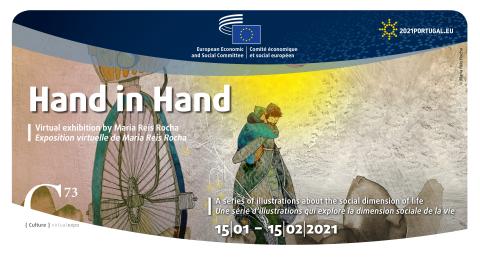
Hand in Hand features a series of illustrations and short videos by Maria Reis Rocha (https://www.mariareisrocha.com/) on burning social issues such as mental health, social participation and transformation, quality education, universal access to healthcare, the fight against poverty and racism, and children's rights.

These topics are closely connected to the priorities of the Portuguese Presidency (a resilient Europe, a social Europe, a green Europe, a digital Europe and a global Europe), which starts on 1 January 2021.

A cultural première, the exhibition is being presented digitally due to the COVID-19 pandemic and will run from 15 January to 15 February 2021 at: https://www.eesc.europa.eu/en/agenda/our-events/events/hand-hand  (ck)

EESC to bring together youth from across Europe to brainstorm way out of climate crisis

The EESC's youth event Your Europe, Your Say! (YEYS) 2021 will model the United Nations' climate change conference (COP), with students giving their take on how to deal with the climate crisis and come closer to the 2050 climate-neutral ambitions.

Read more in all languages

The EESC's youth event Your Europe, Your Say! (YEYS) 2021 will model the United Nations' climate change conference (COP), with students giving their take on how to deal with the climate crisis and come closer to the 2050 climate-neutral ambitions.

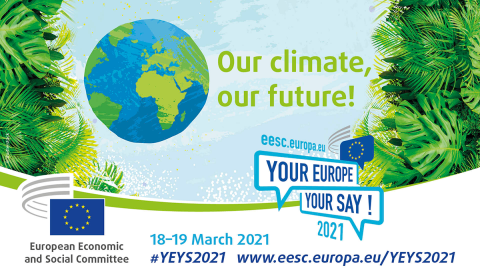
Since 2010, YEYS has brought over 100 young students and more than 30 teachers from across Europe to Brussels each year to debate the hot topics of the day. YEYS 2021, which will take place on 18-19 March 2021 in the shape of a fully virtual event due to COVID-19, will be entitled Our Climate, Our Future!

Thirty-three schools will participate in this youth debate, one from each of the EU's 27 Member States and the five candidate countries (North Macedonia, Serbia, Turkey, Montenegro and Albania) plus one from the UK, as tangible proof of the EESC's resolve to stay close to British civil society.

The aim of this 12th YEYS event is to listen to the students' fresh views on how to tackle the current climate crisis and how to come closer to the 2050 climate-neutral ambitions.

The results of YEYS 2021 will be shared with international environment policy-makers and promoted at conferences around Europe, including the European Parliament's European Youth Event (EYE), which will take place at the end of May 2021.

While the students are busy at their COP, the teachers will be attending online information sessions organised in cooperation with the three main EU institutions (the European Parliament, the European Commission and the Council of the EU) with the aim of adding to their knowledge of the EU's work and resources for youth and education.

In parallel to YEYS, the EESC will run a social media campaign on Instagram and Facebook to raise climate change awareness and encourage young people to take up a sustainable lifestyle. (cl)
 

Editors

Ewa Haczyk-Plumley (editor-in-chief)
Daniela Marangoni (dm)
 

Contributors to this issue

Amalia Tsoumani (at)
Chloé Lahousse (cl)
Chrysanthi Kokkini (ck)
Daniela Marangoni (dm)
David Gippini Fournier (dgf)
Ewa Haczyk-Plumley (ehp)
Jasmin Kloetzing  (jk)
Katharina Radler (kr)
Laura Lui (ll)
Marco Pezzani (mp)
Margarita Gavanas (mg)
Nicola Accardo (na)
Pablo Ribera Paya (prp)
 

Coordination

Agata Berdys (ab)
Katerina Serifi (ks)

Technical support
Bernhard Knoblach (bk)
 

Address

European Economic and Social Committee
Jacques Delors Building,
99 Rue Belliard,
B-1040 Brussels, Belgium
Tel. (+32 2) 546.94.76
Email: eescinfo@eesc.europa.eu

EESC info is published nine times a year during EESC plenary sessions. EESC info is available in 23 languages
EESC info is not an official record of the EESC’s proceedings; for this, please refer to the Official Journal of the European Union or to the Committee’s other publications.
Reproduction permitted if EESC info is mentioned as the source and a link  is sent to the editor.
 

January 2021
01/2021

Follow us

  • Facebook
  • Twitter
  • LinkedIn
  • Instagram