
European Economic
and Social Committee
Gender equality by 2197? The EESC calls for urgent action
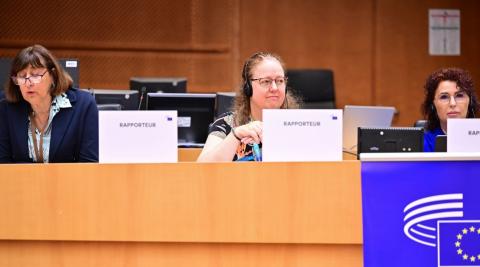
With the UN's targets still off track for 2030, the European Economic and Social Committee (EESC) is calling for faster action. In a Resolution on the EU's priorities for 71st session of the United Nations Commission on the Status of Women (UN CSW71), the Committee highlights persistent barriers to women's economic independence and leadership, widespread gender-based violence and the need for stronger cooperation between EU institutions, Member States, social partners and civil society.
The United Nations Sustainable Development Goals set 2030 as the target for achieving gender equality. But at the current pace, according to UN estimates, it will take 171 years to achieve this goal, pushing gender equality to the year 2197. In a Resolution (SOC/871) prepared by the rapporteurs Giulia Barbucci, Juliane Marie Neiiendam and Christa Schweng adopted at its September 2026 plenary session, the EESC is calling for more proactive and ambitious measures on EU institutions, its Member States and the international community.
In the plenary debate, the rapporteur from Group I, Christa Schweng, underlined that the EESC's aim is not simply to comment once international negotiations are already advanced, but to be sure that the voice of organised civil society is heard.
For Giulia Barbucci, rapporteur for Group II, the central point of the opinion is that the 2030 Agenda cannot be achieved without making concrete progress towards gender equality and that goal 5 cannot be considered separately from the other Sustainable Development Goals (SDGs). Juliane Marie Neiiendam, rapporteur for Group III, asked not to approach the SDGs in the wrong way, setting enormously ambitious goals while not making full use of all the people's talent and experience available to us.
The three rapporteurs declared that: 'CSW71 is a crucial opportunity to turn promises into measurable progress. With 2030 approaching quickly, employers, trade unions and civil society must help advance gender equality through decent work, entrepreneurship, leadership, digital skills, quality care and climate action.'
Structural and systemic barriers
In its resolution, the EESC stresses that progress towards gender equality remains uneven, fragile and increasingly contested, at national, EU and global level, and that women and girls continue to face structural and systemic barriers that limit their participation, economic independence, safety and full enjoyment of human rights.
Equal access to decent work, equal pay for work of equal value, social protection, entrepreneurship and leadership opportunities must be accelerated, according to the resolution, which underlines that particular attention should be given to women entrepreneurs and women-led SMEs, which remain underrepresented despite their essential contribution to innovation, employment, competitiveness, local development and Europe’s economic resilience.
The so-called "glass ceiling" in the corporate world remains a pressing problem. According to the Gender Snapshot 2026 of the UN, which tracks progress towards the Sustainable Development Goals, women account for around 40% of employees in firms worldwide but hold just 5.8% of CEO positions in the publicly traded companies covered by the report and only 25.1% of corporate board seats.
Sustainable Development Goals
There are 17 Sustainable Development Goals in the UN 2030 Agenda. SDG 5 aims to achieve gender equality and empower all women and girls. It covers areas ranging from discrimination and gender-based violence to unpaid care work, political and economic participation, sexual and reproductive health, and access to economic resources and technology. But the EESC stresses that SDG 5 cannot be achieved in isolation, as gender equality is closely interconnected with progress on poverty, health, education, employment, inequalities and climate action.
Widespread violence
The resolution underlines that gender-based violence remains one of the most significant barriers to equality and empowerment. and that preventing and combating violence against women and girls, including digital violence, must remain a political priority, alongside effective protection, survivor support and access to justice.
Nearly 1 in 3 women aged 15 or older – an estimated 840 million globally – has experienced partner or sexual violence during her lifetime, a figure that has barely budged since 2000. In the last 12 months, 316 million women – 11% of those aged 15 or older – were subjected to physical or sexual violence by an intimate partner.
The EESC's role
The EESC is uniquely positioned to bring the CSW71 messages to the ground as it represents 90 million people through employer organisations, trade unions and civil society organizations in all 27 EU Member States. The Committee contributes actively to implementation of the CSW71 objectives by encouraging structured social and civil dialogue, advocating awareness-raising, education and prevention measures, encouraging and facilitating women’s equal participation in decision-making and promoting cooperation between EU institutions, Member States, social partners and civil society.
Background
The 71st session of the United Nations Commission on the Status of Women (UN CSW71) will take place in March 2027 at UN in New York. The session will focus on the priority topic of accelerating the achievement of gender equality and the empowerment of all women and girls in the context of the 2030 Agenda for Sustainable Development. The CSW is the principal global intergovernmental body dedicated to the promotion of gender equality and the empowerment of women. At its January 2026 plenary session, the EESC adopted a resolution outlining the EU’s priorities for the UN CSW70.
Work organisation
Recommended for you
La creazione condivisa di servizi pubblici nel settore sanitario contribuirà a una democrazia più partecipativa nell'UE
News
L'evento organizzato dal Comitato economico e sociale europeo (CESE) in collaborazione con l'Università di Debrecen ha posto in evidenza l'importanza cruciale della creazione condivisa di servizi di…
Per combattere i cambiamenti climatici, l'UE ha bisogno di maggiori investimenti pubblici nelle infrastrutture energetiche
News
In un parere adottato nella sessione plenaria di settembre, il Comitato economico e sociale europeo (CESE) avverte che, per realizzare gli obiettivi climatici e di transizione energetica, sono…
Energia - Il CESE mette in guardia di fronte al rischio di nuove dipendenze
News
Il Comitato economico e sociale europeo (CESE) assume una posizione ferma in materia di energia in un parere adottato nella sessione plenaria di settembre. La proposta della Commissione, infatti, è…
La transizione digitale deve essere equa: i diritti umani e il controllo umano devono rimanere pilastri fondamentali
News
Il Comitato economico e sociale europeo (CESE) sottolinea le opportunità offerte dalla rivoluzione digitale, ma mette anche in guardia dai rischi: se attuate troppo rapidamente, le soluzioni digitali…
L'UE ha bisogno di un piano d'azione per fornire alloggi dignitosi e a prezzi accessibili
News
Il convegno ad alto livello organizzato a Riga dal Comitato economico e sociale europeo (CESE) ha lanciato l'allarme per la crisi degli alloggi a prezzi accessibili, sottolineando che è il momento…