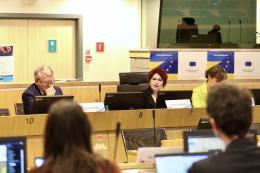
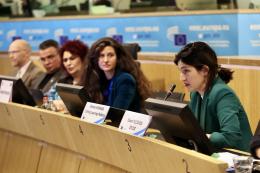
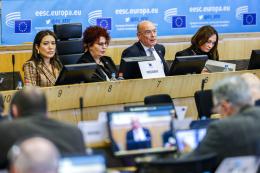
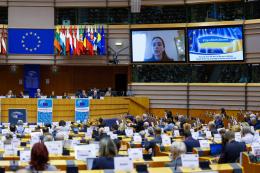
Nella sessione plenaria di marzo, il Comitato economico e sociale europeo (CESE) ha tenuto un dibattito con Marina Elvira Calderone, ministra italiana del Lavoro e delle politiche sociali, sul tema Rendere i mercati del lavoro dell'UE più forti e più inclusivi. Il CESE ha rinnovato il suo sostegno alla proposta della Commissione europea di rafforzare gli organismi nazionali per la parità, che hanno il compito di promuovere la parità per tutti e di combattere la discriminazione sul lavoro.
Alla sessione plenaria di marzo del Comitato economico e sociale europeo, la Presidente del CESE Christa Schweng e la commissaria europea per l'Energia Kadri Simson hanno ribadito il forte impegno dell'UE a favore del futuro dell'energia pulita in Europa.
As part of the European Year of Skills, the European Economic and Social Committee (EESC) held a conference on "Skills and talents as key drivers for personal fulfilment, economic growth and competitiveness" on 10 March to assess the needs and issue recommendations regarding skills development in the EU.
On International Women's Day 2023, the European Economic and Social Committee (EESC) held a debate on dismantling gender stereotypes in education, which are still stopping girls and young women from making their own study and career choices and achieving their full professional potential.
The European Economic and Social Committee (EESC)'s Civil Society Days kicked off today with two sessions discussing how best to protect civic space in the EU against forces eating away at it, be it national governments or foreign powers.
As water scarcity and pollution continue to pose global challenges, the current EU policy framework seems insufficient. To address this, top-level water experts gathered on 27 February at the European Economic and Social Committee (EESC) to identify possible solutions. The hearing marks the beginning of the EESC's work on water. The Committee is preparing a set of own-initiative opinions examining the economic, social, environmental, and geopolitical aspects of water and, in the autumn, will share civil society's recommendations for the future of water in the EU.
Just one day before the anniversary of Russia's invasion of Ukraine, the European Economic and Social Committee (EESC) adopted a resolution calling for Ukraine's swift accession to the EU in full respect of enlargement principles. The EESC supports establishing a special international tribunal on crimes of aggression against Ukraine, and points out that support to civil society must continue for "as long as it takes".
At its plenary session on 22 February, the European Economic and Social Committee (EESC) held a debate that warned about companies' growing struggle to get a skilled workforce and pointed to the pressing need for an all-encompassing skills strategy at all levels. The debate saw the participation of the Organisation for Economic Co-operation and development (OECD), SMEunited and Social Economy Europe.
At the February plenary session of the European Economic and Social Committee (EESC) Sviatlana Tsikhanouskaya, leader of the Belarusian democratic movement, called on the European institutions to support the Belarusian people in their fight against authoritarianism. Belarus must not be Putin’s consolation prize: it deserves to be part of the European family. This will only be possible with the active support of all EU institutions.
On the occasion of the 30th anniversary of the Single Market, the EESC held a debate about the future of the world's largest trading bloc with Commission Executive Vice-President Margrethe Vestager. The Single Market is widely considered the EU's greatest achievement, but has also shown its limitations in the face of current crises.