
European Economic
and Social Committee
Speech by President Séamus Boland, EESC plenary debate on the resolution 'Charting the EU's democratic progress: a resolution for the next legislative mandate'
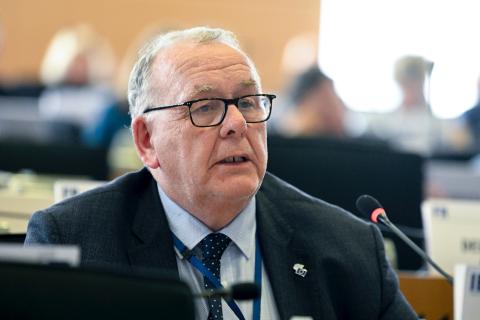
EESC plenary debate on the EESC resolution 'Charting the EU's democratic progress: a resolution for the next legislative mandate'
Dear guests and colleagues,
I would like to join you in welcoming this ambitious resolution.
It has been a lengthy process and not always easy.
But we can be proud of the quality and quantity of the recommendations to be addressed to the new European Institutions.
And I would like to sincerely thank the three rapporteurs, the Section/CCMI Presidents, Group experts and Committee staff, who were extensively involved in drafting and revising of this document.
The Group III rapporteur, Yannis Vardakastanis, has already outlined a number of policy areas prioritised within the resolution, namely: the health sector, respect for the Rule of Law, active inclusion policies, respect for diversity, equality, inter-generational solidarity and of course, the pivotal role of civil society and civic dialogue.
To complement those remarks, I would like to focus on three issues.
Firstly, this resolution makes very clear that despite the relative wealth within the EU, our Union is faced with extremely high levels of poverty, something which is totally unacceptable.
Poverty, inequalities and the perceived absence of opportunities, are breeding grounds for extremist political views of the left and the right, as we have seen in recent elections in Member States.
Put simply: we will not be able to quieten the angry political disconnect and distrust of voters, without focussing on resolving this fundamental issue.
And I am not speaking about reducing the levels of equality. We should be aiming at totally eliminating poverty within the EU!
Secondly, as is stated in the resolution, "…the EESC has a pivotal role in fostering a robust civic space…providing a platform for consensus building and dialogue…supporting the development of inclusive policies that reflect the needs and aspirations of citizens".
The process by which this resolution was drafted, involving so many internal and external actors and including the recommendations of the Civil Society Week and of YEYs, is a living proof of the value added of this Committee.
I am confident in saying that no other European level body would be able to bring together such a variety of actors in consensus, as this House has done.
Thirdly, I would like to highlight the timeliness of this resolution, coming just a few after the EC President elect published her priorities for the next legislative mandate.
As you will note, several of the items that we request are included within her priorities, e.g. an EU Anti-Poverty Strategy and an EU action plan to address the housing crisis.
Other requests made by us were not included, e.g. a European Strategy for Older Persons.
Hence, our role in the next few months and years, is to accompany the European Institutions in delivering these promises and in being even more ambitious!
And to go even further, taking action on.
And that implies each and every one of us taking individual responsibility at the local, national and European levels! We all have much work to do!
Thank you for your attention.
Work organisation
Downloads
-
Speech by President Séamus Boland