
European Economic
and Social Committee
Banning conversion practices in the EU: towards ensuring protection and dignity for all
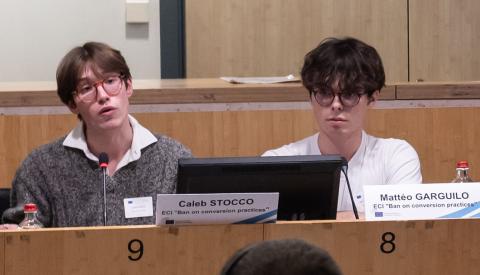
The EESC Section for Employment, Social Affairs and Citizenship (SOC) marked Gender Equality Week 2025 with a pivotal debate on banning conversion practices in the European Union. The event brought together voices from EU institutions, civil society, LGBTIQ+ organisations and policy experts to address the urgent challenge of eradicating conversion practices and ensuring the protection and dignity of all LGBTIQ+ people across Europe.
The European Citizens’ Initiative (ECI) to ban conversion practices has gained remarkable momentum, gathering over 1.2 million signatures in just six days – a testament to the widespread support among EU citizens for ending these harmful practices. As the ECI's campaigners Mattéo Garguilo and Caleb Stocco (European Association Against Conversion Therapy) explained during the 6 November debate marking Gender Equality Week, the initiative was formally submitted to the European Commission on 17 November, triggering a process that includes a meeting with the Commissioner for Equality, a hearing in the European Parliament, and a formal response by the Commission by 18 May 2026, symbolically in the wake of the International Day Against Homophobia, Transphobia and Biphobia (17 May).
The timing of this initiative aligns with the launch of the new EU LGBTIQ+ Equality Strategy 2026–2030, which sets out goals to protect LGBTIQ+ people from violence, discrimination, and harmful practices – including conversion practices. Commissioner Hadja Lahbib has explicitly declared that banning conversion practices will be a key focus of the new strategy, while the European Parliament's LIBE Committee organised a workshop on the strategy on 11 November. The Commission has pledged to work with Member States, in full respect of their competences, to end these practices and ensure that the EU remains a beacon of equality, dignity and respect for human rights.
According to the avaialble data, despite progress, only eight out of 27 EU Member States currently have conversion bans in place, and even where bans exist, conversion practices persist. The ECI calls for a comprehensive, EU-wide ban, robust enforcement, and support for victims – including psychological and legal assistance. Civil society’s role in maintaining pressure on EU institutions is seen as crucial to achieving uniform protection across the Union.
The reality and impact of conversion practices
Conversion practices – defined as efforts to change, suppress, or repress an LGBTIQ+ person’s sexual orientation, gender identity, or expression – are widely condemned by international bodies, including the UN. As Cianán Russell (ILGA Europe) highlighted, these practices take many forms, from pseudo-psychotherapy and religious rituals to physical and psychological abuse. The 2023 LGBTIQ survey revealed that 24% of respondents had experienced some form of conversion practice, with trans and non-binary people disproportionately affected.
The consequences are severe: irreversible psychological and physical harm, increased risk of addiction, depression, and suicide. Conversion practices violate fundamental human rights and dignity, perpetuating the false notion that LGBTIQ+ identities are pathological and need to be “cured.” As Ana-Carla Pereira ("Equality and Non-discrimination" Director in the European Commission'sDG JUST) affirmed, these practices amount to torture and must be abolished.
Barriers and challenges
The debate underscored several barriers to effective action. Data collection remains challenging due to the hidden nature of conversion practices and lack of awareness among the general population. Enforcement is inconsistent, and bans are not always comprehensive or effectively implemented. Vulnerable groups – including young people, those with disabilities, and ethnic minorities – face heightened risks and often lack access to support services.
Miltos Pavlou of the EU Agency for Fundamental Rights presented the latest survey findings showing that conversion practices occur across all age groups and are often perpetrated within families. Trans, non-binary, and intersex people are especially vulnerable, with alarming rates of homelessness and suicidal thoughts among those affected.
The role of policy, law, and Civil Society
Speakers emphasised the need for a multi-faceted approach. Legal tools – such as criminal bans, anti-discrimination laws, and child protection measures – must be complemented by public policy initiatives, awareness-raising, and support for victims. Enforcement agencies and professional associations should be sensitised and empowered to act. The European Commission’s LGBTIQ+ Equality Strategy and ongoing studies aim to provide a foundation for future action, informed by dialogue with Member States and civil society.
MEP and Co-President of the LGBTIQ+ Intergroup Kim Van Sparrentak stressed the importance of continued collaboration, clear guidance for Member States, and adequate funding for organisations supporting victims. The debate highlighted the need for the EU to act decisively, ensuring that no one is subjected to conversion practices and that all LGBTIQ+ people can live with dignity and respect they all deserve.
Juliane Marie Neiiendam, rapporteur of the ongoing EESC opinion on the LGBTIQ+ Equality Strategy 2026-2030, stressed repeatedly that there is no place for conversion practices in the EU as everyone has a fundamental right to live free of violence and discrimination. No one should be made to believe they must change who they really are to deserve safety, love and freedom.
The EESC debate made clear that conversion practices are not a relic of the past but a present and pressing issue. They are a violation of fundamental European values and human rights, and their eradication requires concrete political choices, robust legal frameworks, and sustained civil society engagement.