
European Economic
and Social Committee
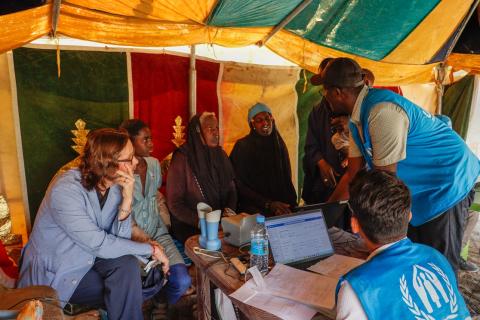
Our new column, The Public Square, gives the floor to voices from across public life ─ civil society, journalists, NGOs, and institutions ─ to share the causes they champion and the issues they believe deserve attention. Our first guest is UNHCR Representative to the EU Jean-Nicolas Beuze, writing about his recent mission to Mauritania, which hosts tens of thousands of Malian refugees and is investing in their self-reliance and dignity alongside local communities. For European policymakers, this shows that such investments are not charity but one of the most effective ways to reduce long-term humanitarian costs and reduce the pressures that push people to move on.
By Jean-Nicolas Beuze, UNHCR Representative to the EU
The new UN High Commissioner for Refugees Barham Salih recently set an ambitious objective: a 50% reduction in the number of refugees living in protracted displacement and dependent on humanitarian assistance by 2035.
After 30 years in the field, my recent mission to Mauritania reminded me that this goal is not wishful thinking. It is a necessity.
In the Hodh Chargui region in eastern Mauritania, at Mbera refugee camp and in surrounding host communities, tens of thousands of Malian refugees live alongside Mauritanian families in an area already facing drought, economic hardship and limited infrastructure. If this population formed a single city, it would be among the largest in the country. Yet this is a remote rural region with scarce public resources, where every additional pressure is felt acutely.
And still, Mauritania has chosen to keep its doors open and to work with us on solutions that restore the dignity of both refugees and local communities by enabling them to become self-reliant. At a time of sharp reductions in humanitarian and development aid from Western donors, this is not only the right path – it is the only viable one.
What struck me most was the commitment of the authorities, both national and local. Ultimately, they are the ones who can deliver lasting solutions. Our discussions focused on practical steps: registering refugees quickly so their children can attend school, ensuring access to social protection systems, and allowing qualified refugees to work – including in public hospitals or schools.
Mauritania is not a wealthy country, and it operates in a fragile regional environment. Stepping back would be politically and financially easier. Maintaining a functioning asylum system and integration services requires real political courage. Mauritanian leaders and communities deserve continued international support.
Equally striking were my conversations with Malian refugees and Mauritanian residents. In the vibrant markets of the region, I heard the same message repeatedly: people do not want to depend on aid. They want the opportunity to work, support their families and contribute economically and socially.
This is where partnership becomes critical.
Despite the challenges, the Mbera region is full of opportunity. Underground water is easily accessible – which is why we are installing solar-powered boreholes. Livestock and agricultural potential are significant – which is why we support value-chain businesses that benefit both refugees and host communities.
Encouragingly, some European companies are ready to invest in these efforts. The European Commission’s Global Gateway initiative is designed precisely to support such partnerships.
Together, we can turn displacement from a permanent humanitarian burden into an opportunity for economic inclusion and local development. Not because we feel sorry for refugees or impoverished communities, but because this is a model that works for everyone.
For European policymakers, the implication is clear: investing in refugee self-reliance in host countries is not charity – it is one of the most effective ways to reduce long-term humanitarian costs, strengthen fragile regions and address the drivers of onward displacement and insecurity.
If we scale such approaches, the High Commissioner’s objective will not remain an aspiration. It will become proof that, with the right partnerships and political will, refugees can move from dependency to autonomy – and contribute to the societies that host them.
Jean-Nicolas Beuze is the UNHCR country representative to the EU, Belgium, Ireland, Luxembourg, the Netherlands and Portugal, having previously served as country representative in Iraq, Yemen and Canada. He has over 27 years of experience working for the UN in the field and at the headquarters in the areas of human rights, peacekeeping and child protection.