The 17th meeting of the EU Domestic Advisory Group under the EU-Ukraine DCFTA took place on 12 September 2025. Click on the programme tab to consult the topics on the agenda.
The 11th EU-Korea Civil Society Forum (CSF) and Workshop took place on 8–9 September 2025 in Brussels. The event opened with a discussion on the benefits of social dialogue in the context of amplified trade diversification.
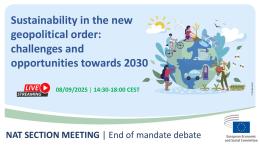
On 8 September 2025 (14:30-18:00), the NAT section of the EESC will host its end of mandate debate with the aim of addressing some of the crucial and systemic questions raised by the new geopolitical order from the point of view of civil society, and to chart possible pathways for the future.
Lessons learned and a new Inflation Governance Framework
Event type
Conference
Location
room VMA 22, Van Maerlant 2
Brussels
Belgium
On Wednesday, 3 September 2025, from 14:00 – 17:30 (CET), the European Economic and Social Committee (EESC) will host an event organised by the Foundation for European Progressive Studies, in cooperation with Fondazione Pietro Nenni and tasc, discussing lessons learned from the recent inflation episode and the new inflation governance framework that needs to be developed to prevent or mitigate the supply side inflation shocks in the future.
Driven by the collaboration between the European Economic and Social Committee (EESC) and the Brazilian Economic and Social Development Council (CDES), the EU-Brazil Civil Society Round Table held eight meetings between 2009 and 2014. Following the re-establishment of Brazil’s civil society advisory body in 2023 – now operating as the Sustainable Economic and Social Development Council of Brazil (CDESS) – and in accordance with the EESC-CDESSMemorandum of Understanding signed on 9 April 2024 in Brasília, as well as the Joint Statement issued by the President of the EESC and the Minister of Institutional Relations of Brazil on 10 April 2024, the EU-Brazil Civil Society Round Table has been officially reactivated.
Building an Inclusive Future in an Enlarged EU: The role of Social Dialogue, Civil Society and Youth Engagement
Location
Charlemagne Building, European Commission
Brussels
Belgium
As part of its ongoing Enlargement Candidate Members (ECMs) initiative, the EESC hosted a second Enlargement Forum on 17 July 2025 in Brussels. The event gathered ministers for European affairs from candidate countries, senior officials from the European Commission, social partners, and civil society representatives to discuss the role of civil and social dialogue in the EU enlargement process.
The debate will start at 12.00 and end at 13.00 CEST. It will be webstreamed in multiple EU languages. Prior registration for the webstreaming is not necessary. It will be available on this website on the day of the event.
The 17th meeting of the EU-Ukraine Civil Society Platform (CSP) took place in Rome on 11 July 2025, in the margin of the Ukraine Recovery Conference. During the meeting, the CSP members discusses key achievements and ongoing challenges of European integration process. The debate included exchanges with the EU and Ukrainian authorities and experts on priority areas such as the energy sector, digital infrastructure, and rights of Ukrainian refugees in the EU.
A joint declaration, prepared by both sides, was discussed and adopted.