EESC's EU Consumer Day 2025 pointed to the urgent need to protect EU markets from an avalanche of cheap imports shipped by Temu, Shein and other third-country e-commerce platforms which are threatening to devastate the European economy and society, forcing European businesses to close and draining billions from public budgets
For Bulgaria and Romania, the costs of not being full members of the Schengen area are counted in billions of euros. The transport and tourism sectors of both countries are most affected and checks at land borders create huge barriers for Romanian and Bulgarian companies, restricting their competitiveness and preventing them from fully reaping the benefits of the single market
Le Comité économique et social européen invite la Commission européenne à réaliser des analyses d’impact plus ciblées sur ses propositions visant à fournir au budget de l’Union des sources supplémentaires de financement, destinées à éponger la dette de NextGenerationEU. D’une manière générale, le Comité approuve les rentrées budgétaires préconisées à titre de «ressources propres». Il relève toutefois qu’elles doivent être stables et équitables, et ne peuvent être un fardeau ni pour les ménages, ni pour les entreprises.
rue Belliard 101, Jacques Delors building, room JDE 63, 9:30-11:00
Brussels
Belgium
EESC, room JDE 63, 9:30-11:00
The policy debate brings together stakeholders to assess how National and Regional and Partnership Plans will work in practice. In a workshop setting connected to the European Economic and Social Committee, participants from civil society, social partners and institutions will exchange perspectives on transparency, inclusiveness and impact. The discussion aims to highlight gaps, share best practices and strengthen the role of organised civil society in shaping and monitoring the implementation of NRPPs in the EU.
« Politique de cohésion 2028–2034 : un nouveau fonds, un nouveau cadre, un nouveau rôle pour la société civile ? » réunit les institutions de l'UE, les partenaires sociaux et les représentants de la société civile afin de réfléchir à l'avenir de la politique de cohésion dans le prochain Cadre financier pluriannuel. L'audition explore les propositions de réforme du financement et de la gouvernance de la cohésion, évalue les implications du nouveau cadre à travers les Plans de partenariat nationaux et régionaux et examine comment les organisations de la société civile peuvent jouer un rôle plus important dans la conception, la mise en œuvre et le suivi de la politique de cohésion. La discussion vise à identifier comment la politique de cohésion peut continuer à promouvoir la cohésion territoriale, sociale et économique tout en répondant aux nouveaux défis et transitions auxquels l'Union européenne est confrontée.
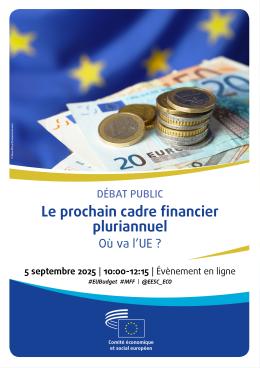
Débat public au sein de la section ECO sur les Derniers rebondissements sur la voie du prochain cadre financier pluriannuel dans le cadre de l'avis ECO/682 Cadre financier pluriannuel 2028-2034.
L'audition publique dans le cadre de l'avis ECO/683 examinera comment les acteurs nationaux, locaux et de la société civile collaboreront ensemble à travers le principe de partenariat et la gouvernance à plusieurs niveaux, afin de favoriser des résultats plus inclusifs, durables et résilients dans toutes les régions.