Is Europe condemned to keep pushing the same rule of law boulder uphill, only to watch it roll back down? At the EESC's seventh annual conference on fundamental rights and the rule of law, civil society and EU representatives called for stronger follow-up to identified shortcomings, as the EU considers a closer link between rule of law recommendations and funding under its next long-term budget.
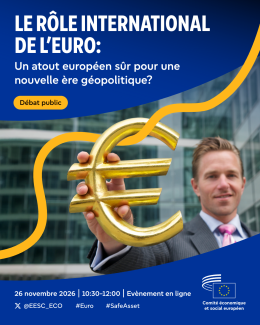
Débat public au sein de la section ECO sur le «Le rôle international de l’euro: Un atout européen sûr pour une nouvelle ère géopolitique?». Ce débat public explorera les opportunités et les défis associés au renforcement du rôle international de l'euro et discutera des arguments économiques, financiers et géopolitiques en faveur et contre la création d'un actif sûr européen.
Le présent avis vise à faire de la participation démocratique inclusive un élément central de la résilience démocratique, en renforçant une coopération significative et durable entre les autorités publiques, les citoyens, les communautés et la société civile tout au long du cycle politique. Il met l’accent sur le rôle des communautés résilientes et demande que la participation soit inclusive, accessible et protégée contre les ingérences indues. Elle promeut également l’éducation civique, la culture numérique et l’utilisation responsable des outils numériques.
Le bénévolat joue un rôle essentiel dans la construction de sociétés résilientes et inclusives, mieux préparées aux défis actuels et futurs. Cette audition publique réunira des acteurs institutionnels, des organisations de la société civile, des partenaires sociaux et des experts afin de réfléchir au rôle que peut jouer le bénévolat dans le cadre d’une approche globale de la préparation (préconisée par la Commission européenne). Les discussions alimenteront l’Avis du CESE (SOC/864) relatif à ce sujet.
Following the third edition of Civil Society Week, the EU’s largest annual gathering of civil society representatives, the EESC reviewed its key outcomes in a plenary debate with EU institutions and stakeholders. With democratic values under growing pressure globally and across parts of the EU, civic participation is more important than ever.
Europe is facing a pivotal moment. Social and economic inequalities, rapid technological change, anti-democratic forces and geopolitical instability are straining the foundations of the European project.
With democracy and civic space under mounting pressure, civil society organisations, human rights defenders and free media face growing constraints - from restrictive laws and disinformation campaigns to underfunding and public distrust. Deepening polarisation and eroding trust in institutions further undermine Europe’s democratic model.