Le CESE soutient le plan d'action pour une stratégie maritime dans la région atlantique, qui définit les priorités en matière de recherche et d'investissement dans la région et apporte une grande valeur ajoutée européenne puisqu'il donnera un élan à la croissance bleue dans le cadre de la stratégie Europe 2020. C'est dans cet encadrement stratégique que se déroulera la coopération entre les autorités et les acteurs économiques et sociaux des régions atlantiques des cinq États membres concernés (Irlande, Royaume-Uni, France, Espagne et Portugal).
Download — Plan d'action pour une stratégie maritime dans la région atlantique
Reimagining the design of cities, communities and housing is essential to face the current challenges. Civil society organisations have a key role to play in steering this transformation. Sustainability and the right to housing must be at the heart of future strategies. The EU could contribute to this by increasing European funding for affordable housing and supporting the social economy.
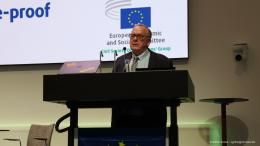
Conference of the EESC Civil Society Organisations' Group in the framework of the Danish Presidency of the Council of the European Union, Copenhagen, Danish Society of Engineers (IDA), 2 July 2025
Dans le cadre de la préparation de l'avis du Comité économique et social européen (CESE) sur une Stratégie européenne pour les îles, le Comité économique et social européen, en coopération avec INSULEUR, organisera une audition publique à Syros, au cœur des Cyclades. Cette audition a pour objectif de réunir les autorités locales et régionales, la société civile organisée, les entreprises, le monde académique et les citoyens afin d'échanger sur les défis, mais aussi sur les opportunités encore largement inexploitées des îles européennes. Au-delà des questions liées à la connectivité, aux évolutions démographiques, à l'accès aux services et à la résilience face au changement climatique, l'événement mettra en lumière les atouts uniques d'îles telles que Syros, notamment leur position stratégique, leur patrimoine culturel, leur potentiel dans l'économie bleue, leur capacité d'innovation, les possibilités offertes par les énergies renouvelables et le développement d'un tourisme durable. Les conclusions de cette audition contribueront directement à l'avis du CESE, en veillant à ce que les voix, les expériences et les aspirations des communautés insulaires soient pleinement prises en compte dans les futures politiques européennes ainsi que dans la mise en œuvre de la première Stratégie européenne pour les îles, adoptée en juin 2026.
rue Belliard 101, Jacques Delors building, room JDE 63, 9:30-11:00
Brussels
Belgium
EESC, room JDE 63, 9:30-11:00
The policy debate brings together stakeholders to assess how National and Regional and Partnership Plans will work in practice. In a workshop setting connected to the European Economic and Social Committee, participants from civil society, social partners and institutions will exchange perspectives on transparency, inclusiveness and impact. The discussion aims to highlight gaps, share best practices and strengthen the role of organised civil society in shaping and monitoring the implementation of NRPPs in the EU.
Le débat du Comité économique et social européen sur « Des régions fortes pour une Europe sûre : résilience et croissance des régions de la frontière orientale de l’Union européenne » se concentrera sur l’importance stratégique du renforcement de la résilience et de la promotion d’une croissance durable dans les régions frontalières orientales de l’Union européenne.
Audition publique dans le cadre de l'avis ECO/689 – La dimension insulaire dans les politiques européennes en faveur de la cohésion, de la compétitivité et du développement durable.