
European Economic
and Social Committee
EESC wants stronger, binding action for second half of EU Disability Strategy
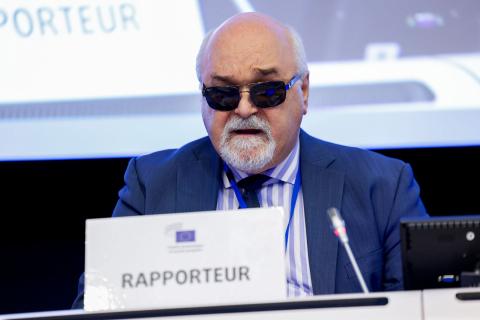
At its June 2025 plenary session, the European Economic and Social Committee (EESC) adopted a forward-looking opinion on the future of the EU Strategy on the Rights of Persons with Disabilities, calling for a more ambitious and binding approach for the 2025–2030 period.
The EU Strategy for the Rights of Persons with Disabilities 2021–2030 aims to ensure full inclusion and equal rights for persons with disabilities across Europe. It focuses on accessibility, independent living, education, employment, and participation, aligning with the UN Convention on the Rights of Persons with Disabilities. It adopts an intersectional approach, recognizing the diverse challenges faced by individuals with different types of disabilities, and includes flagship initiatives like AccessibleEU to promote best practices.
The EESC opinion The Future of the EU Strategy on the Rights of Persons with Disabilities post-2025 aims to guide the European Commission in shaping the final phase (2025–2030) of the EU Strategy. As rapporteur Ioannis Vardakastanis explains: 'The EU’s disability strategy cannot stop halfway through its 10-year existence. We need new actions that clearly improve the lives of persons with disabilities and keeps disability rights highly prioritised. Actions, initiatives and flagships that improve the day-to-day reality of Europeans with Disabilities, that combat discrimination and exclusion that prevent institutionalization and that build real community-based services.'
From consultation to implementation
In the opinion, the EESC welcomes the European Commission’s commitment to continue the strategy and acknowledges the positive impact of actions such as the EU Disability Card, the AccessibleEU Centre, and guidance on independent living. However, it warns that many initiatives lacked legal force, limiting their real-world impact. The Committee calls for meaningful consultation with persons with disabilities and their representative organisations, and for a dedicated budget under the next Multiannual Financial Framework to support implementation.
A roadmap for rights and inclusion
To ensure the strategy delivers tangible change, the EESC proposes a series of targeted actions, including:
- A viable alternative to the stalled Horizontal Equal Treatment Directive
- A Disability Employment and Skills Guarantee, modelled on the Youth Guarantee
- A directive to ensure freedom of movement for persons with disabilities
- A fully-fledged EU Accessibility Agency with regulatory powers
- Stronger protections for women and girls with disabilities, including a ban on forced sterilisation
- A Fund for Accessible Housing to address the housing crisis
- Mutual recognition of assistive technologies across Member States
- Anti-discrimination safeguards in AI and algorithmic management
- A Disability Action Plan in EU external action
Monitoring and momentum
The EESC also calls for a robust evaluation of the strategy’s first half, including the implementation of the EU Accessibility Act and Web Accessibility Directive. It urges the Commission to ensure that the 2028 EU elections are fully accessible, and to tackle stigma, hate speech, and media representation of persons with disabilities.
A call for political will
The EESC concludes that delivering on these priorities will require not only ambition but also adequate funding and political resolve. It urges the EU to uphold its commitments under the UN Convention on the Rights of Persons with Disabilities and to ensure that disability rights remain central to the EU’s social and economic agenda.
Work organisation
Recommended for you
Tetyana Ogarkova: "The day of victory will come but it will not bring normality back"
Agenda
On 24 February 2022, the lives of millions of Ukrainians were turned upside down. Now, when we say the word "victory", we expect that day to be the way things used to be. A normal day, a day of peace…
Lutte contre la précarité énergétique: garantir un approvisionnement énergétique abordable devrait figurer au premier rang des priorités politiques des pays de l’UE
News
Alors que le nombre de ménages qui sont dans l’incapacité de chauffer leur logement va vraisemblablement augmenter dans l’Union, avec une inflation annuelle de l’énergie qui dépasse 40 %, il y a…
Les zones rurales ont le potentiel pour produire davantage de résultats
News
Si l’attrait de la vie à la campagne s’est accru ces toutes dernières années, de nombreuses zones rurales de l’Union restent confrontées à un certain nombre de problèmes qui dissuadent les personnes…
Pour lutter contre le sans-abrisme, il faut une approche globale et une action collective
News
Le 7 octobre dernier, le Comité économique et social européen (CESE) a tenu une conférence sur le sans-abrisme et les moyens d’éradiquer ce phénomène d’ici à 2030, en appliquant le principe du…
Un rôle actif pour la société civile organisée est essentiel à la résilience de l’Union européenne
News
Le CESE a tenu un débat en session plénière sur l’importance croissante de la société civile organisée et des villes pour mettre l’Europe en capacité de faire face aux chocs asymétriques et aux…