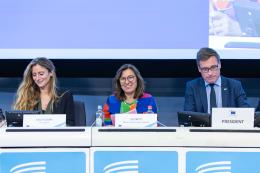
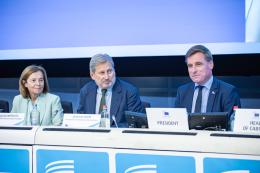
A new report from the Fundamental Rights and Rule of Law (FRRL) Group of the European Economic and Social Committee (EESC) highlights the growing challenges civil society organisations face in Europe. The report was unveiled on 7 November during the FRRL Group's conference on the current state of the rule of law and its impact on civic space.
On 26 October, the European Economic and Social Committee (EESC) unveiled its plan for a comprehensive EU water strategy. The EESC is leading the way as the first European institution to take concrete steps to address the water crisis. Its proposals include: water consumption labels, a Blue Transition Fund, water conditionality in EU fund, and a dedicated EU Commissioner for water. Read EESC President Oliver Röpke's Declaration for an EU Blue Deal.
Malgré plusieurs avancées récentes et les niveaux records atteints cette année par l’indice d’égalité de genre de l’UE, le chemin est encore long avant que les femmes ne bénéficient des mêmes droits que les hommes dans de nombreux domaines.
Le Comité économique et social européen (CESE) a tenu la 9e édition du Forum de la société civile des Balkans occidentaux les 19 et 20 octobre 2023, quelques semaines seulement avant la présentation du paquet «Élargissement» de la Commission européenne et du nouveau plan de croissance. Le Forum a relancé la dynamique d’adhésion de la région à l’UE, à la lumière de la situation géopolitique actuelle et de l’engagement clair des dirigeants de l’UE en faveur de la politique d’élargissement. Les représentants des organisations de la société civile ont souligné la nécessité d’accroître les efforts de renforcement et de protection de l’espace civique afin de faciliter les réformes socio-économiques essentielles nécessaires à l’intégration dans l’Union.
Lors de la conférence qu’il a tenue à Bilbao, le Comité économique et social européen (CESE) a demandé instamment à l’UE de lancer un plan d’action européen visant à renforcer la coopération entre les systèmes de santé nationaux. Le principal objectif: poser de meilleurs diagnostics et fournir des traitements et des soins aux patients atteints de maladies rares.
Dans une lettre conjointe avec le groupe sur l'Eau du Parlement européen, le Comité économique et social européen (CESE) appelle les chefs d'Etats et de gouvernements à soutenir la stratégie du Pacte bleu de l'UE dans le cadre du prochain mandat de la Commission européenne (2024-2029).
On 25 September, the European Economic and Social Committee (EESC) announced its winners in the three categories of the EU Organic Awards: Best organic food processing SME, Best organic food retailer, and ...
The European Economic and Social Committee (EESC) has slammed the EU for its inadequate support and insufficient funding for civil society organisations working in the area of fundamental rights, the rule of law and democracy. With civil society encountering ever more difficulties, the EESC announced that it would monitor the situation of democracy and human rights defenders more closely, both in the EU and in enlargement countries
On 20 September 2023, the European Economic and Social Committee (EESC) hosted a debate highlighting the achievements of the European Citizens' Initiative (ECI) "Fur Free Europe". At its core, the initiative stands as a resounding call for a fur-free continent, pushing for a total ban on fur farming and on the sale of fur products within European markets.
The European Economic and Social Committee has adopted an opinion on the Mid-term review of the multiannual financial framework 2021-27 proposed by the Commission last June. The Committee feels that the proposal lacks the ambition to respond properly to Europe's key challenges. Short-term solutions are needed to address its shortcomings. The debate on the new MFF should start soon.