Face à l’augmentation des menaces tant internes qu’extérieures qui pèsent sur la démocratie libérale européenne, il est de plus en plus important de protéger le pluralisme et l’indépendance des médias
Pour le CESE, le contrôle de la compétitivité devrait s'appliquer à tout processus politique et législatif de l’UE, et plaide en faveur d'un “agenda pour la compétitivité” de l'UE.
As the Russian invasion of Ukraine puts the spotlight on European defence, the European Economic and Social Committeehas said in an opinion that it wants to see coordinated action and spending from Member States and a comprehensive European defence industrial strategy.
The European Economic and Social Committee (EESC) calls on the EU and Member States to work on better communicating fundamental rights and the rule of law towards the general population. In its opinion, the EESC suggests focusing on fairness and justice and giving a voice to those who experience human rights and human rights violations first hand.
The European Economic and Social Committee (EESC) held a debate on how to improve access to finance for women entrepreneurs, as part of Committee's gender equality initiative following up on the Parliament's Gender Equality Week Initiative. Women are underserved when it comes to financing, or not at all provided for. Participants agreed that empowering these women is vital to enhance business productivity and economic growth. Moreover, women in leadership are more conscious of – and deliver on – climate objectives and encourage diversity.
The global food price crisis has only been exacerbated by the war in Ukraine. It is actually due to more structural and systemic problems in the commodities market, creating hunger and threatening people's livelihoods, points out the European Economic and Social Committee (EESC) in its own initiative opinion.
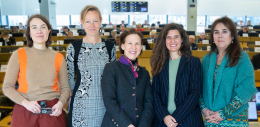
On 15 December, the European Economic and Social Committee (EESC) will award its 2022 Civil Society Prize to six organisations, from Italy, Poland, Portugal, Romania, and Spain.
The European Economic and Social committee held a public hearing on the European Packaging sector on 9 December 2022. The hearing was organised in cooperation with the Czech Chamber of Commerce and under the auspices of the Czech Presidency of the Council 2022.
With the following guests : Nicolas Schmit, EU Commissioner, Álvaro Albacete Perea (Union for the Mediterranean, Josep Ferré (Anna Lindh Foundation), Ivailo Kalfin (Eurofound), Kinga Stanislawska (European Women in Venture Capital) and Xenia Kazoli (Hellenic corp. governance council). Civil Society Prize award ceremony on Thursday 15 Dec at 10 am
Le secteur européen des soins risque de ne pas être en mesure de répondre aux besoins croissants de sa population vieillissante. Il est absolument nécessaire d’investir massivement dans ce domaine et d’y opérer un changement de conception des politiques, ce qui devrait permettre d’assurer que les prestataires de soins soient correctement rémunérés, qu’ils disposent d’horaires de travail réglementés et qu’ils bénéficient d’un soutien adéquat. Pour réaliser ces objectifs, l’action de l’Union européenne ne sera pas suffisante et la volonté politique au niveau national sera fondamentale, comme il ressort d’une audition du CESE.