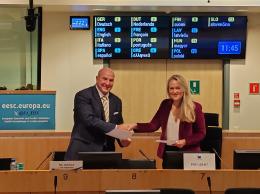
Granting full Schengen status to Bulgaria and Romania will also benefit the EU single market, as any limitations on freedom of movement within the EU adversely affect EU competitiveness and hamper its economic growth
La conférence sur la désinformation, organisée par le Comité économique et social européen, a montré qu’une approche horizontale de la lutte contre la désinformation, mobilisant les citoyens, constitue un pas dans la bonne direction. Les participants à la conférence ont également mis en évidence le rôle que peut jouer la presse régionale en servant de modèle aux grandes plateformes médiatiques afin de rétablir la confiance de leur public.
Montenegro has a good chance of closing all chapters of its EU accession negotiations by the end of 2026, according to the EU-Montenegro Civil Society Joint Consultative Committee. To this end, it needs a cross-party and broader social dialogue.
The European Economic and Social Committee (EESC) held a public hearing on the situation of Roma women, exploring ways to tackle the key challenge of under-representation while addressing the different kinds of discrimination this group faces on a daily basis.
The European Economic and Social Committee (EESC) is actively participating in COP29 in Baku, Azerbaijan, from November 11–22, 2024. Representing the voices of civil society, the EESC is committed to ensuring that marginalized and vulnerable groups are included in global climate solutions.
Il est ressorti d’une conférence tenue en Estonie que l’hydrogène bas carbone constitue un élément essentiel de la transition énergétique, qui peut faire de celle-ci une réalité, moyennant toutefois des infrastructures et des financements pour développer son potentiel.
Dans une déclaration commune signée le 14 novembre 2024, Baiba Miltoviča, présidente de la section spécialisée «Transports, énergie, infrastructures et société de l’information» (TEN) du CESE, et Andres Jaadla, rapporteur d’un avis du CdR sur le logement, pressent les institutions européennes de prendre d’urgence des mesures pour sortir l’Union européenne de la crise actuelle du logement. Ils se félicitent également de la nomination d’un commissaire européen à l’énergie et au logement, qui sera chargé de présenter le tout premier plan européen pour des logements abordables.
The European Economic and Social Committee (EESC) calls on the EU to champion an innovative, sustainable, and circular bioeconomy model that aligns with the European Green Deal and climate goals. In its recent opinion, Aligning the circular economy and the bioeconomy at the EU and national level,adopted at the October plenary, the EESC outlines how a strong bioeconomy strategy can amplify Europe’s economic and ecological benefits, strengthen resilience, and support a fair transition for all.
The European Economic and Social Committee (EESC) has adopted an opinion that aims to safeguard citizens' fundamental rights in the midst of the implementation of AI technology in public services.