Pacto Verde Europeo

This page is also available in:

El 11 de diciembre de 2019, la Comisión Europea puso en marcha el Pacto Verde Europeo, que refuerza el compromiso de la UE de hacer frente a los retos relacionados con el clima y el medio ambiente, que es la misión que define a esta generación. El objetivo del Pacto Verde Europeo es transformar la UE en una economía moderna, eficiente en el uso de los recursos y competitiva que garantice que:

  • hayan dejado de producirse emisiones netas de gases de efecto invernadero en 2050;
  • el crecimiento económico no dependa del uso de recursos;
  • ningún territorio ni persona se queden atrás.

Para cumplir el Pacto Verde Europeo, la UE está aplicando un amplio paquete de iniciativas que incluye propuestas políticas y legislativas y el desarrollo y la modernización de los instrumentos de financiación.

El CESE viene reclamando un «Pacto Verde y Social», subrayando el estrecho vínculo entre el Pacto Verde y la justicia social. Es esencial escuchar a todas las partes interesadas para fomentar las empresas sostenibles y competitivas del mañana en un entorno saludable.

El Pacto Verde Europeo hizo especial hincapié en la inversión y la financiación de la transición ecológica y sostenible. El Pacto Verde es la principal vía de recuperación de Europa tras la pandemia de COVID-19. El Pacto Verde Europeo se financia mediante un tercio de las inversiones por valor de 1,8 billones EUR del plan de recuperación NextGenerationEU y el presupuesto para siete años de la UE. Este impulso de las oportunidades de financiación tiene por objeto convertir la crisis en una oportunidad transformadora para el futuro de Europa.

El CESE desempeña un papel crucial en el seguimiento de la aplicación de las iniciativas y medidas del Pacto Verde Europeo. El CESE elabora dictámenes y organiza actividades (véase el menú lateral izquierdo de esta página) para garantizar que las instituciones de la UE tengan en cuenta los puntos de vista de la sociedad civil organizada y las iniciativas del Pacto Verde sean coherentes con las circunstancias económicas, sociales y cívicas sobre el terreno.

Debido a su carácter transversal y global, el Pacto Verde Europeo está cubierto por todas las secciones del CESE y la CCMI.
  • Published in
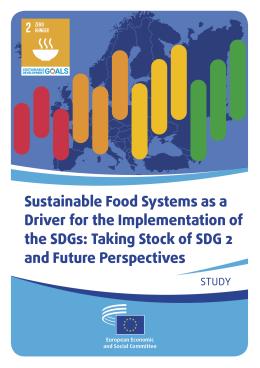
    Study
    71 pages

    Taking Stock of SDG 2 and Future Perspectives

  • Published in
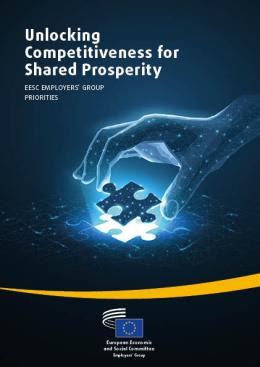
    16 pages

    EESC Employers’ Group priorities
    This document presents the short- and mid-term objectives of the EESC Employers’ Group and 10 policy actions for policymakers to improve the business environment, and thereby the EU’s competitiveness and conditions for creating prosperity for citizens.

  • Greater use of digitalisation in the construction and housing industry and the involvement of social economy actors in housing provision can bring opportunities to address current challenges in the area of housing affordability and sustainability in Europe. Since housing is not just a need but a human right, a pan-European response to the various challenges is needed, according to a conference organised by the Civil Society Organisations’ Group of the European Economic and Social Committee (EESC) on 21 November, at which a new EESC study on the subject was presented.

  • An initiative of the Civil Society Organisations’ Group in cooperation with Friends of the Earth Europe
    -

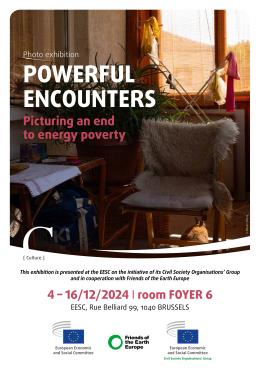
    The European Economic and Social Committee (EESC) presented the photo exhibition ‘Powerful Encounters: Picturing an end to energy poverty’ on the initiative of its Civil Society Organisations’ Group and in cooperation with Friends of the Earth Europe. The work of photographer Miriam Strong was exhibited from 4 to 16 December 2024 at the EESC’s premises in Brussels.

  • Published in
    Study
    53 pages

    This study explores effective practices for youth participation in policy and decision-making processes, providing a comprehensive overview of what youth participation means and its key characteristics

  • Almost five years after it was launched, the Green Deal – Europe’s blueprint for a carbon-free Europe – has seen its implementation become increasingly complex. It is high time for a review of the green transition targets and to ensure they will not be achieved at the expense of Europe’s industrial and social systems, workers’ well-being and the EU’s competitiveness.

  • Event type
    Conference
  • The EESC:

    • points out that there is still a long way to go to reach the final objectives of decarbonisation and transition to a more sustainable economy, objectives that were set out by the Commission in its original Green Deal formulation. Companies need much more certainty, global agreement, guidance, sophisticated accountability methods and, ultimately, support from legislators;
    • highlights the urgent need for public funds to be strategically allocated to goals that are jointly agreed on by European policy-makers and civil society. This initiative must be closely interlinked with the industrial strategy;
    • emphasises that Member States need EU-level support and civil society input to assist companies through guidance, benchmarking and shared learning capacities to adopt and carry out the structural reforms flowing from the Green Deal: bolstering employment rates, enhancing access to skills and labour, and promoting flexibility and efficiency in labour markets.
  • The EESC:

    1. while fully supporting the Green Deal and its objectives, points out the need to assess it in order to gauge its response to exogenic shocks, the geopolitical situation, and technological, social and economic developments, as well as to measure progress achieved thus far;


    2. calls on the European Commission to initiate the mapping of measures adopted under the Green Deal to address overlaps, conflicts and the cumulative administrative burden and to provide a publicly available online dashboard recording each Member State's progress in this domain;


    3. points out that the EESC itself should be empowered and endowed with the necessary resources to play the role of independent monitor of Green Deal implementation, since it is in a position to create a fact-based picture of the progress achieved within the different pillars of the Green Deal.
  • Conference organised by the EESC's Consumers and Environment Category