Europa

This page is also available in:

En Europa, el CESE mantiene relaciones con los interlocutores sociales y las organizaciones de la sociedad civil de los Balcanes Occidentales, la vecindad oriental, los Estados de la AELC integrados en el EEE (Islandia, Liechtenstein y Noruega) y el Reino Unido.

El Comité de Seguimiento para los Balcanes Occidentales (un organismo interno permanente del CESE) es el principal instrumento para coordinar las actividades del CESE en la región. El Foro de la Sociedad Civil de los Balcanes Occidentales, que se celebra cada dos años, forma parte de la labor del Comité de Seguimiento.

El CESE también colabora bilateralmente con los países de los Balcanes Occidentales que han iniciado las negociaciones de adhesión y con Turquía, a través de organismos especializados creados sobre la base de acuerdos de asociación entre estos países y la UE: el objetivo de estos comités consultivos mixtos es involucrar a los interlocutores sociales y a las organizaciones de la sociedad civil en el seguimiento de los procesos de preadhesión y reforma hacia una posible adhesión a la UE. Cada organismo se compone de un número equivalente de miembros del CESE y del país socio y se suele reunir una o dos veces al año.

El CESE también ha creado un Comité de Seguimiento de la Vecindad Oriental, un órgano interno encargado de mejorar las relaciones con la sociedad civil de los países de la región: Armenia, Azerbaiyán, Bielorrusia, Georgia, Moldavia y Ucrania.

Los principales mecanismos de cooperación con Armenia, Georgia, Moldavia y Ucrania son las plataformas de la sociedad civil, que permiten a las organizaciones de la sociedad civil de la UE y del país socio supervisar la aplicación de los acuerdos de la UE con estos países y elaborar recomendaciones destinadas a las autoridades pertinentes. Además, Ucrania y Moldavia se convirtieron en países candidatos en 2022.

En cuanto a Bielorrusia y Rusia, se están entablando relaciones con las organizaciones de la sociedad civil que siguen operando libremente, la mayoría de ellas con sede en territorio de la UE. El CESE considera importante mantener vivo el diálogo, a la espera de mejores condiciones en el futuro.

El Espacio Económico Europeo (EEE) agrupa a los Estados miembros de la UE y a tres de los cuatro Estados de la AELC (Islandia, Liechtenstein y Noruega) en un mercado interior en el que pueden circular libremente bienes, servicios, capitales y personas. El CESE forma parte del Comité Consultivo del Espacio Económico Europeo, en cuyo seno se debaten cuestiones de interés común con representantes de los interlocutores sociales de los Estados de la AELC integrados en el EEE.

Por último, el CESE cuenta con un Comité de Seguimiento UE-Reino Unido encargado de supervisar las relaciones entre la UE y el Reino Unido de Gran Bretaña e Irlanda del Norte desde la perspectiva de la sociedad civil. Su trabajo se centra especialmente en la aplicación del Acuerdo de Retirada entre la UE y el Reino Unido y del Protocolo sobre Irlanda e Irlanda del Norte, sobre los que mantiene conversaciones con organizaciones de la sociedad civil del Reino Unido, así como en la aplicación del Acuerdo de Comercio y Cooperación entre la UE y el Reino Unido, sobre el que el Comité de Seguimiento UE-Reino Unido coopera con el Grupo Consultivo Interno de la UE en el marco del Acuerdo de Comercio y Cooperación entre la UE y el Reino Unido.
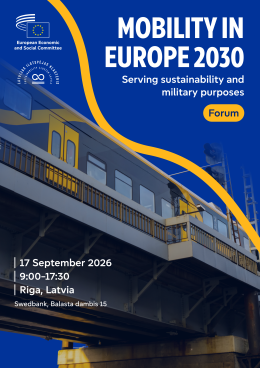

  • The TEN section, in cooperation with the Latvian Sustainability Cluster, is organising a forum on Mobility in Europe 2030 – serving sustainability and military purposes on 17 September 2026 in Riga, Latvia. The forum will deliver recommendations, identify investment and regulatory priorities, and clarify implementation pathways. The outcome of the forum will feed into the EESC’s policy work at EU level and provide practical guidance for Member States in advancing climate-neutral, resilient and competitive mobility systems, including strengthened military mobility, in response to evolving geopolitical challenges. 

  • On 25th of March, the EESC Workers’ Group gathered together with a number of guest speakers from academia, trade unions and MEPs from the European Parliament, to discuss the current geopolitical situation, its impact on social and defence expenditure, its spillovers on supply chains and industry, and the consequences for the welfare states and workers’ rights.  

  • Published in
    Study
    36 pages

    This study examines how social partners and civil society organisations in six Member States — Italy, Austria, Hungary, Poland, Portugal and Sweden — view the effectiveness of current policies in raising employment levels and increasing adult participation in training. It also puts forward recommendations for improving policy outcomes.

  • Published in
    28 pages

    On 8 June 2022 the Consultative Commission on Industrial Change (CCMI) celebrated its 20th anniversary with a conference focused on the challenges of today and the prospects for tomorrow. This publication is a record of the occasion and a commemoration of what CCMI has achieved since joining the EESC.

  • Published in
    Study
    63 pages

    Exploring the evolving landscape of generative artificial intelligence (GenAI) within the European Union, this study delves into technological advancements, market dynamics, and regulatory challenges. It highlights the EU’s position in the global GenAI ecosystem, revealing significant US dominance, while uncovering sector-specific opportunities and risks across industries such as automotive, renewable energy, and education.

  • Published in
    Study
    71 pages

    Taking Stock of SDG 2 and Future Perspectives

  • The EESC:

    • suggests that a systematic stocktaking exercise be carried out, evaluating how EU funds and instruments are perceived and used by the Arctic stakeholders in practice;
    • calls for Arctic decision-makers at all levels to more rigorously apply legal obligations and draw inspiration from best-practice standards and mechanisms for including, consulting and empowering all section of local civil society;
    • supports and encourages full consultation of and cooperation with indigenous peoples in the Arctic, bearing in mind the principle of free, prior and informed consent, before adopting and implementing measures that might affect them directly.
  • Where do EU-US relations go from here?

    In this issue:

    • Our members comment on the results of the US presidential election and reflect on their possible impact;
    • Guest articles by Lennart NILSSON (General Confederation of Agricultural Cooperatives - COGECA), Beatriz ABELLÁN MERELO (Foundation for European Progressive Studies - FEPS) and Francesca CARLSSON (European Environmental Bureau - EEB);
    • Report on our recent conference on protecting Europe's most vulnerable through sustainable and affordable housing;
    • Interview with rapporteur Anastasis YIAPANIS on the new EESC opinion on 'Advanced materials for industrial leadership'.
    • Civil Society Organisations' Bulletin - December 2024
  • Reference number
    39/2024

    The European elections proved that the pro-European majority still holds, but also showed that voters across the EU demand urgent political and legislative responses to the challenges raised in the electoral campaign. Otherwise, the pro-European majority may risk losing support as citizens may increasingly turn their backs on the mainstream political forces.

  • Published in
    15 pages

    This document seeks to provide input to the Global Coalition for Social Justice. It highlights key messages from EESC opinions on the six priority areas identified by the International Labour Organization (ILO) for immediate action.