Newsletter Info

EESC info

European Economic and Social Committee A bridge between Europe and organised civil society

NOVEMBER 2020 | EN

EESC INFO - SPECIAL ISSUE - THE EESC'S NEW LEADERSHIP
GENERATE NEWSLETTER PDF

Available Languages:

  • BG
  • CS
  • DA
  • DE
  • EL
  • EN
  • ES
  • ET
  • FI
  • FR
  • GA
  • HR
  • HU
  • IT
  • LT
  • LV
  • MT
  • NL
  • PL
  • PT
  • RO
  • SK
  • SL
  • SV
Editorial

Editorial

Dear readers,

We have just inaugurated the new EESC term of office  in a very atypical way. Due to COVID-19 restrictions, for the first time in our history, the inaugural plenary session was virtual. 

Online working methods - the new normal in the upcoming months- can be both challenging and beneficial. Finding compromise on EU policies is easier with direct contact. On the other hand, we save time spent on commuting and we virtually travel throughout the EU in just a few clicks.

Read more in all languages

Dear readers,

We have just inaugurated the new EESC term of office in a very atypical way. Due to COVID-19 restrictions, for the first time in our history, the inaugural plenary session was virtual. 

Online working methods - new normal in the upcoming months- can be both challenging and beneficial. Finding compromise on EU policies is easier with direct contact. On the other hand, we save time spent on commuting and we virtually travel throughout the EU in just a few clicks.

The EESC is a bridge between organised civil society and the European institutional framework. Building digital bridges has advantages - we can be faster, more flexible and we can engage with even more people.

This interconnectivity is especially important nowadays, when the EU is combating the COVID-19 pandemic and its economic, social and societal consequences. That is why I've chosen unity as a leading word for my presidency. We need to unite in fighting the crisis and we need to unite in shaping the EU after COVID-19. We need to be united for the future of Europe!

What kind of Europe do we need? For me, it's a Europe that prospers economically, is socially inclusive and environmentally sustainable. It provides sound conditions for all of civil society to thrive and live in open, values-based democracies.

We need a more participatory Europe and policies that are more effective and which tie in better with the situation on the ground. The EESC is willing to provide its expertise to policymakers to assist in making this happen.

Internally and externally, I am working hard on strengthening the EESC's image and regaining trust and credibility. Together we have adopted a mandate to review our Rules of Procedure and Code of Conduct to ensure that the Committee meets the highest ethical and professional standards.

I would like to ask all of you to actively participate in EESC activities. By joining our events, by contributing to discussions and by sharing the results of our work you can help us make the voice of the civil society heard. Let's unite for the future of Europe!

Christa Schweng

EESC President


One question to...

"One question to...".

Starting from this issue of EESC info, we are launching a new section entitled "One question to...". We will continue this question-and-answer series by asking EESC members to give their response to a topical question that seems to us to be the most relevant at the time.


Read more in all languages

Starting from this issue of EESC info, we are launching a new section entitled "One question to...". We will continue this question-and-answer series by asking EESC members to give their response to a topical question that seems to us to be the most relevant at the time.

The first guests to share their thoughts are the new vice-presidents.

They have replied to the following question: "As you begin your term of office at a time of lockdown, distancing and virtual working relations, how might it be possible to rekindle a spirit of creative conviviality within the EESC itself and outside the EESC?"

Cillian Lohan, EESC Vice-President for Communication

I often think if things are going too easy then I am not challenging myself enough. And yet our objective when creating functioning systems is to ensure that things do go easy – work effectively and function smoothly. The distinction I draw is that processes should be easy, and content should be challenging.

I have always liked to find a way to push my work at the EESC until it becomes challenging, and then to find that there, at that point, is where the valuable solutions can be determined.

Read more in all languages

I often think if things are going too easy then I am not challenging myself enough. And yet our objective when creating functioning systems is to ensure that things do go easy – work effectively and function smoothly. The distinction I draw is that processes should be easy, and content should be challenging.

I have always liked to find a way to push my work at the EESC until it becomes challenging, and then to find that there, at that point, is where the valuable solutions can be determined.

The processes and ways of working, when I first became a member, were confusing to me – from finding the right meeting room, to knowing when to push the button to take the floor.

For anyone starting a new term of office, that can take a few meetings to get used to. Repetition feeds familiarity. And, of course, the coffee breaks and mingling in the corridors is an invaluable source of knowledge and information on how things work!

With all of those usual means of building our comfortableness with new surroundings taken away, it has been a different start to the term. It's not even clear who has returned and whose face is no longer present. It's not easy for new members to feel their way into how the EESC functions and to understand the dynamics.

We have realised that we can function from a distance. But equally we have come to value the added advantage of face to face. I want to pay credit to the technical staff at our Committee. They have been thrown into the spotlight as critical workers in facilitating our work continuing.

They have made the process run smoothly and effectively and eased us all into this new way of working.

I like to think that working remotely, connecting via our home offices or kitchens or living rooms has brought us closer together somehow. Reminded us that we are all just people who are working in this space trying to do our best.

I know that when we all fill the rooms of JDE again that we will do so with a new appreciation, and hopefully a greater empathy for each other, as we strive to bring valuable content to the table at an EU level.

Giulia Barbucci, EESC Vice-President for the Budget

The health crisis we are currently experiencing is unparalleled in European and world history: it is severely affecting the human race in all corners of the globe, bringing us face to face with the transient nature of our human lives. A microscopic organism has attacked us, but although we are not yet able to defeat it, we will.

Read more in all languages

The health crisis we are currently experiencing is unparalleled in European and world history: it is severely affecting the human race in all corners of the globe, bringing us face to face with the transient nature of our human lives. A microscopic organism has attacked us, but although we are not yet able to defeat it, we will.

For the first time in the thousands of years of our history, the human race finds itself forced to carry out many human and social activities without physical contact, without being in the same place, without direct human relationships. We have had to learn to live "virtually", something that will profoundly, anthropologically, change our way of being as people. The world is changing and consequently we have to change too: we have to learn to use digital instruments to connect in video meetings, we have to learn to communicate in a different way, without seeing each other physically at all or maintaining social distancing when we do; mobility is also changing and we are trying out new ways of getting around, such as scooters. These are only a few examples of how the change has become a major part of our lives.

Our generation's challenge is to tackle all these challenges and find solutions.

But in spite of everything, we are human beings, and we can adapt. We know that this is just an interlude in our long history and that, sooner or later, we will be able to return to our original nature as social animals.

In a way, it was sad to hold the Constitutive Plenary of the EESC for the new term of office remotely, a feeling that is probably shared by many. Without having the chance to meet in person and get to know the new members, to have a coffee together during the break or a glass of wine after a long working day, it is simply not the same. These are, in fact, important moments and social interactions in our working lives, vital for getting to know each other and exchanging views with the colleagues with whom we need to negotiate and find consensus in order to deliver our opinions.

We are aware that we have to postpone these activities for a while longer, but sooner or later we will resume being human beings in all senses of the word.

EESC News

EESC elects Austria's Christa Schweng to its top post

United for the future of Europe: the new president is determined to rebuild the EESC's unity and reputation and demonstrate its added value in influencing policy shaping at EU level.

Read more in all languages

United for the future of Europe: the new president is determined to rebuild the EESC's unity and reputation and demonstrate its added value in influencing policy shaping at EU level.

Austria's Christa Schweng has become the 33rd president of the European Economic and Social Committee and the fifth woman to head the EU body representing organised civil society since its establishment in 1958. The two new vice-presidents elected to join her at the helm of the EESC are Giulia Barbucci (Italy) for budget and Cillian Lohan (Ireland) for communication.

Ms Schweng brings to her new post extensive experience in and knowledge of social and employment issues, gained over twenty years in advisory work both at EU level and in her native Austria.

She has been a senior adviser to the Social Policy Department of the Austrian Federal Economic Chamber since 1994.

A convinced European, she has been with the EESC for 22 years as a member of the Employers' Group.

Following her appointment, Ms Schweng said: "This term of office will be marked by COVID-19 and, sadly, by times of uncertainty and economic and social hardship, in which businesses struggle to survive and workers lose their jobs. In the current context, more than ever, we need to join forces, develop a vision for a new, post-COVID-19 Europe and do our utmost to ensure that our Committee provides a powerful contribution to Europe's recovery and future resilience. This will go hand in hand with rebuilding a more united, effective and highly regarded EESC."

In this spirit, the motto of Ms Schweng's presidency is "United for the future of Europe".

The new president vowed to act immediately to restore the EESC's reputation and rebuild trust in the institution after it recently reiterated its firm commitment to fighting harassment in the workplace.

"We need a Committee that is united and meets the highest ethical standards, a Committee with an excellent image," Ms Schweng said, adding that the EESC's Code of Conduct for Members and the Rules of Procedure will be reinforced at the start of her term of office.

Since the EESC presidency changes halfway through the term of office, the tenure of the new Bureau headed by Ms Schweng, who takes over from her predecessor Luca Jahier, will last two and a half years, until March 2023.

The president's programme will be based on the following priorities, which are in line with her vision of a post-COVID-19 Europe that enables its citizens to thrive and live in an open and values-based society: a Europe that prospers economically; a Europe that is socially inclusive; and a Europe that is environmentally sustainable.

The fourth priority is making sure the EESC plays a vital role in the Conference on the Future of Europe, which is an important initiative intended to give Europeans a sense of ownership of their EU by enabling them to debate major EU topics and so improve how the European Union works.(ll)

Christa Schweng: "The input of civil society is a must to shape Europe for the better"

Christa Schweng made her first appearance as newly elected president of the EESC at an inaugural debate with the EU's top leaders the day following her election at the October plenary.

Read more in all languages

Christa Schweng made her first appearance as newly elected president of the EESC at an inaugural debate with the EU's top leaders the day following her election at the October plenary.

The debate, which took place online, focused on the Recovery for the future of Europe, with contributions from the presidents of all the main EU institutions, who reflected on the role that civil society can play in tackling the challenges currently facing Europe and the whole world.

Christa Schweng, the newly elected EESC President, said that the Committee plays a key role in making the voice of organised civil society heard at European level.

"Thanks to the input of organised civil society", she said, "European policies can reflect the situation on the ground more accurately and can be implemented more effectively at national or local level".

This role, according to Ms Schweng, is not only positive, but indeed necessary: "Employers', workers', consumers', farmers' and NGOs' hands-on experience is a must to shape Europe for the better. We act as a bridge: we need to deliver on that role, and I am convinced we can".

The newly appointed EESC Vice-Presidents also took part in the debate. Giulia Barbucci, Vice-President for Budget, recalled that the EU has done a great job on tackling the current crisis, but what is still missing is the fundamental involvement of the citizens, and the EESC can play a very important role on this.

Cillian Lohan, Vice-President for Communication, stressed that EESC members have a unique perspective on the EU's impact on the daily lives of different sectors of society.

The President of the European Commission, Ursula von der Leyen also took part in the debate with a video message, joining European Parliament President David Maria Sassoli, European Council President Charles Michel and the President of the European Committee of the Regions, Apostolos Tzitzikostas, in wishing Christa Schweng all the best for her term in office. All of them expressed great appreciation for the EESC's contributions and outlined the need to take into account the voice of European civil society. (dgf)

Watch a video message of the EESC President:

Cillian Lohan: "We need leadership that we can trust"

Cillian Lohan (Ireland) will be one of the two EESC's vice-presidents for a two-and-a-half year term from October 2020 to March 2023. He will be in charge of communication.

Read more in all languages

Cillian Lohan (Ireland) will be one of the two EESC's vice-presidents for a two-and-a-half year term from October 2020 to March 2023. He will be in charge of communication.

After his election, Cillian Lohan, said: "We live in challenging times, dealing with a global pandemic and the consequential effects on our economies, at a time when we need to be investing in an urgent transition away from a dependency on outdated energy systems. We need solutions that deliver for everybody, and we need leadership that we can trust.

"The EESC brings a unique voice to the table….Our outputs need to reach the EU institutions loudly and clearly".

At this critical time, "the EESC can bring an added value in the sense that we build consensus around our input into new policies, and we identify gaps in legislation, making concrete proposals to fill them. Our outputs are the result of tireless work amongst our staff and members to produce valuable unique perspectives that critically have the support of all these different civil society groups. Amplifying this work will be my priority as vice-president", he stressed.

A member of the Diversity Europe Group appointed to the EESC through the environmental sector, Cillian Lohan has worked in Ireland on policy through the Irish Environmental Pillar and has served as chair of the Irish Environmental Network.

He is a leading voice in the field of the Circular Economy and was the inaugural chair of the European Circular Economy Stakeholder Platform, which he helped to establish.

He has long experience as a delegate at UN initiatives such as the Climate COP negotiations and the High-Level Political Forum on the Sustainable Development Goals.

As CEO of the Green Economy Foundation, Cillian Lohan has overseen a range of ambitious projects including the planting of over one million trees in Ireland and the establishment of a wildlife reserve in Tobago.

He takes office as vice-president for Communication following a term as spokesperson for the Environment and Consumers Category at the EESC.

He has been the rapporteur of a number of major opinions, including the first comprehensive piece of work at EU institutional level on establishing the principles of Climate Justice: Climate Justice, the 2015 and 2019 Circular Economy Action Plans, Youth Engagement, Reflection paper on Sustainable Europe  and Access to climate finance. (mr)

Watch a video message of the EESC vice-president for communication:

Giulia Barbucci: "It is essential to maintain sound and transparent budget management"

Italian trade unionist Giulia Barbucci is new EESC Vice-President with responsibility for the budget.

Read more in all languages

The Italian trade unionist Giulia Barbucci is the EESC's new Vice-President with responsibility for the budget.

"I am delighted to be part of a presidency that is two-thirds female," said Barbucci at the plenary session. "Gender equality is still an open issue within the EESC, the institutions and the European Union as a whole."

Giulia Barbucci has been working for CGIL (Confederazione Generale Italiana del Lavoro), Italy's largest trade union, since 1989. At this time of economic crisis, she considers it essential to maintain sound and transparent budget management, with one key priority: ensuring that members can carry out their political work.

Giulia Barbucci's work has always focused on the protection of workers of both sexes. In July this year she took charge of the opinion on the Strategy for Gender Equality in the European Union, representing the Committee's contribution to the European Commission.

In 2002, she took part in the negotiations on the European Framework Agreement on Telework, which should now be reviewed in the light of the pandemic. "During this health crisis, businesses have managed to get by, often without clear rules," Ms Barbucci explained. "The impact of teleworking on people and households is now immense, however, and women are the first to bear the consequences, as their tasks also include care work. This is why it is essential to safeguard the right to disconnect." (na)

Watch a video message of the EESC vice-president for budget:


Renewal rate per country

Record numbers of new and female members join the EESC

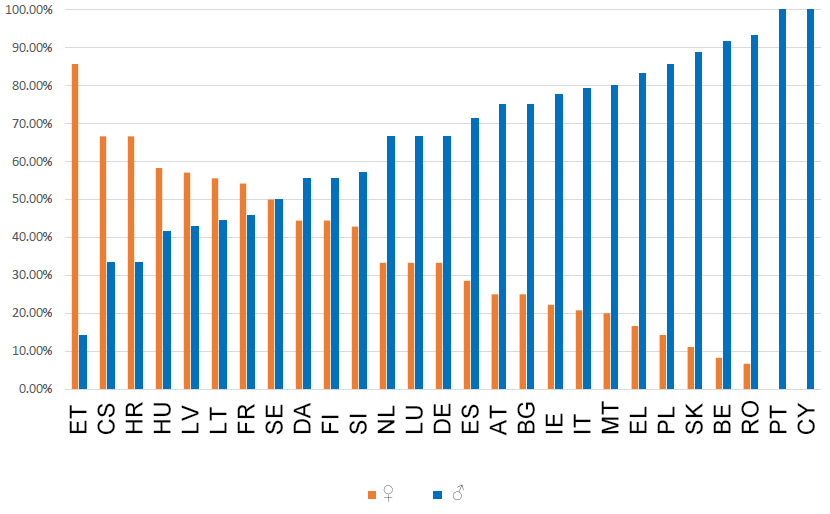
The EESC's 2020-2025 term of office has the highest number of new and female members since statistics on membership began in 2010. There is a higher percentage of women at the Committee than ever before: 33% compared to 28% in 2015 and 24.70% in 2010. Ireland has 33 % new members and 22.22 % female members.

Read more in all languages

The EESC's 2020-2025 term of office has the highest number of new and female members since statistics on membership began in 2010. Ireland has 33 % new members and 22.22 % female members.

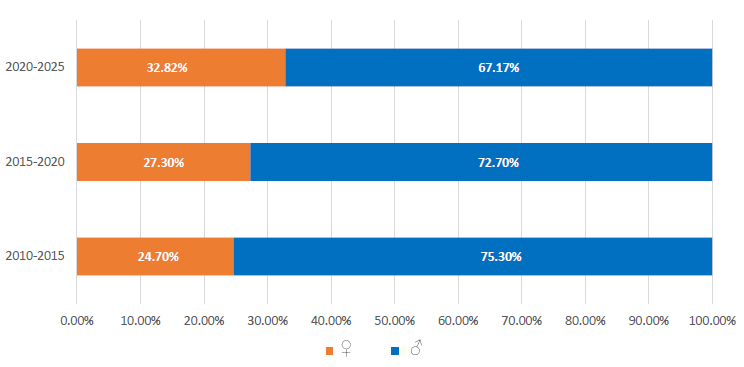
There is a higher percentage of women at the Committee than ever before: 33% compared to 28% in 2015 and 24.70% in 2010 (see graph 3).

In addition, for the first time in 15 years, a woman, Austria's Christa Schweng from the Employers Group, will lead the new Committee.

The countries with the most female members are Estonia, at 85.71%, and the Czech Republic and Croatia with 66.67%. At the other end of the scale, Portugal and Cyprus have appointed no women at all. Sweden has a perfect gender balance (see graph 2).

Overall, seven countries (those already mentioned plus Hungary, Latvia, Lithuania and France) have more women than men.

Of the three groups that make up the EESC, the Workers have the most female members (37.96%) and the Employers the fewest (28.30%), with Diversity Europe coming in between (32.17%).

The Council of the EU's guidelines to Member States ahead of the renewal flagged up the need to ensure a gender balance. While the Council is formally responsible for appointing EESC members, Member State governments put forward names after hearing the social partners and other civil society organisations.

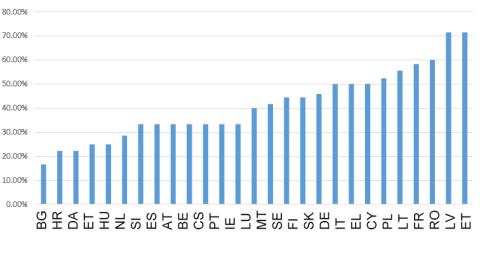
With 137 new members out of a total of 329, the incoming EESC has the highest percentage of newcomers (41.64%) of the last three terms, up from 30% in 2010 and 40.29% in 2015 (see graph 4).

Latvia and Estonia have the highest renewal rate, with five new members out of a total of seven, and Bulgaria the lowest: just two out of 12 (see graph 1).


The Workers have the fewest members serving a first term (39 out of 108) and Diversity Europe the most (52 out of 115), while the Employers are in between (46 out of 106).

In terms of age, the youngest member is 27 and the oldest 76, the average age is 55.

Compared to the European Parliament and the Committee of the Regions, the other EU assemblies which are renewed on a regular albeit different basis, the EESC currently has a smaller percentage of new members and women than the former (58.50% and 40.40% respectively) but a higher one than the latter (31% and 29.10%). (dm)

The EESC Employers', Workers' and Diversity Europe Groups pick their new leaders

The three interest groups that make up the EESC elected their new presidents on the opening day of the European Economic and Social Committee's inaugural plenary session for the new term of office.

Read more in all languages

The three interest groups that make up the EESC elected their new presidents on the opening day of the European Economic and Social Committee's inaugural plenary session for the new term of office.

The new Group presidents are:

  • Stefano Mallia for the Employers' Group
  • Oliver Röpke for the Workers' Group
  • Séamus Boland for the Diversity Europe Group.

They will remain in office for the next two and a half years until 2023.

The vote took place during the Groups' constitutive meetings held alongside the plenary.

Stefano Mallia has been a member of the EESC since 2010. The clear focus of his presidency of the EESC Employers' Group will be to help businesses survive the COVID-19 crisis and construct a recovery that takes advantage of the harsh lessons learned during the last months. Other priorities will include the transition to a cleaner economy, which must take place in an economically sustainable manner, and digitalization. Mr Mallia emphasizes that the EESC and the Employers' Group have to be a natural partner of the other EU institutions when it comes to discussing the European economy. Mr Mallia is Partner at the economic analysis and business consultancy EMCS Ltd and former President of the Malta Chamber of Commerce, Enterprise and Industry. His area of expertise lies in the EU Structural Funds and SME financing.

Oliver Röpke is a returning president first elected halfway through the past term to replace Gabriele Bischoff when she became an MEP in 2019. A member of the Austrian Trade Union Federation ÖGB, which he represents on the ETUC's executive committee, he has served at the EESC since 2009, penning opinions on pivotal social issues such as decent minimum wages and common minimum standards in the field of unemployment benefits. Mr Röpke is committed to a strong EU social recovery and reconstruction strategy to tackle the impact of COVID-19, focusing on solidarity and a social agenda with measures to protect workers' rights.

Poverty and the role of civil society organisations in combatting it will be the focus of Séamus Boland's first term as president of the Diversity Europe Group, which gathers together a large variety of civil society organisations. The new president wants to frame the issue in the broader context of the European Green Deal and the impact of COVID-19 on society. A farmer and long-time civil society actor, Mr Boland is CEO of Irish Rural Link, a board member of Inland Fisheries Ireland and chair of Peatlands Council. He has been an EESC member since 2011 and a rapporteur for various EESC opinions related to agriculture, rural development, energy, social affairs and Brexit.

For more information see the Groups' pages:

Stefano Mallia takes over as President of the EESC Employers' Group

Oliver Röpke will continue as Workers' Group President during the new EESC mandate

Séamus Boland from Ireland is the new President of the EESC Diversity Europe Group

EESC presidency and group and section presidents 2020-2023

See below for the new organisational chart for the EESC presidency and group and section presidents 2020-2023

Read more in all languages

President


 Christa Schweng


Vice-presidents

Cillian Lohan
EESC Vice-president/President of the Communication commission

Giulia Barbucci
EESC Vice-president/President of the Commission for financial and budgetary affairs

 
Group presidents

Stefano Mallia
President of the Employers' Group

Oliver Röpke
President of the Workers' Group

Séamus Boland
President of the Diversity Europe Group

 
Section presidents

Stefano Palmieri
Section for Economic and Monetary Union and Economic and Social Cohesion (ECO)

Alain Coheur
Section for the Single Market, Production and Consumption (INT)

Dimitris Dimitriadis
Section for External Relations (REX)

Peter Schmidt
Section for Agriculture, Rural Development and the Environment (NAT)

Aurel Laurenţiu Plosceanu
Section for Employment, Social Affairs and Citizenship (SOC)

Baiba Miltoviča
Section for Transport, Energy, Infrastructure and the Information Society (TEN)

Pietro Francesco De Lotto
Consultative Commission on Industrial Change (CCMI)

Editors

Ewa Haczyk-Plumley (editor-in-chief)
Daniela Marangoni (dm)
 

Contributors to this issue

Daniela Marangoni (dm)
David Gippini Fournier (dgf)
Ewa Haczyk - Plumley (ehp)
Laura Lui (ll)
Margarida Reis (mr)
Nicola Accardo (na)

Coordination

Agata Berdys (ab)
Katerina Serifi (ks)

Address

European Economic and Social Committee
Jacques Delors Building,
99 Rue Belliard,
B-1040 Brussels, Belgium
Tel. (+32 2) 546.94.76
Email: eescinfo@eesc.europa.eu

EESC info is published nine times a year during EESC plenary sessions. EESC info is available in 23 languages
EESC info is not an official record of the EESC’s proceedings; for this, please refer to the Official Journal of the European Union or to the Committee’s other publications.
Reproduction permitted if EESC info is mentioned as the source and a link  is sent to the editor.
 

November 2020
11/2020

Follow us

  • Facebook
  • Twitter
  • LinkedIn
  • Instagram