Ahead of the UN Water Conference 2026, the European Economic and Social Committee (EESC) held a plenary debate with EU Commissioner for Environment and Water Resilience Jessika Roswall. The EESC calls for water to be treated as a strategic resource for Europe’s economy, security and global role.
The EU needs a long-term vision that takes greater account of geographic specificities. Sustainable water management and food security must become top priorities, with food security and biodiversity going hand in hand.
The first EU Water Resilience Forum, co-organised by the European Economic and Social Committee (EESC), the Committee of the Regions, and the European Commission, brought together people working on Europe’s water challenges to share ideas and solutions to protect water for families, communities and future generations. The Forum also launched the Water Resilience Stakeholder Platform to turn these ideas into action.
Water resilience was the focus as the European Economic and Social Committee (EESC) met in Nicosia for its Extraordinary Bureau Meeting under the incoming Cypriot Presidency of the Council of the EU. Civil society representatives, experts and policy makers examined Europe’s water challenges and explored coordinated solutions.
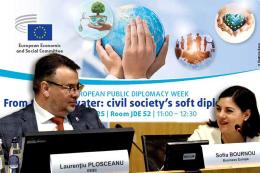
On 25 June 2025, the European Economic and Social Committee (EESC) held an event in the context of European Public Diplomacy Week, launched for the first time by the European External Action Service (EEAS). The participants highlighted a fundamental dimension of European action, the contribution of civil society to public diplomacy, from international trade to water, through enlargement. When official diplomacy has limited outreach due to political or other issues, civil society can provide added value.
The EESC calls on the EU to focus on water as a driver for peace and stability. In turn, empowering young people, women and indigenous and local communities will lead to greater water security. The EESC's Declaration for an EU Blue Deal therefore calls for water management to be acknowledged as a key concern across all sectors and mainstreamed into all policies.