Fundamental Rights and the Rule of Law

This page is also available in:

The EU is not only a common market; it is a union of common values that shape the European identity. These values are set out in the Treaty on the European Union and also include the rights, freedoms and principles laid out in the Charter of Fundamental Rights: the "indivisible, universal values of human dignity, freedom, equality and solidarity; [the Union] is based on the principles of democracy and the rule of law. It places the individual at the heart of its activities, by establishing the citizenship of the Union and by creating an area of freedom, security and justice."

The Charter brings together into a single text all the personal, civic, political, economic and social rights enjoyed by people within the EU and apply to the EU institutions and Member States when they implement EU law.

The EESC is very active in the promotion of fundamental rights, the rule of law and democracy, and especially in the fight against discrimination based on race, ethnic origin, disability or gender. In 2018, it established the Group on Fundamental Rights and the Rule of Law to further expand analysis of the situation across Europe and promote a constructive dialogue amongst all stakeholders.
  • The EESC Fundamental Rights and Rule of Law (FRRL) Group expresses concern regarding recent developments in the Czech Republic following the decision of 18 May 2026 to abolish the Department for Human Rights and the Protection of Minorities at the Office of the Government. 

  • Published in
    22 pages

    Rapport sur la visite en Pologne – 15-16 décembre 2025 et observations des autorités sur le rapport
    Le rapport relaie les points de vue de la société civile polonaise sur la liberté d’association, la liberté de réunion et l’État de droit. Ce rapport a été communiqué aux autorités polonaises, qui ont ensuite transmis leur réponse.

  • On 5-6 May 2026, the Fundamental Rights and Rule of Law (FRRL) Group of the European Economic and Social Committee (EESC) concluded a two-day visit to Prague. 

  • Published in
    8 pages

    Cette publication présente le Groupe des organisations de la société civile du Comité économique et social européen (CESE) et expose ses priorités pour la période 2025-2028. Sous le thème « Œuvrer en faveur de collectivités durables, qui sont le cœur battant de la société civile et de la démocratie », le groupe se concentrera sur les priorités suivantes :

  • Published in
    16 pages

    Europe is facing a pivotal moment. Social and economic inequalities, rapid technological change, anti-democratic forces and geopolitical instability are straining the foundations of the European project.

    With democracy and civic space under mounting pressure, civil society organisations, human rights defenders and free media face growing constraints - from restrictive laws and disinformation campaigns to underfunding and public distrust. Deepening polarisation and eroding trust in institutions further undermine Europe’s democratic model.

  • The EESC FRRL Group has learned that the Budapest Mayor, Gergely Karácsony, is facing charges by the Prosecutor's Office for having allowed the 30th annual Budapest Pride to take place on 28 June 2025, despite a police ban following the Hungarian 'anti-LGBT propaganda law'.

  • Published in
    16 pages

    Rapport sur la visite en Allemagne – 28-29 août 2025 et observations des autorités sur le rapport

    Le rapport relaie les points de vue de la société civile allemande sur la liberté d’association, la liberté de réunion et l’État de droit. Ce rapport a été communiqué aux autorités allemandes, qui ont ensuite transmis leur réponse.

  • On 15-16 December 2025, the Fundamental Rights and Rule of Law (FRRL) Group of the European Economic and Social Committee (EESC) concluded a two-day visit to Warsaw.

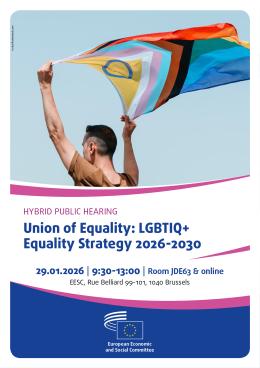
  • Le CESE organisera une audition publique pour examiner la stratégie en faveur de l’égalité de traitement à l’égard des personnes LGBTIQ+ récemment adoptée pour la période 2026-2030. L’événement réunira diverses parties prenantes pour discuter des possibilités et des défis liés à la mise en œuvre des actions de la stratégie, à l’application des normes de lutte contre la discrimination et aux stratégies visant à garantir que les cadres d’action de l’UE favorisent de manière significative l’Union de l’égalité. Les questions clés porteront sur l’intégration de l’égalité de traitement à l’égard des personnes LGBTIQ+, les cadres de suivi et d’évaluation, les mécanismes d’engagement des États membres et les stratégies visant à combler les écarts entre les pratiques au niveau de l’UE et les pratiques nationales.